NEW DELHI: Candidates who are preparing for the UPSC Combined Geo-Scientist Examination 2027 should keep in mind that the Preliminary and Main examinations are very different in both exam pattern and approach. Clearing the Prelims is only the first step, while the Mains exam requires candidates to demonstrate a deeper understanding of their chosen subject. As per the paper pattern, the UPSC Geo-Scientist Prelims 2027 will be an objective-type examination, while the UPSC Geo-Scientist Mains 2027 will consist of conventional or descriptive papers.
The Preliminary Examination is scheduled for January 10, 2027, while the Main Examination will be held on June 19 and 20, 2027, according to the UPSC notification. The examination will be conducted in three stages- Stage I: Preliminary Examination, Stage II: Main Examination and Stage III: Personality Test/Interview. Final merit will be prepared on the basis of marks obtained in both Prelims and Mains.
UPSC Geo-Scientist 2027 Prelims vs Mains: Key difference
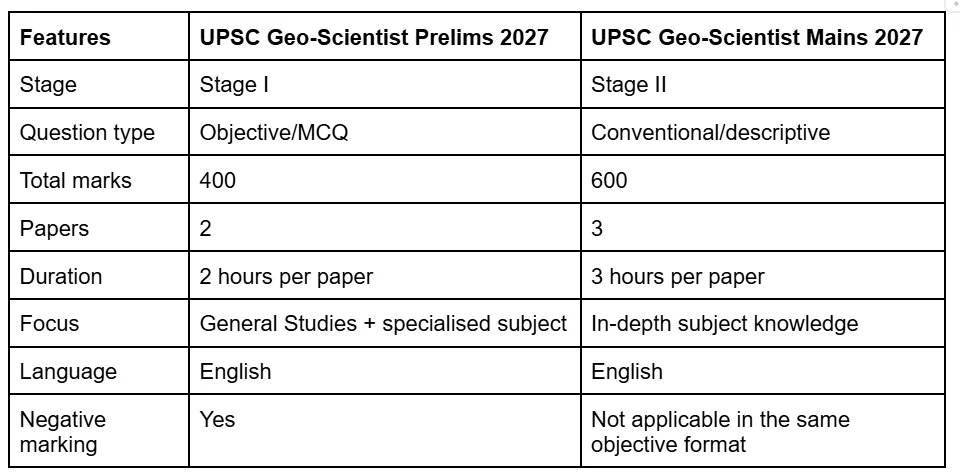
UPSC Geo-Scientist Prelims 2027 exam pattern
The UPSC Geo-Scientist Preliminary Examination has two objective-type papers for each stream. The first paper is General Studies, which is common to all streams and carries 100 marks. The second paper is stream-specific and carries 300 marks. Duration of each paper will be 2 hours and total marks will be 400.
Stream-I : Geologist Group ‘A’ and Assistant Geologist Group ‘B’ in GSI and Scientist B (Hydrogeology) Group ‘A’ and Assistant Hydrogeologist Group ‘B’ in CGWB
- Paper I: General Studies – 100 marks
- Paper II: Geology/Hydrogeology – 300 marks
Stream-II : Geophysicist Group ‘A’ and Assistant Geophysicist Group ‘B’ in GSI and Scientist ‘B’ (Geophysics) Group ‘A’ and Assistant Geophysicist Group ‘B’ in CGWB
- Paper I: General Studies – 100 marks
- Paper II: Geophysics – 300 marks
Stream-III : Chemist Group ‘A’ and Assistant Chemist Group ‘B’ in GSI and Scientist ‘B’(Chemical) Group ‘A’ and Assistant Chemist Group ‘B’ in CGWB
- Paper I: General Studies – 100 marks
- Paper II: Chemistry – 300 marks
The UPSC notification states that both Preliminary papers are set in English language.
Negative marking in UPSC Geo-Scientist Prelims
Candidates should also keep the negative marking rule in mind while preparing for the UPSC Geo-Scientist Prelims 2027. There are four alternatives for each question. For every incorrect answer, one-third of the marks assigned to that question will be deducted. No marks are deducted when a question is left unanswered. Thus, candidates should balance speed with careful selection of answers instead of making unnecessary guesses in the exam.
UPSC Geo-Scientist Mains 2027 exam pattern
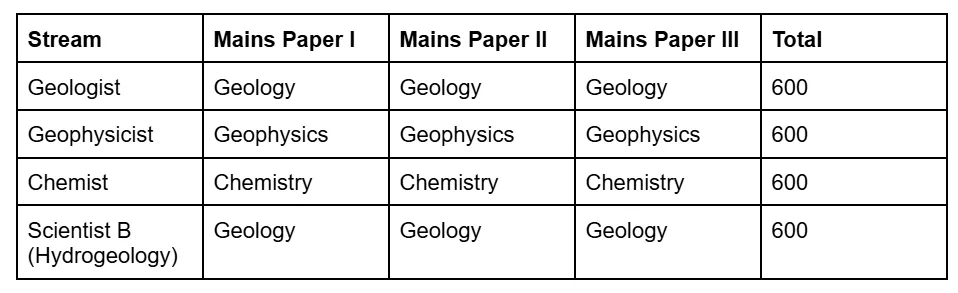
The UPSC Geo-Scientist Main Examination is different from Prelims in both format and depth. It consists of three conventional-type papers for each stream. Each paper carries 200 marks and is of three hours. This makes the total marks for the Main Examination 600.
The stream-wise structure is as follows:
 UPSC Geo-Scientist Prelims syllabus 2027
In the Prelims, candidates have to appear for two papers. Paper-I is General Studies and is common to all streams. It covers current affairs, Indian history and the freedom movement, Indian and World Geography, Indian Polity and Governance, Economic and Social Development, environment and ecology, biodiversity, climate change and General Science. Paper-II is stream-specific and covers Geology/Hydrogeology, Geophysics or Chemistry, depending on the candidate’s chosen stream. The stream-specific paper tests the candidate’s understanding of the basic concepts of the subject.
UPSC Geo-Scientist Mains syllabus 2027
The Mains examination focuses entirely on the candidate’s specialised subject and has three compulsory papers. For Geologist candidates, the papers are Geology I, II and III; for Geophysicists, they are Geophysics I, II and III; and for Chemists, they are Chemistry I, II and III. For Scientist B (Hydrogeology), the papers cover Geology I, Geology II and Hydrogeology III. These papers are approximately at the M.Sc. level and mainly test the candidate’s understanding of the fundamentals of the respective subject.
Check complete UPSC Geo-Scientist Syllabus
Preparation tips for UPSC Geo-Scientist 2027
The UPSC Geo-Scientist Prelims tests a candidate’s ability to identify the correct answer, while the Mains examination focuses more on how well the candidate understands the subject and can explain it through conventional answers. For Prelims, candidates should focus on building clear concepts, revising quickly, practising objective questions, improving accuracy, solving previous-year papers and taking mock tests. Time management also becomes important because candidates have to answer a large number of objective questions within a limited time.
Preparation for Mains, however, needs to go a step further. Candidates have to study their subjects in greater detail, strengthen their conceptual understanding and regularly practise descriptive answer writing. Solving previous-year Main papers can help candidates understand the type of questions asked and the level of detail expected in the answers.
What happens after UPSC Geo-Scientist Mains?
Stage III is the Personality Test/Interview, carrying 200 marks, with no minimum qualifying marks. Candidates who secure the required marks in Mains will be called for the interview, with around twice the number of candidates as available vacancies being shortlisted. The interview assesses their suitability for the post, including leadership, initiative, intellectual curiosity, practical thinking, integrity, communication and ability to adapt to field conditions.