

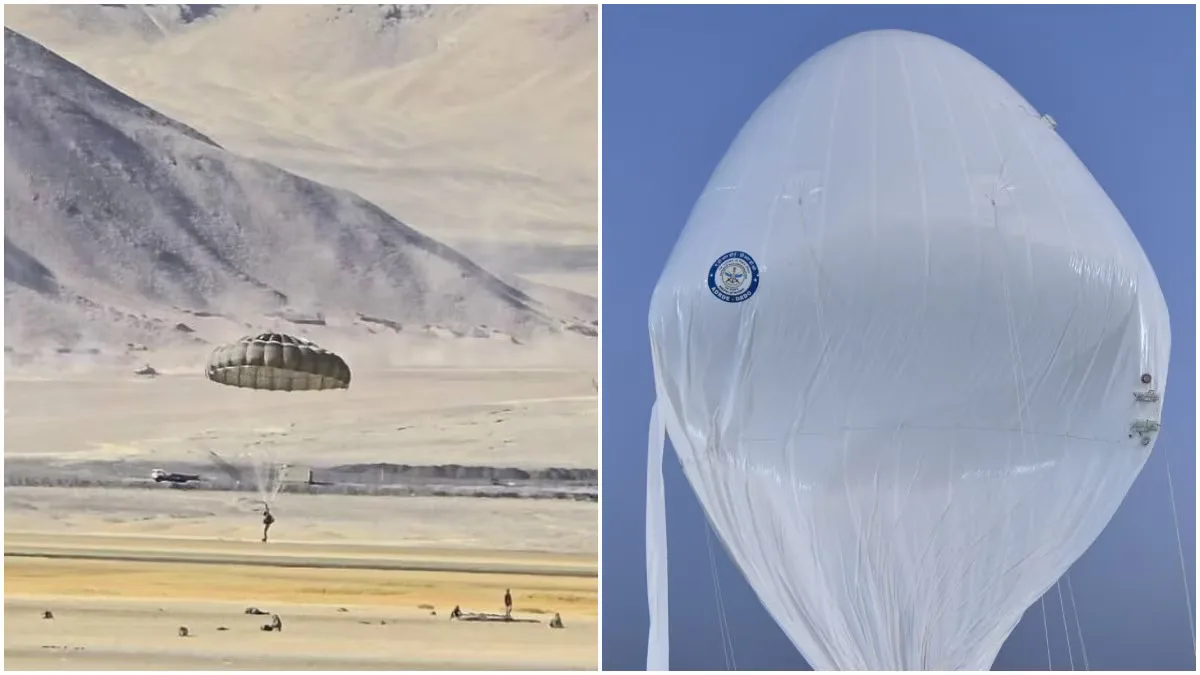
In a major boost to India’s high-altitude military and aerial surveillance capabilities, the Defence Research and Development Organisation (DRDO) has achieved two significant milestones. An indigenously developed High-Altitude Platform (HAPS) successfully reached 21 km above mean sea level (AMSL) and sustained flight at 20 km for more than 30 minutes, while the Advanced High-Altitude Parachute (AHAP) successfully completed its maiden live jump from 16,000 feet in Ladakh. Both the military milestones reflect India’s growing defensive capabilities, state-of-the-art military infrastructure and solid indigenous or domestic military ecosystem that aids to consolidate national security.
Defence Research and Development Organisation (DRDO) has carried out the successful flight trial of indigenously developed High-Altitude Platform (HAPS). The experimental flight attained an altitude of 21 km above mean sea level (AMSL) and remained at an altitude of 20 km AMSL… pic.twitter.com/Pk55sY38Tl
— ANI (@ANI) October 6, 2026
Indigenous HAPS reaches 21 km altitude
The DRDO successfully conducted the flight trial of the indigenously developed High-Altitude Platform (HAPS), marking a significant step towards developing a long-endurance stratospheric aerial surveillance capability for the Indian defence forces.
During the experimental flight, the HAPS attained an altitude of 21 km above mean sea level. It subsequently remained at an altitude of 20 km AMSL for more than 30 minutes before being commanded to descend to the ground. The system was successfully recovered after the flight, following which its performance data was analysed.
The HAPS is a lighter-than-air system being designed and developed by the Aerial Delivery Research and Development Establishment (ADRDE), Agra, a DRDO laboratory. The platform is intended to operate in the stratosphere for long-duration aerial surveillance and can potentially support intelligence gathering and earth observation missions.
High Altitude Platform System (HAPS), a long-endurance stratospheric aerial surveillance platform designed and developed by ADRDE, Agra was successfully flight tested.
The experimental flight attained an altitude of 21 km above mean mean level (AMSL) and remained at an altitude… pic.twitter.com/FpbQPfGKRP
— DRDO (@DRDO_India) October 6, 2026
Real-time surveillance data transmitted during flight
The flight trial also demonstrated the platform’s ability to transmit critical information to the ground control station throughout its mission. According to the Defence Ministry, real-time video data and other vehicle parameters were acquired from the airborne platform at the Ground Control Station during the entire flight. The data indicated that the system achieved the intended flight performance.
The platform carried several instrumentation and control electronic packages, including an inertial measurement unit (IMU), Global Positioning System (GPS) receiver, onboard cameras and an altitude control mechanism, besides other subsystems. The successful demonstration of these systems is significant for the development of persistent aerial platforms capable of operating at very high altitudes for extended periods.
The trial was conducted in coordination with several agencies, including the Indian Air Force (IAF), Centre for Military Airworthiness and Certification (CEMILAC), Directorate General of Civil Aviation (DGCA), Airports Authority of India (AAI) and other civil authorities.
Defence Minister Rajnath Singh hails HAPS milestone
Defence Minister Rajnath Singh congratulated the DRDO, IAF, public sector undertakings and industry involved in the successful HAPS flight trial. The Minister described the achievement as an important milestone in India’s Aatmanirbhar Bharat journey towards realising a long-endurance stratospheric airship.
The development reflects India’s continued focus on strengthening indigenous capabilities in advanced aerospace and defence technologies, particularly for operations and surveillance in challenging environments. Defence Secretary Rajesh Kumar Singh also congratulated the teams associated with the successful flight trial of the high-altitude airship platform.
AHAP completes maiden live jump in Ladakh
In a separate and significant development, the DRDO conducted the maiden live jump of the Advanced High-Altitude Parachute (AHAP) at Nyoma’s Mudh drop zone in Ladakh, one of the highest-altitude drop zones. The jump was executed from 16,000 feet AMSL, with the parachute deployed at 15,500 feet. The paratrooper subsequently landed at Nyoma’s Mudh drop zone, which is situated at an altitude of 13,700 feet.
Maiden flight trial of Advanced High-Altitude Parachute (AHAP) was successfully carried out at one of the highest-altitude drop zones, Nyoma (Mudh DZ).
AHAP is a static line parachute system for mass drop of paratroopers and designed and developed by ADRDE, Agra.… pic.twitter.com/j8noN0ynBC
— DRDO (@DRDO_India) October 6, 2026
The trial demonstrated the efficacy and tactical employability of the AHAP system in extremely high-altitude terrain. Like the HAPS, the AHAP has been designed and developed by ADRDE, Agra. It is a static-line parachute system intended for the mass deployment of paratroopers, particularly in demanding high-altitude operational environments.
Parachute designed for high-altitude operations
The AHAP offers multiple deployment modes and has an operational altitude range of up to 18,000 feet. It has been designed to provide a safer rate of descent suited to the tactical requirements of the Indian defence forces operating in high-altitude terrain.
High-altitude static-line parachute operations are particularly challenging because of the extreme environmental conditions, high opening shock and risks associated with the rate of descent. The successful live jump therefore provides an important validation of the system’s performance under operationally demanding conditions.
The AHAP has been manufactured by the Ordnance Parachute Factory (OPF), Kanpur, inspected by the Directorate General of Aeronautical Quality Assurance (DGAQA) and certified by CEMILAC, RCMA Kanpur.
The successful HAPS flight and AHAP live jump together represent significant advances in India’s indigenous high-altitude technology. While the HAPS is aimed at providing long-endurance surveillance capabilities from the stratosphere, the AHAP is focused on enabling the mass deployment of troops in difficult high-altitude terrain.