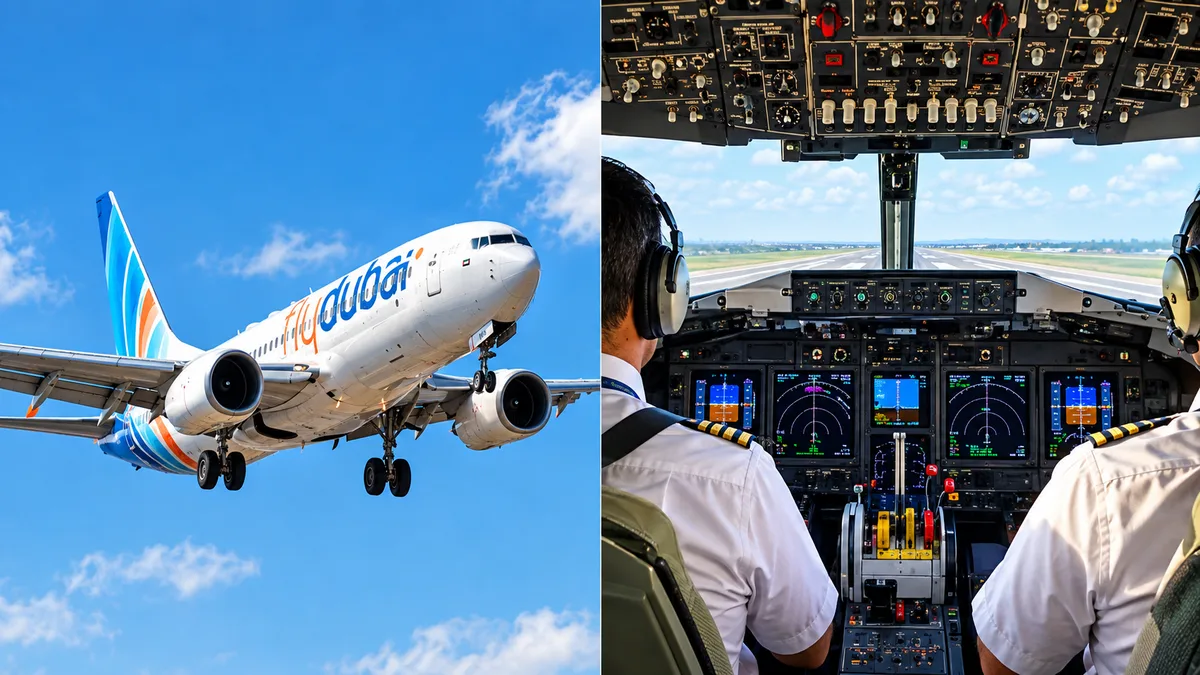
TEL AVIV/ABU DHABI: The UAE has launched a formal investigation into the mid-air crisis and hijack scare aboard flydubai Flight FZ1073, after an Omani co-pilot stabbed Indian Captain Smit Machchhar and attempted to take control of the aircraft carrying mostly Israeli passengers to Tel Aviv. The incident has also unleashed various facets concerning the 9/11-style hijack attempt, thus has triggered multiple dimensions and apprehensions about the real motive behind the Omani pilots misadventure.
It has put cockpit security, crew screening and most importantly, the UAE-Israel aviation arrangements under renewed scrutiny, as Tel Aviv and Muscat doesn’t have diplomatic relations. In this backdrop, pilots from non-friendly nations are not allowed to fly Israel bound aircrafts. So, the question is why did Abu Dhabi allowed Omani pilot in Dubai-Tel Aviv flight. This exposes a major security lapse or loophole and the incident comes, just days after Israel PM Benjamin Netanyahu visited UAE and held high-level security talks with his counterpart.
UAE opens probe into FZ1073 incident
The UAE Ministry of Foreign Affairs said that the judicial authorities have opened a comprehensive investigation into the incident aboard the Dubai-Tel Aviv flight. UAE Attorney-General Counsellor Dr Hamad Al Shamsi has directed a specialised Public Prosecution team to establish the precise circumstances, causes and motives behind the cockpit confrontation, including whether the incident involved prior planning, direction or any possible connection to terrorist activity.
The Boeing 737 was diverted to Tabuk, Saudi Arabia, where it landed safely after the altercation inside the flight deck. The UAE has asserted jurisdiction over the case, noting that the aircraft is registered in the country and operates under its national flag. UAE authorities also said that they are coordinating with Saudi authorities.
The Omani co-pilot on Israel bound flight? A prickle in Israel-UAE relations
At the centre of the investigation is the nationality of the attacker. Israeli officials identified the co-pilot as an Omani national. Israeli media reports said he had joined flydubai less than a year ago. The development has raised a specific question: How was an Omani national assigned to the cockpit of a flight carrying Israeli passengers to Tel Aviv when Oman does not have diplomatic relations with Israel?
The issue is significant because Israel has pointed to arrangements governing UAE-Israel aviation operations that places restrictions on pilots from countries that do not maintain diplomatic relations with Israel. Israeli Transportation Minister Miri Regev has thus, called for an investigation into whether the aviation agreement between Israel and the UAE was breached.
Authorities are examining whether the co-pilot held another passport or nationality that enabled him to meet the applicable requirements. Another possibility is a failure in the airline’s crew-assignment or screening process. However, it is unlikely that the Omani pilot has dual nationality.
Israel’s aviation-security system under scrutiny
Israel maintains stringent aviation-security procedures, shaped by decades of threats against Israeli aircraft and passengers. Israeli airlines employ armed security personnel on international flights, while cockpit access is tightly controlled and aircraft operating to Israel are subject to extensive security protocols.
However, the latest Dubai-Tel Aviv incident has exposed a different type of vulnerability. The threat did not come from a passenger attempting to enter the cockpit. It came from inside the flight deck itself. That raises questions about the security scanning of foreign pilots operating into Israel and the extent to which Israeli authorities can independently verify the background and suitability of crew members employed by foreign carriers.
The incident is also likely to prompt renewed scrutiny of crew access, airport screening and cockpit procedures.
How did a knife reach the cockpit?
Another major unanswered question is how the alleged attacker obtained the knife reportedly used to stab Captain Machchhar. Investigators will have to establish whether the weapon was brought aboard by the co-pilot, obtained after boarding or was otherwise accessible to him.
The question is particularly significant because crew members operate under a different security framework from ordinary passengers. They have legitimate access to restricted airport areas and the aircraft, making insider threats fundamentally different from conventional passenger-security risks.
The investigation could therefore examine crew screening, airport access controls, personal searches, cockpit procedures and the security protocols applicable to pilots operating flights to Israel.
Flydubai suspend flights to Israel
The incident has also had immediate operational consequences. Flydubai has temporarily suspended flights to and from Israel while the investigation into the FZ1073 incident continues. The suspension comes as Israeli authorities examine the circumstances surrounding the crew assignment and the security procedures followed before the aircraft departed Dubai.
For Israel, the incident raises a wider security concern: foreign airlines regularly transport large numbers of Israeli passengers, but their cockpit crews and internal security systems are primarily governed by the airlines and their home jurisdictions.
A test for UAE-Israel aviation security
The FZ1073 incident has now brought several questions into sharp focus. Was the Omani co-pilot properly cleared to operate an Israel-bound flight? Did the UAE-Israel aviation arrangements permit his assignment? How did a knife reach the cockpit? And did existing crew-screening procedures adequately account for the possibility of an insider threat or did it have any loopholes? If so, that will be a major security crisis and is a steep prickle in the UAE-Israel ties, which has been normalising post 2020 Abraham accords and is been stable despite the conflict with Iran.
Moreover, the incident comes, just days after Israel Prime Minister Benjamin Netanyahu secretly flew to UAE and held high-level closed door talks with the UAE President. If there has been any breach in the UAE-Israel aviation security agreement, as mentionned, it will be a major bottleneck in the Tel Aviv-Abu Dhabi ties that is gradually taking shape amid a voltile West Asia geopolitics and fractured regional security architecture.