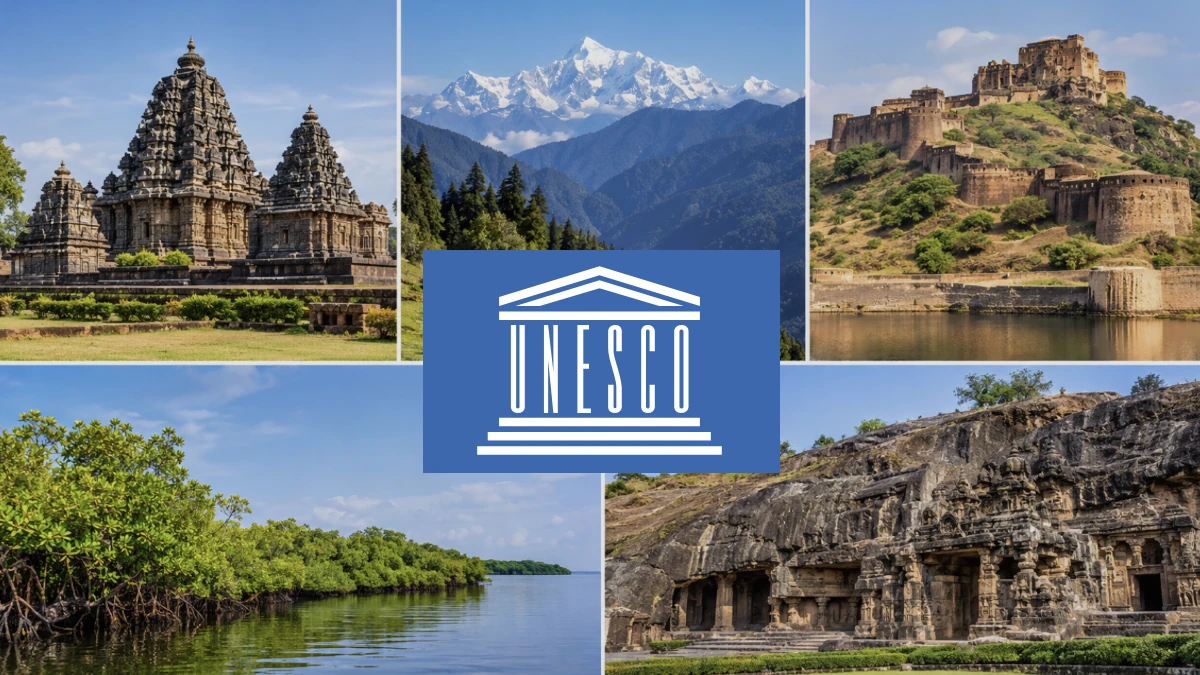
NEW DELHI: India’s heritage map has received a significant boost, with five new sites and serial/transnational proposals added to UNESCO’s Tentative List of World Heritage, taking the country’s total to 78.
The latest additions bring together ancient Buddhist art, Gupta-era architecture, tribal history, medieval mandir traditions and the global legacy of Mahatma Gandhi’s Satyagraha movement.
5 new sites and serial and transnational proposals have been included in India’s UNESCO Tentative List, increasing India’s count to 78.
The newly added sites include the Buddhist murals of Bagh Cave Paintings, the Group of Temples of the Chambal Valley, the Gupta-era Udaigiri… pic.twitter.com/FvFTCNMP2u
— All India Radio News (@airnewsalerts) September 29, 2026
The announcement was highlighted by PIB Culture, which described the development as a “proud milestone” for India’s heritage.
The five additions are Bagh Cave Paintings, the Group of mandirs of the Chambal Valley, Udaigiri Caves, Ginnorgarh, and the India-South Africa serial transnational proposal, Sites of Satyagraha.
Gupta-era Udaigiri Caves among key additions
Located in Madhya Pradesh, the Udaigiri Caves represent a major surviving sacred landscape associated with Gupta-era patronage between the late 4th and early 5th centuries.
According to UNESCO, the site features 20 excavated caves, sculptural panels, inscriptions, ancient rock markings, circulation paths and associated topographical and hydrological features, forming an integrated ritual landscape.
The addition places renewed focus on the architectural and religious traditions that flourished during one of ancient India’s most influential periods.
Bagh Caves showcase Buddhist mural heritage
The Bagh Caves, situated on the southern slopes of the Vindhyan range along the Baghni River in western Madhya Pradesh, comprise nine rock-cut Buddhist caves.
The caves are particularly significant for their mural paintings and distinctive sandstone geology. UNESCO notes that the site represents the only sandstone outcrop in an otherwise predominantly basaltic region, a geological feature that influenced both the caves’ architecture and the preservation of their murals.
Tribal and mandir heritage also gets recognition
The newly added Ginnorgarh Fort represents the tribal and political heritage of central India. It served as the principal fortified capital of the erstwhile Raj Gond rulers.
The Group of mandirs of the Chambal Valley includes the historic mandir complexes of Bateshwar, Padavali and Kakarmath, adding another important dimension to Madhya Pradesh’s growing representation on the Tentative List.
Gandhi’s Satyagraha journey crosses borders
The fifth addition is distinctive because it spans India and South Africa. The proposed serial transnational property, titled Sites of Satyagraha, traces the evolution of Mahatma Gandhi’s philosophy of Satyagraha from its emergence in South Africa to its development and institutionalisation in India.
The proposed nomination consists of nine components: two in South Africa and seven in India.
The South African components are Pietermaritzburg Station and the Phoenix Settlement. The Indian components include the Mahatma Gandhi Satyagraha Smarak, Sabarmati Ashram, Mani Bhavan, Harijan Sevak Sangh, Sevagram Ashram, Aga Khan Palace and Gandhi Smriti.
Together, the sites are intended to document the transformation of Satyagraha from Gandhi’s response to racial discrimination in South Africa into a wider philosophy of truth, non-violence and mass civil resistance in India.