Hindu Samaj: Revitalising the organic society
October 18, 2026
  • Read Ecopy
  • Circulation
  • Advertise
  • Careers
  • About Us
  • Contact Us
Android AppiPhone AppArattai
Organiser
  • ‌
  • Bharat
    • Assam
    • Bihar
    • Chhattisgarh
    • Jharkhand
    • Maharashtra
    • View All States
  • World
    • Asia
    • Europe
    • North America
    • South America
    • Africa
    • Australia
  • Editorial
  • International
  • Opinion
  • RSS @ 100
  • More
    • World Hindu Congress 2026
    • Op Sindoor
    • Analysis
    • Sports
    • Defence
    • Politics
    • Business
    • Economy
    • Culture
    • Special Report
    • Sci & Tech
    • Entertainment
    • G20
    • Azadi Ka Amrit Mahotsav
    • Vocal4Local
    • Web Stories
    • Education
    • Employment
    • Books
    • Interviews
    • Travel
    • Law
    • Health
    • Obituary
  • Subscribe
    • Subscribe Print Copy
    • Subscribe & Read Ecopy
  • ‌
  • Bharat
    • Assam
    • Bihar
    • Chhattisgarh
    • Jharkhand
    • Maharashtra
    • View All States
  • World
    • Asia
    • Europe
    • North America
    • South America
    • Africa
    • Australia
  • Editorial
  • International
  • Opinion
  • RSS @ 100
  • More
    • World Hindu Congress 2026
    • Op Sindoor
    • Analysis
    • Sports
    • Defence
    • Politics
    • Business
    • Economy
    • Culture
    • Special Report
    • Sci & Tech
    • Entertainment
    • G20
    • Azadi Ka Amrit Mahotsav
    • Vocal4Local
    • Web Stories
    • Education
    • Employment
    • Books
    • Interviews
    • Travel
    • Law
    • Health
    • Obituary
  • Subscribe
    • Subscribe Print Copy
    • Subscribe & Read Ecopy
Organiser
  • Home
  • Bharat
  • World
  • Operation Sindoor
  • Editorial
  • Analysis
  • Opinion
  • Culture
  • Defence
  • International Edition
  • RSS @ 100
  • Magazine
  • Read Ecopy
Home Bharat

Hindu Samaj: Revitalising the organic society

From the sacred waters of Prayagraj to centuries of self-organised resistance, the diverse communities of Hindu society have always functioned as limbs of a single civilisational body. True resilience lies not in manufactured uniformity, but in remembering an ancient, decentralised fraternity capable of withstanding modern political fracture

Swami VigyananandSwami Vigyananand
Sep 28, 2026, 08:30 pm IST
inBharat, Hindu World View, Analysis, Culture, RSS in News
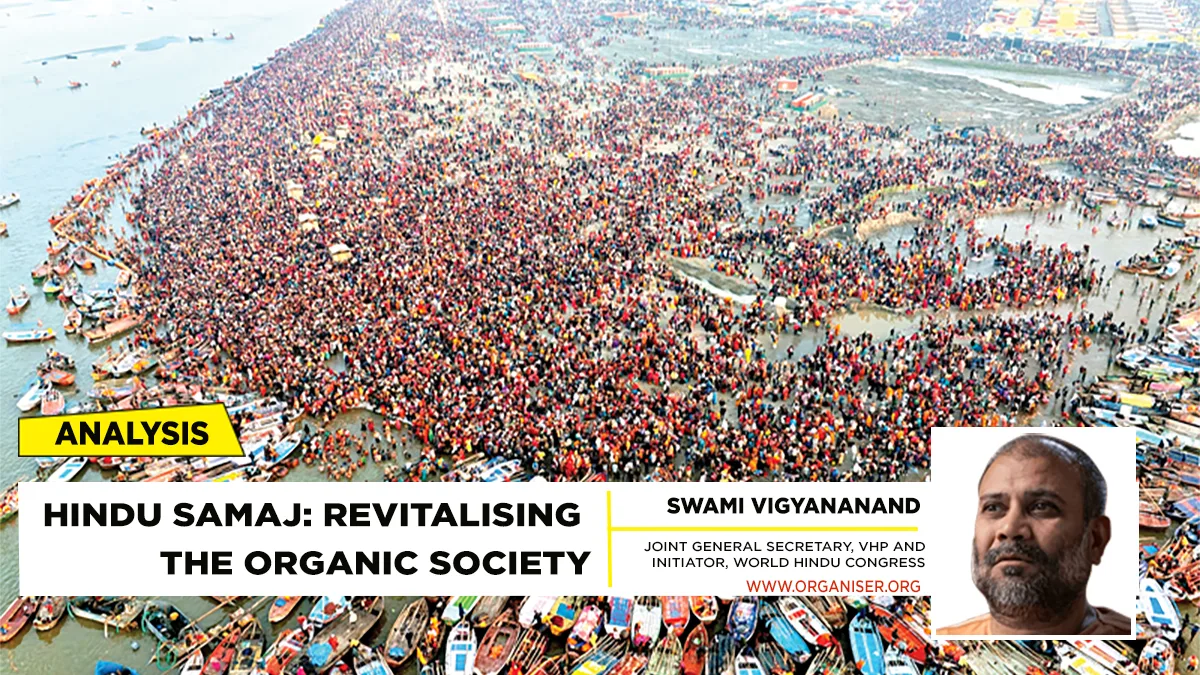
Hindus from diverse castes and traditions taking a sacred dip during the Maha Kumbh in Prayagraj, 2026

Hindus from diverse castes and traditions taking a sacred dip during the Maha Kumbh in Prayagraj, 2026

Facebook
Twitter
WhatsAppTelegramEmail

Last year, at the sacred confluence of Ganga, Yamuna and the invisible Saraswati, over sixty crore pilgrims walked into the holy waters of Prayagraj during the Maha Kumbh. For those forty five days, the unique identities that critics insist divide us – jati, community, region, language, income – revealed their deeper harmony at the ghats.

A farmer from Bihar took his dip beside a software engineer from Bengaluru. A youth from Jharkhand stood shoulder to shoulder with a trader from Rajasthan. Nobody asked which community or Samaj the other belonged to. Everybody belonged to one Samaj, the Hindu Samaj.

This was not an accident; it is the unique architecture of our civilisation at work. One need only look to Dharmasthala — where the presiding deity is Bhagwan Shiva, the chief priests are Vaishnavas, and the Mathadhipati is a Jain — to see this living synthesis. It is a reminder of something Hindu society has always known and, only in recent decades, begun to forget: unity is not something we need to invent; it is an inherent bond we need to rediscover.

Our scriptures articulated this civilisational truth millennia before modern sociology even had a name. The Valmiki Ramayana tells us, Sarve varna yatha puja prapnuvanti susatkritah, ie ‘The very architecture of society ensures honour is bestowed on every individual and group’. Acharya Panini, in his Ashtadhyayi, described communities as bandhu, formed to foster brotherhood. This was never a call for uniformity. It was a reminder of inherent unity and harmony, many communities sharing one civilisational spirit.

Look at how Hindu society actually organised itself through history. Hindus organised around essential commonalities – shared attributes, professions, and vocations – to form communities like Maheshwari, Lohana, Patidar, Agarwal, Kshatriya, Reddy, Kamma, Maratha, Kunbi, Kurmi, Yadav, and many more. Each of these samajas carried its own professional duties and social obligations, yet all of them understood themselves as limbs of one larger body.

These Samajas undertook essential social duties such as promoting education, supporting marriages, advancing economic upliftment, and initiating social and structural changes as per the needs of society at the time, while safeguarding the overarching interests of Hindu society. For example, the Bisa Agarwal Samaj still manages the Nigam Bodh Ghat in Delhi with quiet diligence. Institutions such as Hindu College in Delhi, Hindu College in Sonepat and the RV group of colleges in Bengaluru were built by Samaj leaders who saw education as a duty to the whole of Hindu society, not merely to their own community.

This is what makes the Samaj system remarkable. It was decentralised, yet it never fractured Hindu society. This well-established system functioned effectively for centuries, contributing to the development, protection, and defence of Hindu society. Messages flowed seamlessly across Samajas — from the head to every member — and in moments of true peril, this network could self-organise into an army.

Reclaiming Collective Resolve

When Timur’s forces devastated Delhi in December 1398 and later advanced towards other nearby areas, there was not a single ruler or army that rose to answer him. Raja Devpal Rana convened a Sarvajati Mahapanchayat at Doghat (present-day Baghpat district), and out of it came a united Sarvajati Sena (combined army) of eighty thousand men – Jats, Rajputs, Gurjars, Ahirs, Tyagis, Valmikis, Pandits, Naiis, weavers, potters, every community contributing its share. Timur was wounded in that final battle and forced to retreat to Central Asia. That is what Samaj unity looks like when it is tested.

The same Samaj network stood as a quiet wall against conversion for generations, and when families sought to return to the Hindu fold, it was the Samaj that opened its arms without hesitation.

Today, that same network is under strain, not from foreign invaders this time, but from something subtler. Political actors have learned to approach Samaj organisations and community leaders not to strengthen them but to use them, offering short term gains in exchange for loyalty that fragments the wider Hindu society from within. A leader who trades the trust of a Samaj for a seat at someone else’s table does far more damage than any external force ever could.

In the twenty-first century, Hindu society faces new and increasingly subtle challenges. But our response must remain rooted in time-tested principles: the same spirit that built Sarvajati Senas, that established schools for the whole of society, and that opened its arms to welcome back our own. Today, community elders and leaders must recognise opportunistic political machinations designed to fragment Hindu society, and choose, repeatedly and decisively, the path of unity and collective resolve.

The Kumbh showed us what is possible when Hindu society remembers itself. The task before us now is to carry that spirit beyond the ghat, into every Samaj, every gathering, every decision, so that we move forward together, with dignity, with honour, and with the self respect of a civilisation that has always known how to act as one.

Topics: Timur's forces devastated DelhiPrayagrajMaha KumbhSamaj system remarkableSarvajati SenasSarvajati Mahapanchayat
Share
Tweet
SendShareSend
✮ Subscribe Organiser YouTube Channel. ✮
✮ Join Organiser's WhatsApp channel for Nationalist views beyond the news. ✮
Previous News

Beyond the Brand: How IITs can turn pressure into support

Next News

BIHAR: THE ‘SAMRAT’ EXPECTATIONS

Related News

Prerna Park in Prayagraj: How Yogi Adityanath’s new memorial celebrates three pillars of India’s nationalist legacy

Ganga Expressway: India’s 594-km lifeline powering Uttar Pradesh’s rise to a USD1 trillion economy

Magh Mela: The unifying festival of Bharat that teaches us to live with nature, time and Dharma

The Phaphamau six-lane bridge is being built to address severe traffic congestion on the existing two-lane Chandrashekhar Azad Setu bridge

UP: Phaphamau six-lane Ganga bridge nears completion, promises relief for 40,000 vehicles a day in Prayagraj

Sacred ghats of Maa Ganga

Ghats of Kashi

UP emerges as India’s most visited state in 2025 with record tourist surge; Ayodhya, Varanasi, Prayagraj lead the list

Load More

Latest News

A representative image

PM-AJAY records 18,093 Adarsh Grams, 785 student hostels completed across India

A representative image

India Infrastructure Push: Highway awards surge 62.9 percent, renewable capacity grows 29.5 percent

A representative image

PM-SETU approves Rs 1,194.92 crore for five ITI clusters in Maharashtra, Odisha and Jammu and Kashmir

AI Generated Representative Image

NSAM 2.0: Supporting Startup India and propelling GDP

Tiger Shroff Firing Incident: Lawrence Bishnoi Gang takes responsibility

Assassination attempt on Tiger Shroff in Mumbai: Actor unhurt, driver injured; Bishnoi gang takes responsibility

From Gujarat to the Himalayas: Exploring the 12 sacred Jyotirlingas of Bhagwan Shiva spread across Bharat

AI Generated Representative Image

DRDO tests quantum key distribution on military track; Indigenous tech shields critical defence data from espionage

Rashtra Sevika Samiti: Ninety years of resolve

How Chinese funds, Soros-linked groups and global leftist networks amplify protest in India: Big expose by Disinfo Lab

ASI recovers the missing head of an 11th-century Vishnu murti at Khajuraho, paving the way for restoration

ASI recovers missing head of 11th-century Vishnu murti at Khajuraho, experts to examine it before restoration

Load More
  • Privacy
  • Terms
  • Cookie Policy
  • Refund and Cancellation
  • Delivery and Shipping

© Bharat Prakashan (Delhi) Limited.
Tech-enabled by Ananthapuri Technologies

  • Home
  • Search Organiser
  • Bharat
    • Assam
    • Bihar
    • Chhattisgarh
    • Jharkhand
    • Maharashtra
    • View All States
  • World
    • Asia
    • Africa
    • North America
    • South America
    • Europe
    • Australia
  • Editorial
  • Operation Sindoor
  • Opinion
  • Analysis
  • Defence
  • Culture
  • Sports
  • Business
  • RSS @ 100
  • Entertainment
  • More ..
    • Sci & Tech
    • Vocal4Local
    • Special Report
    • Education
    • Employment
    • Books
    • Interviews
    • Travel
    • Health
    • Politics
    • Law
    • Economy
    • Obituary
  • Subscribe Magazine
  • Read Ecopy
  • Advertise
  • Circulation
  • Careers
  • About Us
  • Contact Us
  • Policies & Terms
    • Privacy Policy
    • Cookie Policy
    • Refund and Cancellation
    • Terms of Use

© Bharat Prakashan (Delhi) Limited.
Tech-enabled by Ananthapuri Technologies