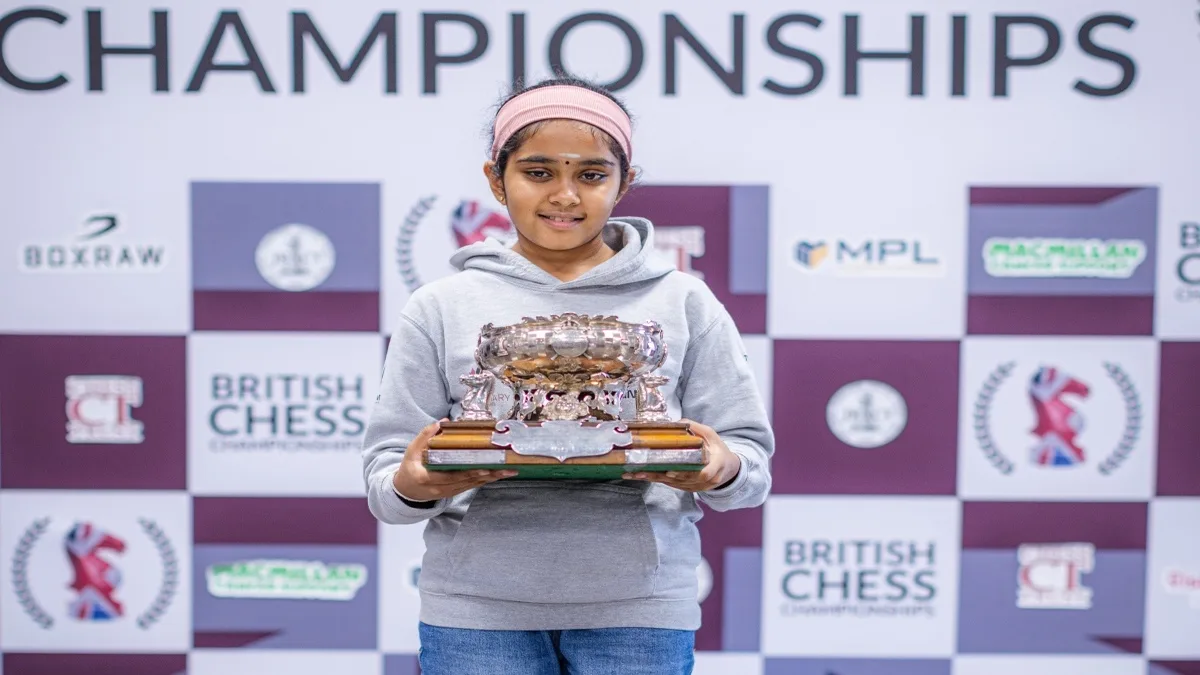
An 11-year-old British-Indian girl from Harrow has made chess history, becoming the youngest player ever to qualify for the Woman Grandmaster title, but the story of Bodhana Sivanandan’s extraordinary rise began with something far less grand than an international chessboard in Uzbekistan. It began with an old chess set that happened to find its way into her home.
Bodhana was five when a family friend preparing to return to India gave away some possessions. Among them was a chessboard. The little girl was fascinated by the pieces, particularly the knight and the queen, and initially wanted to play with them as toys. Her father, Sivanandan Velayutham, who works in IT and knew only the basics of chess, explained that the pieces belonged to a game and began showing her how they moved.
Nobody in the family had played competitive chess. Her mother, Lakshmy Priya Sivanandan too knew the basics of the game. There was no carefully constructed plan to produce a chess champion. Yet within a few years, the little girl who had discovered the game almost by accident was defeating masters and grandmasters, representing England at the Chess Olympiad and travelling across Europe for elite tournaments.
On September 27, 2026, Bodhana secured her third and final qualifying norm for the Woman Grandmaster title while representing England at the 46th Chess Olympiad in Samarkand, Uzbekistan. Playing on England’s top board, she scored eight points from 11 games. The International Chess Federation confirmed that her performance made her the youngest player in history to qualify for the WGM title.
The previous record was held by Kateryna Lagno, who became a Woman Grandmaster in 2002 at the age of 12. Bodhana has now taken that record at 11.
The dream she announced years ago has come true
What makes Bodhana’s latest achievement particularly remarkable is that becoming a grandmaster was not a goal attached to her only after she became famous. She had spoken about it when she was still a little-known eight-year-old.
In December 2023, after her extraordinary performance at the European Rapid and Blitz Championship in Zagreb, The Times reported that Bodhana wanted to become a grandmaster, become England’s youngest Olympic gold medallist and eventually win a world title.
At that tournament, aged only eight, she scored 8.5 points from 13 games in the blitz and finished 73rd among 555 players. She defeated England women’s coach and International Master Lorin D’Costa and then drew with Romanian Grandmaster Vladislav Nevednichy, becoming the youngest player at the time to avoid defeat against a grandmaster in a competitive game.
Chess experts were already describing her as something exceptional. English Chess Federation president Dominic Lawson called her a “phenomenon”, while International Master and commentator Lawrence Trent said he had no doubt she could become England’s greatest player.
Three years later, the child who spoke about that ambition has taken another historic step towards it.
There is, however, an important distinction. The Woman Grandmaster title is a FIDE title below the full Grandmaster title, which remains Bodhana’s ultimate ambition. Her performance in Samarkand also earned her a second International Master norm, bringing her closer to the tougher IM title.
Bodhana has made no secret of what she wants next. She wants to become a full Grandmaster as soon as possible.
The Indian family behind the English chess star
Bodhana was born and raised in Britain and represents England, but her Indian heritage is an unmistakable part of her identity. Her parents have roots in Tamil Nadu, and the family home in Harrow retains a strong connection with Indian culture. Her father, Sivanandan Velayutham, moved to Britain in 2007 and works in IT. Her mother, Lakshmy Priya, has repeatedly described how neither parent expected their daughter to become a chess prodigy. Their role, they have said, has largely been to support an interest that came from Bodhana herself. That Indian identity is also visible when she plays.
Bodhana has been photographed at major international chess events wearing a bindi and the traditional vibhuti or chandan marking on her forehead. At an age when young sporting personalities can easily be absorbed into the culture of the country they represent, she carries her Indian Hindu identity openly into the international arena.
There is no apparent attempt to choose between the two identities. She is a British girl representing England and, at the same time, a proud Indian-origin Hindu child whose cultural markers travel with her to chess halls around the world. That detail gives her story a particularly unusual resonance. She did not discover chess through an Indian chess academy or inherit it from a family tradition. Instead, an Indian family returning home indirectly set off the chain of events that led her to the game in Britain.
If one wanted to view the coincidence through the Hindu idea of karma and the interconnectedness of seemingly unrelated events, it makes for an almost irresistible story. An old chessboard left behind by an Indian family friend became the object that captured a five-year-old girl’s imagination, and that moment eventually led to a world record. There is no need to turn that coincidence into proof of destiny. The facts themselves are remarkable enough.
From YouTube lessons to defeating grandmasters
During the COVID pandemic lockdown, chess became an absorbing activity for Bodhana. Her father found instructional videos for her on YouTube and ChessKid, intending simply to give the children something constructive to do while schools were closed.
Bodhana raced through them. Her mother later recalled that her husband had found enough free material to keep her occupied for about a month, but Bodhana completed it within a week. Her father then began playing with her more regularly, only to discover that his daughter was rapidly becoming too strong for him. She entered her first tournament in July 2021, playing at Harrow Chess Club. In March 2022, aged six, she won a silver medal in the under-eight girls’ category at the European Youth Rapid and Blitz Championships in Thessaloniki. Two months later, at the European Schools Championship, seven-year-old Bodhana won all 24 of her games and collected three gold medals. Her progress from there was extraordinary.
In September 2023, she became a Woman Candidate Master after her FIDE rating passed 2,000. By the end of that year, she had stunned the European chess circuit in Zagreb.
In 2024, she became the youngest person ever to represent England in any sport when she was selected for the women’s team at the Chess Olympiad in Budapest. Because she was so young, photographs of her sometimes showed her sitting on a booster seat to reach comfortably across the board. The image was charming, but her opponents were not treating her as a novelty.
The grandmasters started falling
In August 2025, Bodhana became the youngest female player to defeat a grandmaster when she beat Peter Wells at the British Chess Championships in Liverpool. Two months later came one of the most eye-catching victories of her career. At the European Chess Club Cup in Rhodes, Greece, she defeated Ukrainian Grandmaster Mariya Muzychuk, the former women’s world champion.
Grandmaster Daniel Gormally called it a “sensational upset”, while England’s leading Grandmaster David Howell described the result as an “incredible win”.
By April 2026, Bodhana had become England’s No. 1 female player, with her rating rising to 2,366. She was ranked 72nd in the world among female players. She subsequently became the youngest woman to win the British Women’s Championship. Now, at 11, she has added the youngest Woman Grandmaster in history to that rapidly expanding list.
A remarkably quiet prodigy
For all the noise surrounding her achievements, Bodhana herself remains strikingly understated. She has previously told the UK daily The Sunday Times that she does not experience a particular adrenaline rush when she plays. Instead, she tries to remain calm and concentrate on finding the best move. Her mother has described her as calm and composed, saying that it can be difficult to tell from her face whether she has won, drawn or lost a game.
That composure has become part of Bodhana’s reputation among chess professionals. Her playing style has been described as mature and strategic, with an ability to calculate patiently rather than simply relying on spectacular attacks.
Away from the chessboard, she continues to balance school with music. She plays both the violin and piano and has excelled in mathematics. She has drawn a connection between mathematics and chess, particularly in the way both involve calculation and pattern recognition. Her school has given her special dispensation to travel for tournaments, allowing an 11-year-old to spend substantial periods flying between international competitions while keeping up with her academic work.
And the chessboard keeps moving
Bodhana’s achievement in Samarkand is therefore not the end of the story she began telling at eight. In many ways, it is the fulfilment of only the first part of the ambition she articulated then. She now has the Woman Grandmaster title within reach through the completion of her qualifying norms, while her second International Master norm points towards the more demanding title that she ultimately wants. The full Grandmaster record remains held by American Abhimanyu Mishra, who became the youngest-ever Grandmaster at 12 years, four months and 25 days.
Bodhana has never suggested that becoming a Woman Grandmaster is enough. Her stated ambition has always been larger: to become a full Grandmaster, and eventually a world champion. For now, the picture from Samarkand is extraordinary enough. An 11-year-old girl from Harrow, wearing the visible marks of her Hindu heritage, has represented England on the world’s biggest team chess stage and broken a record that stood for more than two decades.
The chessboard that entered her home because an Indian family friend was returning to India could have remained just another old object in a child’s room. Instead, it became the beginning of a journey that has taken a British-Indian girl from YouTube tutorials to the highest levels of international chess. And Bodhana, characteristically, does not appear ready to stop playing.