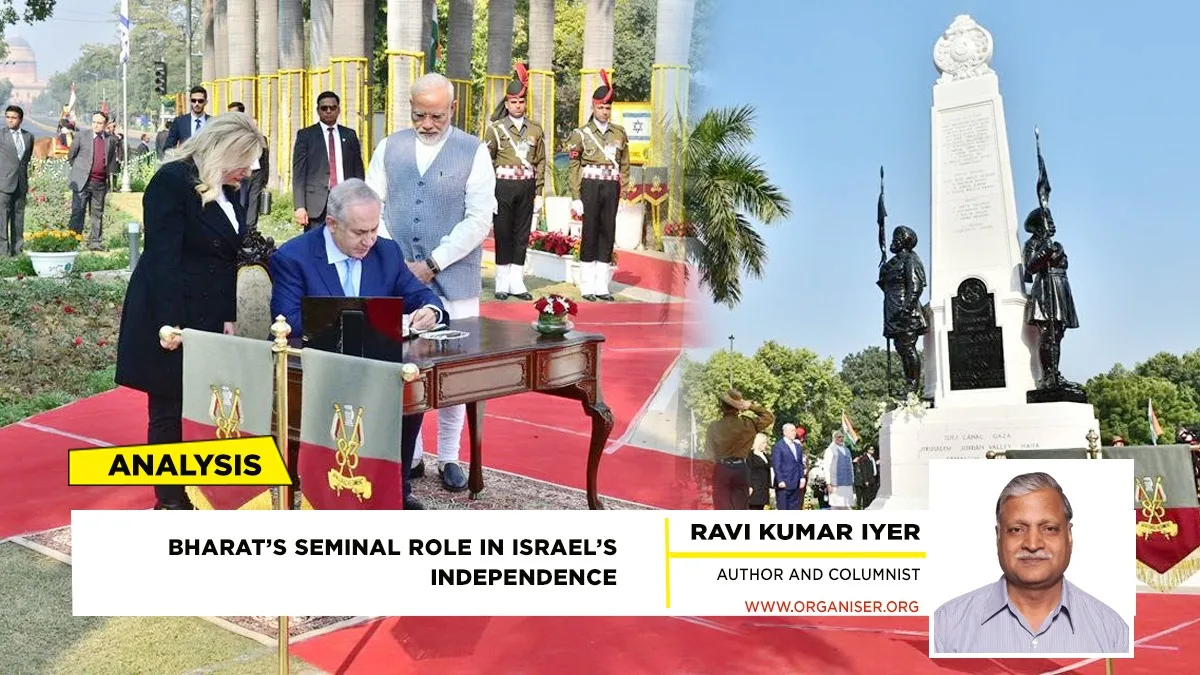
On September 23, 1918, during World War I, Bharatiya bravehearts, numbering 900, demonstrated exemplary bravery by sacrificing themselves in order to liberate Palestinian port of Haifa from Ottoman rule. Israeli Govt is indebted to these bravehearts, as they played a big role in creation of Israel. Their names and accounts of their bravery are included in Israeli history textbooks. They will be etched perennially in hearts & minds of all Israelis
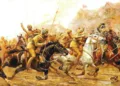
The Indian troops exhibited exemplary cavalry skills and bravery in a successful cavalry charge which finally culminated in the liberation of Haifa from 400 years of slavery under the Ottoman rule.
Eighty thousand Jews from India migrated to Israel after Israel’s Independence in 1949. They are very successful as engineers, professionals, and agriculturists. They are proud of their Indian heritage. They proudly say: “Israel is our Fatherland and India is our Motherland” and “Israel is in our blood but India is in our Heart.”
A large number of Indian soldiers sacrificed their lives in Israel during the liberation of the port city of Haifa in 1918. Nearly 900 of these soldiers are cremated or buried in cemeteries across Israel. Every year on September 23, the Indian Army commemorates “Haifa Day” on which two brave Indian cavalry regiments helped liberate the city in 1918 following dashing cavalry action by the 15th Imperial Service Cavalry Brigade. In the autumn of 1918, the Brigade swept northwards through Palestine in the last great cavalry campaign in world history. The Indian troops exhibited exemplary cavalry skills and bravery in a successful cavalry charge which finally culminated in the liberation of Haifa from 400 years of slavery under the Ottoman rule.
The possibility of a Jewish homeland in Palestine had been a goal of Zionist organisations since the late 19th century. The British Foreign Secretary Arthur Balfour stated in the Balfour Declaration of November 1917: “His Majesty’s Government views with favour the establishment in Palestine of a national home for the Jewish people, and will use their best endeavours to facilitate the achievement of this object…..”
An elite unit of Indian horsemen serving under the British army and armed with spears and swords were sent to attack the Turkish positions on the flanks and overrun their artillery guns on Mount Carmel. Haifa was captured from the Ottomans on September 23, 1918, by the Indian horsemen after overrunning Ottoman positions.
The action of the Indian troops has been vividly recorded in the Official History of the War- Military Operations in Egypt and Palestine (Volume 2): “No more remarkable cavalry action of its scale was fought in the whole course of the campaign. Machine gun bullets over and over again failed to stop the galloping horses even though many of them succumbed afterwards to their injuries”. This remains the only known incident in military history when a fortified town was captured by cavalry on the gallop.
Bharatiya Soldiers: Trouncing Ottoman Forces
During World War I, a force of nearly 150,000 Indians saw action in what is modern-day Egypt and Israel. They played a major part in the Palestine campaign, resulting in the fall of the Ottoman forces, the Third Battle of Gaza, the Battle of Mughar Ridge of Jerusalem and the Battle of Megiddo. Cemeteries and War Memorials of Indian soldiers are well maintained in Israel at Haifa, Jerusalem, Ramleh and Khayat Beach. Several Indian soldiers also died in the fighting that erupted across Israel during World War II.
The Indian Army fought in every major theatre of operation in Europe, Africa and Asia during World War I and II. According to the records of the Commonwealth War Graves Commission, 1,302,394 Indian soldiers fought across Europe, Africa and Asia during World War I. As many as 121,598 Indian soldiers were casualties in the war, including 53,486 dead, 64,350 wounded and 3,762 missing or imprisoned as of December 31, 1919. The campaigns in World War II cost the lives of 36,000 Indian servicemen, while another 34,354 were wounded and 67,340 became prisoners of war.
Tribute to Hero of Haifa
The Jodhpur Lancers and the Mysore Lancers, which were Imperial Service Troops during World War I, fought as part of the Allied forces during the Palestine campaign of the war. They played a key role in the liberation of Haifa. Major Dalpat Singh Shekhawat or Major Thakur Dalpat Singh, who led the Jodhpur Lancers in the battle for Haifa, is known in the annals of history as the “Hero of Haifa” for his critical role in the battle.
Major Dalpat Singh Shekhawat was born and brought up in Jodhpur. His father, Col Hari Singh Shekhawat was a famous polo player. Under his guidance, Dalpat Singh grew and became an Army officer. He received his `King Commission’ in 1912. During the First World War, on September 23, 1918, Haifa (now in Israel), a stronghold of the British, was captured. Maj Shekhawat was given the task of recapturing Haifa from the enemy. By showing his military skill, tactics and leadership in battle, he succeeded in his mission and won Haifa. However, he became a martyr while completing his task. Haifa victory was a great achievement of Maj Dalpat Singh, and he was honoured with ‘Military Cross’ on the battlefield.
Col Harvey, a British Army officer, lamented the death of such a heroic personality and in his words, “His death is a loss not only to all Jodhpuris, but to India and the whole of the `British Empire’. The British Government eulogised his heroic deed and adored him as Hero of Haifa.”
The Government of Marwar built `Dalpat Memorial Hall’ in the premises of Pratap School in his memory. Maharaja Shri Umed Singhji prepared his silver replica which is now a piece of glory for 61 Cavalry at Jaipur.
Maj Dalpat Singh’s valour has been depicted in the literature of Rajasthan. A great poet of Marwar, Mr Kishore Dan Baharat has written many poems in his memory named `Veer Vilas’ and ‘Dalpat Raso’ in Rajasthani language.
The 83rd death anniversary of late Maj Dalpat Singh Shekhawat was celebrated at his native place, Jodhpur. At a meeting held on this occasion, the senior officers of the Indian Army and civil administration recalled the supreme sacrifice of this Haifa Hero. During the battle for Haifa in September 1918, the Indian troops exhibited exemplary cavalry skills and bravery in a successful cavalry charge which finally culminated in the liberation of Haifa.
Captain Anop Singh and 2 Lt Sagat Singh were also awarded the Military Cross (MC) and Captain Bahadur Aman Singh Jodha and Dafadar Jor Singh were awarded the Indian Order of Merit (IOM) as recognition for their bravery in this battle.
Lt General Sir Pratap Singh had accompanied his Jodhpur Lancers on their 70-mile ride to Nazareth during a night and a day. Just short of 73-year-old, the empire’s faithful warrior was, in Allenby’s words, “quite knocked up.” He also had a fever. Allenby ordered him to rest for a few days. Otherwise the old war horse would no doubt have joined his lancers in their action at Haifa. This is described by the anonymous author of Through Palestine with the 20th Machine Gun Squadron.
The action of the Indian troops has been vividly recorded in the Official History of the War- Military operation Egypt and Palestine (volume 2): “No more remarkable cavalry action of its scale was fought in the whole course of the campaign. Machine gun bullets over and over again failed to stop the galloping horses even though many of them succumbed afterwards to their injuries”. This remains the only known incident in military history when a fortified town was captured by cavalry on the gallop.
Battle of Haifa: Sept 22 & 23, 1918
To keep his forces moving after the retreating Turks, Gen. Allenby’s ‘Megiddo’ plan required securing Haifa, with its harbour and railhead. Without Haifa, the lack of viable roads meant it would be impossible to keep his army resupplied.
From the Dispatch dated October 31, 1918, by Gen Sir. E.H.H. Allenby: item 19
“……..I ordered the Desert Mounted Corps to occupy Acre and Haifa. The roads leading to Haifa from Tul Keram are only country tracks, which, in the event of rain, might become impassable for motor lorries at any time. Any force, advancing northwestwards from Haifa along the coast, would have to depend on supplies landed at that harbour. It was necessary, therefore, to occupy the town without delay, in order that the harbour could be swept for mines, and the landing of stores could be taken in hand.”
A force of 700 Turks from the garrison of Haifa attempted to get to Tiberias, but at 0130 hrs on the morning of September 22, 1918, it reached the outposts of the 13th Cavalry Brigade and was attacked in moonlight by the 18th Lancers. A large number were killed, and 311 were captured together with 4 machine guns.
The next air reconnaissance of Haifa seemed to indicate that the town was evacuated and at 1330 hrs that afternoon a detachment of Light Armoured Cars under Brig Gen A. D’A. King advanced along the Nazareth road to occupy Haifa. Before the town was reached however they found that the road was barricaded. At this point they were shelled from the slopes of Mount Carmel and subjected to machine gun fire. The column withdrew with slight casualties.
The next day, September 23, 1918, the 14th and 15th Cavalry Brigades turned over their line to the 3rd Australian Light Horse Brigade and at 0500 hrs commenced their march on Haifa. Their route ran along the foot of the Mount Carmel range and was confined to a narrow strip by the boggy ground along the River Kishon and its tributary streams. This left little room for cavalry to manoeuvre. At 1015 hrs as the 15th Cavalry Brigade approached Haifa they came under fire from 77mm guns on Mount Carmel. The 14th Cavalry Brigade together with the divisional headquarters occupied the Kishon railway bridge and ‘Harosheth of the Gentiles’ at midday.
At 1400 hrs the Jodhpur Lancers supported by ‘B’ Battery H.A.C. attacked Haifa and encountered strong resistance, the lancers making a brilliant charge in the face of the enemy’s machine guns. A squadron of the Mysore Lancers (supported by a squadron of Sherwood Rangers) had meanwhile gone over Mount Carmel to turn the town from the south. They captured two naval guns on the ridge of the Carmel and also made a gallant charge against the fire of the enemy’s machine guns.
After street fighting, the town was captured at about 1500 hrs with 1,352 prisoners, 17 guns and 11 machine guns being taken. Not without cost however. In the main text of his Despatch of October 31, 1918, General Allenby particularly mentioned: “Whilst the Mysore Lancers were clearing the rocky slopes of Mount Carmel, the Jodhpur Lancers charged through the defile, and riding over the enemy’s machine guns, galloped into the town, where a number of Turks were speared in the streets. Colonel Thakur Dalpat Singh, M.C., fell gallantly leading the charge.”
India and her army have not forgotten their heroes of the Great War. The two famous regiments which took Haifa have been combined to form the republic’s 61st Cavalry Regiment and annually India commemorates September 23rd, 1918, as Haifa Day.
Bharatiya Soldiers lauded in Israeli Textbooks
Bharatiya soldiers have become household names in Haifa, Northern Israel, after appearing in history textbooks taught in schools for their role in liberating the city. The municipality of Haifa moved ahead with its decision to immortalise the sacrifices made by Indian soldiers, many of whom are buried in the cemetery here, by including stories of their valiant efforts to liberate the coastal city during the First World War in school curricula as part of history textbooks.
“The move is a part of Haifa municipality’s efforts to preserve the city’s history and heritage,” Hedva Almog, Deputy Mayor of Haifa, told people gathered to pay respects to Indian soldiers who made the ultimate sacrifice in the war to liberate the city. Haifa Historical Society has done extensive research on the role of the Indian Army in the region. As per their findings, a large number of Indian soldiers sacrificed their lives in this region during the First World War and nearly 900 are cremated or buried in cemeteries across Israel.
The Indian Army commemorates September 23rd every year as Haifa Day, to pay its respects to the two brave Indian Cavalry Regiments that helped liberate the city in 1918 following a dashing cavalry action by the 15th Imperial Service Cavalry Brigade. A task force of the Indian Navy, comprising four ships, paid a goodwill visit to Haifa Port in August 2012. During the visit, the Fleet Commander paid respects at the Memorial in Haifa for the Indian soldiers who had lost their lives in the First World War.
Residents of the Israeli city also celebrate Haifa Day the same day with a series of cultural programmes during the week. Vishwa Adhyayan Kendra, Mumbai celebrated Haifa Day on 23 Sept 2012 by arranging a joint Hindu Jew Dialogue session at Synagogue in Thane, Mumbai.
Captain Anop Singh, 2 Lt Sagat Singh , Captain Bahadur Aman Singh Jodha and Dafadar Jor Singh were awarded in recognition of their bravery in this battle. A two-member Indian Army delegation led by Col. M.S. Jodha, grandson of Captain Aman Singh Bahadur, had especially come to Haifa in Israel, to attend the ceremony.
Chief of Naval Staff Admiral Nirmal Verma in October 2009, visited the memorial of fallen Indian soldiers, who showed exemplary courage in the liberation of this Israeli city during World War I, and paid tribute by laying a wreath. He was joined at the ceremony by his Israeli counterpart Eliezer Marom on whose invitation he paid a four day visit to Israel to promote “service to service cooperation”.
Embassy of India, Tel Aviv, Israel, has brought out a book Memorials of Indian Soldiers in Israel. The book was foreworded by Navtej Sarna, Ambassador of India in Israel.
Jews from Europe started pouring into Israel from 1919 onwards, swelling the Jewish population of Israel and thus paving the way for the state of Israel subsequently in 1948.
Haifa Day: Bharatiya Soldiers entered Haifa Centenary of Haifa Day in 2018
*The year 2018 marked the centenary of the capture of Haifa and the process of independence of the modern state of Israel.
*Eighty thousand Jews from India migrated to* Israel after Israel’s Independence in 1949. They are very successful as engineers, professionals, agriculturists etc. They are proud of their Indian heritage. They proudly say: “Israel is our Fatherland and India is our Motherland” and “Israel is in our blood but India is in our Heart.”
Indian soldiers fought, died and played key roles in the liberation and Independence of Israel, Bangladesh, Singapore, Malaysia and Myanmar. But their martyrdom and sacrifice are not well documented. Proper memorials have not been erected in these countries.