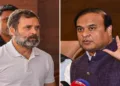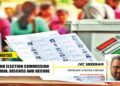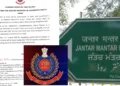
For over a year now, a familiar script has played out every time the Election Commission runs a Special Intensive Revision. The moment a state’s rolls get cleaned up, the same opposition ecosystem — Congress, TMC, assorted activists, a chorus of NGOs — reliably claims the exercise is a saffron-tinted purge aimed at Muslims, migrants and the poor. Delhi’s SIR has just handed that narrative its most inconvenient rebuttal yet: the list of people caught up in the very same “discrepancy” notices includes the Union External Affairs Minister, a former Chief Justice of India, a former Vice-President, a sitting Election Commissioner, and the Chief Minister of Delhi herself.
A dragnet with no political preference
The facts are not in dispute. External Affairs Minister S Jaishankar and his wife received notices. So did BJP veteran L K Advani and his daughter Pratibha. Former Vice-President Jagdeep Dhankhar is on the list. So is Election Commissioner S S Sandhu — a member of the body actually running SIR. CBI Director Praveen Sood, former Army Chief General Upendra Dwivedi, SEBI chief Tuhin Kanta Pandey, Foreign Secretary Vikram Misri, and retired Supreme Court judge Justice Ranjana Desai were all flagged. A law professor’s widely shared post adds former CJI D Y Chandrachud, Subramanian Swamy and BJP MP Bansuri Swaraj to that list as well — names I haven’t seen independently confirmed elsewhere yet, but which fit the pattern already on the record. Delhi’s own Chief Minister, Rekha Gupta, wasn’t spared either, flagged over an age mismatch in her family’s records before being cleared within days.
If this were a machine built to quietly disenfranchise one community, it is doing a spectacularly bad job of it — it can’t seem to stop catching the people who are supposed to be running the country.
What the numbers actually show in Delhi and Bihar
Critics love to cite Bihar’s 2025 SIR, where Muslims made up a larger share of deletions than their population share. What gets left out is the Election Commission’s own response to that charge: it told the Supreme Court the disparity relied on unverified name-recognition software of dubious accuracy, and called the attempt to frame a technical cleanup in communal terms something that “is to be deprecated.” West Bengal’s numbers, meanwhile, cut the other way from what the “anti-Muslim” narrative predicts: deletions there ran roughly 63% Hindu to 34% Muslim — a state where Mamata Banerjee’s own party spent months insisting the opposite was happening.
Delhi tells the same story in miniature. Of the 47.7 lakh names dropped from the draft roll, the overwhelming majority — 43.32 lakh — fall under a single administrative bucket: people who had moved, were absent, or couldn’t be traced at their registered address. That’s not a communal or class signature. It’s what you’d expect in a city with one of India’s largest transient, migrant workforces, where people move for work far more often than the electoral rolls get updated to match.
Yes, the Supreme Court raised questions — that’s the system functioning, not failing
Opposition-aligned commentary has seized on today’s Supreme Court hearing, where Chief Justice Surya Kant’s bench noted that Delhi’s “logical discrepancy” notices appear machine-generated and asked the Election Commission to consider additional filters. It’s worth being straight about what that hearing did and didn’t say. The Court was not questioning whether SIR should happen — it settled that question in the Commission’s favour back in May, ruling the exercise sits squarely within the ECI’s constitutional mandate to keep rolls accurate. What it asked for today was procedural fine-tuning: clearer criteria for the “logical discrepancy” category, and better on-the-ground support for voters responding to notices. The Commission had already deployed roughly 14,000 Booth Level Officers and 1,200 Electoral Registration Officers for Delhi alone, along with assistance camps and WhatsApp helplines — and the Court’s response was essentially to ask for more of the same, not to halt anything.
That’s what a functioning safeguard looks like: courts asking an administrative body to tighten its process, not striking down the process itself. Nobody’s name gets deleted without a chance to respond and a reasoned, appealable order — the Commission has said so repeatedly, and Rekha Gupta’s own case, cleared within days of being flagged, is the proof of concept.
The takeaway
Strip away the outrage cycle, and what’s left is a technical exercise that has, by its own admission-proof design, treated a Cabinet minister and a Delhi household with the same paperwork it applies to everyone else. The “targeting Muslims and the poor” narrative needs the intake process to discriminate. It demonstrably doesn’t. What critics are left arguing is a much softer claim — that document-heavy bureaucracy burdens people with fewer resources more than it burdens ministers with staff to handle it — which is true of almost any government process anywhere, and a far cry from the deliberate disenfranchisement conspiracy that’s been alleged.