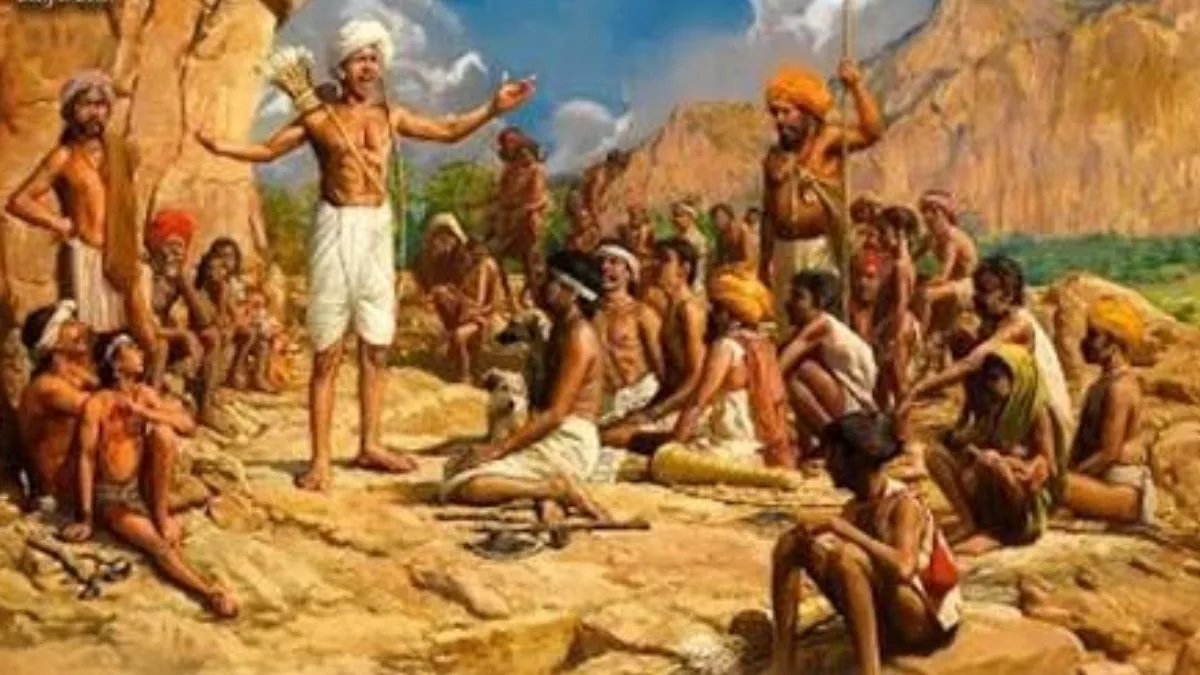
On a serene Bhadra evening in Chalkad village, nestled within the Chotanagpur plateau, an atmosphere of deep celebration engulfed the Ankhra (traditional festival ground). Organised on the auspicious day of Shukla Ekadashi, the village resounded with the rhythmic beats of dhamsa and madal drums, set against a backdrop of lush, vibrant sal and piyal forests. Holding a bamboo flute in his hand, young Birsa Munda led the village youth into the deep woods to respectfully cut and bring back a sacred branch of the Karam tree. Erecting the branch with solemn reverence at the center of Chalkad’s Ankhra, and decorating it with Jawa—seven types of sprouted grains carefully nurtured in clean river sand—the entire Munda community immersed itself in the worship of the Karam deity.
Yet, amid this flowing tide of joy, a village elder sighed deeply and remarked to Birsa: “Today we worship the Karam deity, but the way the dikus (outsider landlords and moneylenders) and British forest contractors are clear-cutting our ancestral Khuntkatti forests, a day may soon come when not a single Karam tree will remain for us to worship.”
That elder’s agonizing distress ignited a wildfire within young Birsa’s heart. Lowering his flute under the open Bhadra sky, Birsa proclaimed at the Chalkad Ankhra:
“If outsider enemies cut down the very roots of our forests and soil, then dancing and singing around a severed branch of the Karam tree is utterly meaningless! We must defend not merely a severed branch, but the very soil and forest that sustain us with supreme love—even if we must shed our blood to do so.”
That night, the rhythm of the Karam dance at Chalkad underwent a fundamental transformation. From Birsa’s flute flowed no longer simple seasonal melodies, but powerful anthems of Adivasi self-respect, the sovereignty of nature, and the battle cry of liberation: “Abuua Dishum, Abuua Raj” (Our Country, Our Rule). Chalkad’s Karam Puja transcended the boundaries of a localized nature ritual to become the sacred battle hymn of Munda independence—a epic struggle immortalized in history as the Ulgulan (The Great Rebellion).
Bhagwan Birsa Munda demonstrated that an Adivasi’s forest, land, and spiritual heritage form an indivisible sacred entity, represented by the supreme cosmic entity Singbonga and the foundational principles of the Sarna faith. However, a critical review of post-independence Indian history reveals a agonizing and deeply entrenching political conspiracy. For decades, a systematic ideological assault has been launched against the distinct spirituality and traditional lifestyle of Indian indigenous communities by Marxist intellectuals, Communist-Naxalite insurgents, and international missionary networks.
Attempting to force Birsa Munda’s life into the narrow confines of European Marxist materialism, leftist historians reduced his profound religious reforms and spiritual consciousness to “backward superstition” or simplified it into a mere “peasant economic struggle.” Simultaneously, armed Maoist-Naxalite cadres active across the Red Corridor—spanning Chhattisgarh, Jharkhand, Odisha, and West Bengal—have routinely used Bhagwan Birsa’s image as a propaganda shield while violently suppressing traditional Adivasi religious festivals (such as Karam and Sarhul), customary indigenous governance (the Manki-Munda system), and core Sarna rituals. This ideological aggression has been compounded by international, heavily funded Christian missionary organizations engaged in cultural erasure and aggressive conversion campaigns. Together, this unholy nexus between missionaries and Communist-Naxalites continuously strives to sever Indian Adivasis from their Sanatan ancestral roots.
Marxist Historiography and the Character Assassination of Birsa Munda’s Spiritual Identity
To truly grasp the essence of Bhagwan Birsa Munda’s life and struggle, one must understand the ‘Birsait’ religious order and social reform movement he founded. Birsa Munda (1875–1900) was far more than an armed guerrilla commander; he was a revered spiritual prophet and social reformer. He established the monotheistic Birsait faith, which mandated the complete renunciation of alcohol and violence, urged strict personal hygiene and moral cleanliness, and directed devotion exclusively toward the supreme creator, Singbonga, and the sacred natural order of Sarna.
Distinguished anthropologist and historian K.S. Singh, in his authoritative monograph Birsa Munda and His Movement 1874–1901: A Study of a Millenarian Movement in Chotanagpur (Oxford University Press, 1983), rigorously documented that for Munda society, the preservation of water, forest, and land (Jal, Jangal, Jameen) was inextricably tied to religious devotion toward Singbonga.
Marxist historians, however, committed severe epistemological violence against this history. By stripping away Birsa’s spiritual identity, leftist academic frameworks attempted to recast a sacred millenarian uprising into a secular, materialist class conflict, dismissing his spiritual teachings as irrelevant or reactionary while co-opting his anti-colonial legacy for Marxist propaganda.
Naxalite-Maoist Violence: Assault on Adivasi Culture and Traditional Governance – Red Terror of ‘Jan Adalat’
The armed Naxalite-Maoist extremism that expanded across eastern and central India following the 1967 Naxalbari uprising proved to be not a blessing, but a devastating curse for Adivasi society. Armed groups affiliated with the CPI (Maoist) across the Red Corridor posted photographs of Birsa Munda and invoked slogans of the Ulgulan to recruit impressionable tribal youth. In practice, however, their terror campaigns represented a complete betrayal of Birsa Munda’s philosophy.
At the heart of Munda and indigenous tribal society lies their traditional system of self-governance—specifically the Manki-Munda System and the Parha Panchayat. Under this hereditary and democratic customary framework, village headmen (Mundas) and cluster leaders (Mankis) resolve social disputes, safeguard communal land rights, and oversee religious festivals. Upon infiltrating tribal territories, Maoists systematically dismantled these traditional self-governing institutions, imposing in their place a brutal, parallel military rule known as the Janatana Sarkar.
Renowned anthropologist Nandini Sundar, in her field study The Burning Forest: India’s War in Bastar (Juggernaut Books, 2016), provides an objective account of how Maoist insurgents stripped authority from traditional village elders, village headmen, and Pahans (traditional village priests). Through kangaroo courts (Jan Adalat), thousands of ordinary Adivasis were branded as “police informers” or “class enemies” and publicly executed. Research by Dr. Girish Kant Pandey on Chhattisgarh’s insurgency reveals that an astonishing 98% of the victims executed during Maoist “cleansing drives” (Safaiya Abhiyan) were innocent local tribals.
Maoist Ban on Adivasi Religious Worship and Festivals
Bhagwan Birsa Munda sacrificed his life to defend the sanctity of Adivasi faith and cultural traditions. Yet, armed Maoist cadres enforced a suffocating ban on tribal social and religious expressions.
Professor Alpa Shah, in her ground-breaking ethnographic study Nightmarch: Among India’s Revolutionary Guerrillas (University of Chicago Press, 2018) as well as her academic work published by Cambridge University Press, demonstrated how Communist cadres viewed indigenous festivals and religious rituals with profound ideological disdain, actively discouraging and disrupting sacred ceremonies like Karam and Sarhul.
Systematic Red Conspiracy to Destroy Adivasi Development, Education, and Infrastructure
Sustained Maoist Attacks on Education and Infrastructure
Bhagwan Birsa Munda was a staunch proponent of education. His early education at the German Mission School in Chaibasa equipped him with the literacy required to understand legal documents, colonial land deeds, and British administrative policies. Birsa understood that education was the most potent instrument for tribal self-reliance and true self-governance.
In stark contrast, the core doctrine of Naxalite-Maoist insurgency relies on keeping Adivasi regions underdeveloped, illiterate, and isolated. Maoist strategists realized that if schools, hospitals, paved roads, and electricity reached tribal hamlets, Adivasis would integrate into the democratic Indian state, dissipating the manufactured “revolutionary grievance” required to sustain the insurgency. Consequently, Maoists executed a systematic four-decade campaign to destroy educational and public infrastructure.
Reports by Human Rights Watch—Sabotaged Schooling: Naxalite Attacks and Police Occupation of Schools in India’s Bihar and Jharkhand States (2009) and “Being Neutral is Our Biggest Crime” (2008)—documented in extensive detail how Maoists detonated Improvised Explosive Devices (IEDs) to blow up government school buildings, hostels, and residential ashrams. Thousands of Adivasi children were deliberately denied basic literacy, creating a vulnerable pool of youth forced into Maoist child-soldier units (Bal Sangham) and armed insurgent squads, while widespread allegations of sexual exploitation and abduction of young women emerged.
Data from the Ministry of Home Affairs (MHA) indicates that between 2004 and 2024, Maoists destroyed thousands of kilometers of roads, mobile towers, health centers, village assembly buildings (Panchayat Bhawans), and Eklavya Model Residential Schools. Official figures presented in Parliament in 2024 revealed that following the successful eradication of Maoist strongholds, state governments in Chhattisgarh and Jharkhand had to rebuild 14,474 km of roads, 5,139 mobile towers, 1,007 bank branches, and 179 residential schools—exposing how Maoist terror shattered Birsa Munda’s dream of education-driven tribal empowerment.
Extortion Economy and Maintenance of Artificial Poverty
Maoist exploitation extended far beyond structural destruction. A monograph published by the Institute for Defence Studies and Analyses (IDSA), The Political Economy of Maoism in India (2010), uncovered a multi-million-dollar extortion economy operated by Maoist commanders in forest zones.
Maoist cadres forcibly collected ₹200 to ₹300 crore annually in “Janatan Tax” from impoverished Kendu leaf gatherers, small timber collectors, mining contractors, and local traders. While these vast sums funded the lavish lifestyles, security, and weaponry of senior insurgent commanders, ordinary Adivasis were kept trapped in chronic malnutrition, lack of medical care, and severe poverty.
Jharkhand Movement and the Communist Strike on Adivasi Autonomy
From ‘Jaipal Singh Munda’ to ‘Red-Green Alliance’: Communist Political Hijacking
The movement for a separate state of Jharkhand was the political embodiment of Birsa Munda’s vision of “Abuua Dishum, Abuua Raj.” Founded in 1938 as the Adivasi Mahasabha and later transformed in 1949 into the Jharkhand Party by Oxford-educated Olympian Jaipal Singh Munda (Marang Gomke), the movement demanded statehood based on unique geographical, cultural, and ethnic identities. In India’s first general elections in 1952, the Jharkhand Party emerged as the principal opposition party in the Bihar Legislative Assembly, winning 32 seats.
Over subsequent decades, however, leftist factions sought to hijack this indigenous movement, attempting to subvert a struggle for cultural self-determination into a class-oriented agrarian conflict.
Missionary Activities and the Historical Revelations of the Niyogi Committee
To comprehend the strategic nexus between Communist insurgents and Christian missionaries, one must examine historical documentation. Under the guise of humanitarian aid, healthcare, and schooling, evangelical missionary networks initiated a process of deculturation (de-tribalization), detaching Adivasis from their ancestral Sarna faith and customary traditions.
In 1956, the Government of Madhya Pradesh published the historic report of the inquiry committee headed by retired Chief Justice M.B. Niyogi—the Niyogi Committee Report on Christian Missionary Activities. The report unequivocally documented that foreign missionary bodies were actively fostering a separatist ideology aimed at carving out an independent “Adiwasisthan”, attempting to sever tribals from the national mainstream of India and uprooting them from their ancestral heritage.
Strategic and Financial Nexus of the Missionary-Naxalite Alliance
The operational and strategic alignment between Communist-Maoist insurgents and proselytizing missionary networks rests on four primary pillars:
Shared Hostility: Both entities view the constitutional, democratic Indian state and traditional Sanatan-Vedic heritage as their primary structural adversaries.
Exploitation of Human Resources: Missionary networks culturally alienate tribal youth through conversions, while Maoist commanders recruit these alienated youth into armed anti-state insurgent units. Exploitation of Remote Geography: Both groups operate predominantly in remote, geographically isolated regions where formal state administrative structures were historically thin.
Foreign Funding and NGO Networks: Investigations conducted in 2026 by the Enforcement Directorate (ED) and the Central Bureau of Investigation (CBI) unearthed extensive financial trails linking foreign evangelical funds to insurgent support structures.
Investigation into ‘The Timothy Initiative’ and Proof of Financial Conspiracy
In June 2026, Indian security agencies and the Enforcement Directorate (ED) dismantled an international financial conspiracy involving a US-based evangelical organization, The Timothy Initiative (TTI), involving ₹92.55 crore (1+ million) in illegal foreign funding. Investigations revealed that over ₹6.34 crore was withdrawn directly using US debit cards at local ATMs across Naxal-affected districts of Chhattisgarh, including Dhamtari and Bastar, to directly finance Maoist cadres and fund illegal conversion networks. An FIR registered under the Unlawful Activities Prevention Act (UAPA) by the CBI at Kothanur Police Station in Bengaluru confirmed that the foreign-funded network was actively destabilizing internal security, proving that the “Joshua Conspiracy”—the strategic alliance between proselytizers and insurgents—is a documented financial and operational reality.
Misuse of the Pathalgadi Movement and the Urban Naxal Conspiracy
The subversion of the traditional Adivasi Pathalgadi custom in Jharkhand’s Khunti and Simdega districts between 2017 and 2019 serves as another stark instance of this conspiracy. Pathalgadi is a sacred ancestral Munda tradition wherein carved stone monoliths are erected to mark village boundaries, commemorate ancestors, or honor milestone events.
However, investigations established that converted Christian leaders, such as Vijay Kujur, in tandem with prominent “Urban Naxal” activists, hijacked this sacred practice. Misinterpreting constitutional provisions on stone slabs erected at village entrances, they proclaimed that the Indian Constitution, national courts, and state police possessed no jurisdiction over tribal villages. Government teachers, healthcare workers, and administrative officers were violently barred from entering, turning these hamlets into lawless zones that facilitated human trafficking and enforced a total boycott of the 2019 Lok Sabha general elections.
Birsa’s true ‘Abua Dishum’ and tribal revival
The Government of India’s resolute “Naxal-Mukt Bharat Abhiyan” (Campaign for a Naxal-Free India), combined with massive infrastructure creation—comprising thousands of kilometers of paved highways, digital connectivity, banking facilities, and modern Eklavya residential schools—has successfully eradicated the Maoist shadow from the Red Corridor.
From Bastar to Chotanagpur, the authentic voice of Bhagwan Birsa Munda reverberates once more: “Abuua Dishum, Abuua Raj.” The true empowerment and dignity of Indian Adivasis lie not in foreign-imported materialist violence or cultural erasure, but in the enduring brilliance of Birsa Munda’s vision—a vision rooted in ancestral spirituality, environmental harmony, self-governance, and unwavering devotion to the motherland.