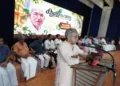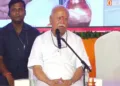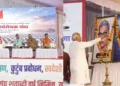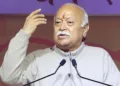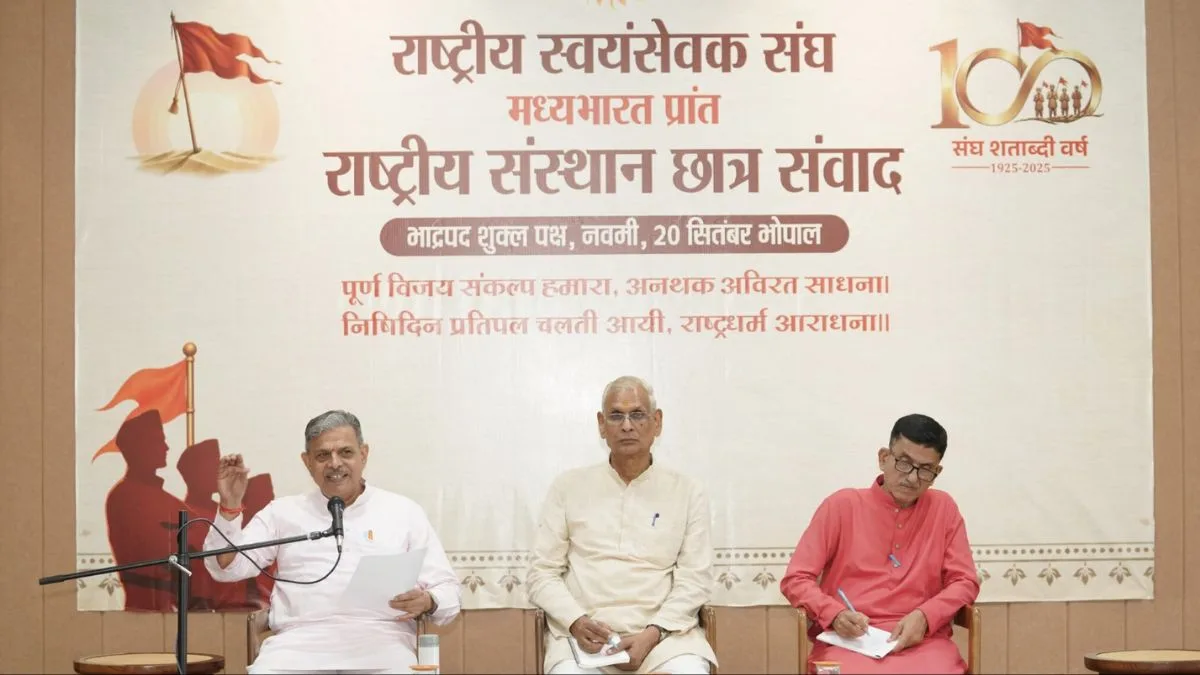
Bhopal: A dialogue was organised by Samaj Seva Nyas, in which around 250 students and professors participated. RSS Sarkaryavah Dattatreya Hosabale interacted with the students and answered their questions. Students raised queries related to social, cultural, educational, administrative, technological and national issues. For the question of connecting with youth in the era of social media and ideological ‘echo chambers’, RSS Sarkaryavah Dattatreya Hosabale said that today generations are defined by names such as ‘Gen Z’ and ‘Gen Alpha’, whereas Swami Vivekananda called the youth ‘Yuva Bharat’.
Swami Vivekananda, as Narendra, had also asked questions, and Nachiketa’s questioning is well known in the Bharatiya tradition. Therefore, when the new generation questions the government, society or any organisation, it should not be considered wrong. He said that the questions of youth should be heard and there should be engagement through dialogue. Instead of rejecting someone merely because they ask questions, an effort should be made to understand their views.
On the question of freeing Bharat from a colonial mindset, he said that the country has achieved political independence, but the process of ‘Decolonisation of Mind’ is still continuing. He said there is a need for greater research into the values, perspective and terminology of Bharatiya civilisation, citing the concept of ‘Dharma’ as an example. According to him, to understand the Bharatiya perspective, study is required in various fields including history, archaeology, linguistics and social sciences.
On ways to change the ideological environment among students, he suggested starting self-study groups, group discussions and constructive activities related to national interest. Citing the example of the ‘Namo Bharati’ programme of students in Bengaluru, he said that a positive environment can also be created through small activities. On questions related to the Sangh’s work and use of technology in the digital age, Sarkaryavah ji said that basic thoughts and values remain permanent, but available means should be used with changing times. Social media and digital platforms should be used, but what is being disseminated there and for what purpose depends on an individual’s values and discretion. Technology should be beneficial for humanity, the nation, the environment and history, and human beings should keep it under their control instead of becoming slaves to technology.
He said there is a need for democratisation of technology so that its benefits reach the last person in society. At the same time, it is necessary to maintain human control over technology. If this control is lost, technology may cease to remain a means for individuals and instead become a force that controls them.
On the question of ideological conflict, He said that if it is being called a ‘discourse war’, effective means are also necessary for it. Arguments should be based on truth and study, there should be clarity in presenting one’s views, effective mediums should be used and training should also be provided for this. On questions related to the Bharatiya perspective in the education system, he said that for a long time, attempts were made to view Bharat through a Western perspective in several fields of history, archaeology, linguistics and social sciences. While accepting social evils in Bharatiya society, efforts for their reform are necessary, but the positive achievements and traditions of society should also be studied objectively.
On a question regarding corruption, he said that reforms in the system are necessary, but it should begin with an individual’s own life. One should first make an effort to remain free from corruption and awareness against it should also be developed in society. He said that technology should be used while keeping the basic thoughts and values unchanged. Technology should be beneficial for humanity, the nation, the environment and history.
In his concluding address, he said that students and professors are the educated section of society, and therefore their responsibility is also greater. Society contributes to an individual’s education, so education should not be considered merely a means of personal success but should be connected with responsibility towards society.
He said that coordination between personal responsibilities and duties towards society is an important form of Dharma. Society must become capable along with having self-confidence, but this strength should be for the welfare of humanity and the nation. He called upon students to think about how deep their sensitivity towards society is and what their plan is to transform that sensitivity into action.
Madhya Bharat Prant Sanghchalak Ashok Pandey and Bhopal Vibhag Sanghchalak Somkant Umalkar were present on the dais. The programme began with floral tribute to Bharat Mata. This was followed by the screening of a documentary based on the Shri Ram Janmabhoomi movement. The programme concluded with the collective chanting of ‘Vande Mataram’.