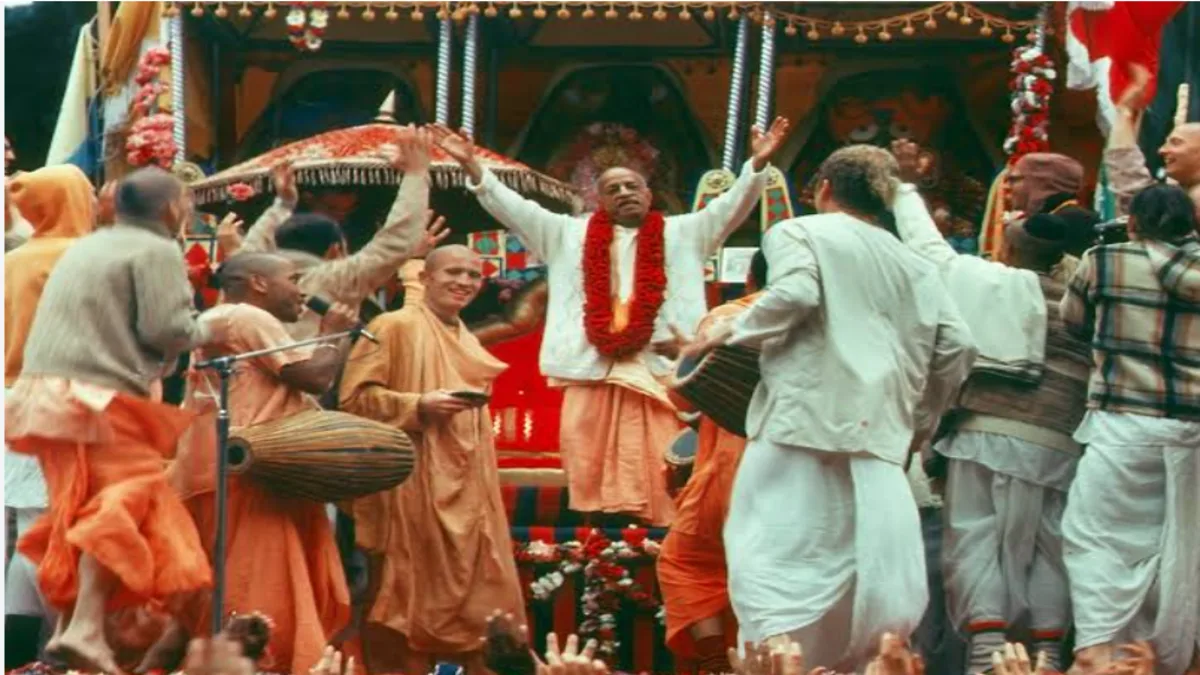
On the sacred occasion of Sri Radha Ashtami—occurring on the Shukla Ashtami of the month of Bhadra—the holy appearance day of Srimati Radharani, the supreme pleasure potency (hladini-shakti) of Bhagwan Krishna and the crown jewel of all devotees, is not merely a conventional religious festival. It marks the eternal manifestation of transcendental pure love, supreme mercy, and universal spiritual consciousness.
Ancient Gaudiya Vaishnava and Vedic scriptural traditions record an incomparable narrative: King Vrishabhanu received the divine effulgent infant girl, Srimati Radharani, floating upon a self-luminous golden lotus on the waters of the Yamuna. Yet, after her manifestation, the divine child’s eyes remained tightly closed, filling the residents of Vrindavan Dham with profound anxiety. Only when Yashodanandana Child Krishna first set foot in Gokula and granted His vision did Child Radharani open her eyes for the very first time. This unearthly pastime demonstrates that unalloyed love and dedicated service unto the Supreme Lord constitute the ultimate essence of Radha-tattva.
“The spiritual etymology of the word ‘Radha’ derives from the Sanskrit root Aradhyate”—this was elucidated by Srila A.C. Bhaktivedanta Swami Prabhupada, the Founder-Acharya of the International Society for Krishna Consciousness (ISKCON), during his historic Radhastami discourse delivered on August 30, 1968, in Montreal, Canada.
Standing upon the auspicious moment of Radhastami, a re-evaluation of the historic struggle of Srila Prabhupada and his global Vaishnava movement carries profound historical significance. Against Srila Prabhupada’s God-centered universal movement, his distinct philosophy of spiritual patriotism, and the international organization of ISKCON, international and Indian communist forces conducted a long-standing, well-orchestrated political conspiracy, malicious slander campaigns, state persecution, psychological torture, and direct armed assault.
The year was 1981, at the absolute height of the Cold War. General Semyon Tsvigun, a top-ranking official of the Soviet Union’s formidable intelligence agency, the KGB, publicly declared in an official Communist Party organ that Soviet socialism faced three grave threats to its national security: first, Western pop music; second, Western culture; and third, vegetarians chanting the “Hare Krishna” Mahamantra on the streets. In a world trembling under the constant fear of nuclear catastrophe, one of the world’s most ruthless state machineries perceived people playing clay drums (khols), brass cymbals (kartals), and expounding spiritual philosophy as an existential threat to its survival. Thus, ancient India’s spiritual philosophy landed directly on the hit-list of the Cold War’s most fierce intelligence agency: the KGB.
On the surface, this confrontation might appear as a clash between two disparate social or religious ideologies. In reality, it was a historic face-off between the atheistic Dialectical Materialism of Karl Marx, Vladimir Lenin, and Joseph Stalin, and the panentheistic spiritual idealism of Sanatana Gaudiya Vaishnava philosophy. Internationally, from the former Soviet Union’s notorious KGB to the CPI(M) and extremist Naxalite Maoist factions during the Left Front regime in West Bengal, India—all viewed Srila Prabhupada’s Vaishnava revival as the single greatest psychological obstacle to their atheistic communist revolution. This was because the eternal liberation of human consciousness and India’s traditional Bhagavata Egalitarianism or Vedic Egalitarianism presented a timeless global paradigm that decisively exposed the futility of both Marxist materialism and Western capitalism.
Subhas Chandra and Abhay Charan on the Campus of Scottish Church College
Born in Kolkata during the first half of the 20th century under British colonial rule, Abhay Charan De (later Srila Prabhupada) was raised in an atmosphere of intense patriotism and deep spirituality. During his studies at Kolkata’s prestigious Scottish Church College from 1916 to 1920, Abhay Charan became deeply acquainted with the mainstream student politics and freedom struggle of contemporary India.
Studying at the college at the same time was his senior classmate by exactly one year—Netaji Subhas Chandra Bose, a legendary revolutionary figure in India’s independence movement. After being expelled from Presidency College for protesting the arrogance of a British professor, Subhas Chandra enrolled in the Philosophy Department at Scottish Church College, where young Abhay Charan was studying English, Sanskrit, and Philosophy.
In the first volume of Satsvarupa dasa Goswami’s famous six-volume biographical masterwork, Srila Prabhupada-lilamrita, it is detailed how a profound spiritual and intellectual friendship blossomed between Abhay Charan De and Subhas Chandra Bose at this historic Kolkata institution. The razor-sharp youth Subhas Chandra Bose was the secretary of the college’s ‘Philosophy Club’. As direct political activity was impossible under the strict surveillance and political bans of the colonial British government, Subhas conducted secret organizational work for India’s Swaraj (self-rule) and freedom movement under the cover of Philosophy Club gatherings. Young Abhay Charan actively participated in those deep political discussions. Subhas’s uncompromising anti-British stance, intense patriotism, and fearless organizational leadership left an indelible impression on young Abhay’s mind.
In 1920, when Mahatma Gandhi issued the historic call for the Non-Cooperation Movement across India’s political landscape, both Subhas Chandra and Abhay Charan responded wholeheartedly. As a symbolic protest against British cloth imports, Abhay Charan began wearing handspun Khadi garments. In 1920, despite passing his B.A. final examinations from Scottish Church College with distinction, Abhay Charan De formally rejected his degree certificate from Calcutta University (under the colonial British government) as a unique mark of protest against the enslavement of Mother India. This visionary decision proved that uncompromising nationalist blood flowed through his veins.
Netaji at the Gaudiya Math
On a memorable evening in October 1930, a historic meeting occurred bridging world politics and Indian spiritual history. Kolkata’s then-Mayor and rising young nationalist leader, Subhas Chandra Bose, visited the Bagbazar Gaudiya Math accompanied by his prominent political associates. There, he held a memorable meeting with Srila Prabhupada’s spiritual master, the Founder-Acharya of the Gaudiya Math, Srila Bhaktisiddhanta Sarasvati Thakura.
Archival documents preserved in the history archives of Gopinath Gaudiya Math and the periodical Sanatan Jnan reveal fascinating details of this encounter. Subhas Chandra Bose humbly expressed his political resolve to Srila Bhaktisiddhanta Sarasvati Thakura, stating that to liberate Mother India from British bondage, he needed weapons, blood, and disciplined youth power. He requested that thousands of well-educated, high-character, disciplined young men from the Gaudiya Math directly join the nation’s armed struggle for independence.
Without diminishing young Subhas’s grand nationalist fervor in the slightest, Srila Bhaktisiddhanta Sarasvati Thakura presented a profound spiritual perspective. He explained that political independence or geographical borders are temporary playthings of Maya (illusion). Spiritual consciousness or Vedic knowledge cannot wait for political freedom; it is humanity’s immediate and eternal necessity. Subhas Chandra Bose was deeply moved by this high level of logic. Though Netaji proceeded along his resolute path of armed struggle, he retained lifelong reverence for Vaishnava discipline and spiritual power.
Historical Truth of the INA, Naval Mutiny, and British Departure
Srila Prabhupada declared at a massive public rally in Mumbai that India was not a beggar seeking technology or wealth from the West; India’s true strength lay in her invaluable Vedic knowledge. Offering this eternal spiritual wisdom to the entire world was the genuine global duty and “Nationalism of Pure Consciousness.”
Srila Prabhupada’s analysis of how India achieved independence was remarkably objective, historically accurate, and imbued with sharp political acumen. Preserved in Hari Sauri Dasa’s five-volume work A Transcendental Diary and his interview in Hong Kong on April 19, 1972, Prabhupada’s unique assessment stands out clearly. He explicitly stated that India did not gain independence primarily due to Mahatma Gandhi’s non-violence movement; rather, it was obtained through the military blows delivered by Netaji Subhas Chandra Bose’s Indian National Army (INA) and the 1946 Royal Indian Navy Mutiny.
Moscow Visit, the Debate with Professor Kotovsky, and ‘Bhagavata Communism’
At the height of the Cold War, ISKCON maintained a completely neutral and distinct stance from both global ideologies—American capitalism and Soviet communism. Srila Prabhupada stated that American capitalism was a slave to unchecked sense gratification and immoral consumerism, whereas Soviet communism was the naked manifestation of atheistic state tyranny. Both systems inflicted severe trauma upon human spiritual consciousness.
Between June 20 and June 25, 1971, Srila Prabhupada undertook a highly perilous and historic visit to Moscow, the capital of the Soviet Union. Right at the outset, the communist state machinery initiated institutional psychological harassment against him. Despite being an accredited representative from India, the Soviet Ministry of Culture granted him no permission for religious preaching. He was issued merely a brief five-day tourist visa and forced to remain virtually under house arrest in a small, substandard hotel room in Moscow, preventing him from interacting with ordinary Soviet citizens.
Nevertheless, defying the vigilant eyes of the KGB, on June 22, 1971, a historic debate took place between Srila Prabhupada and Professor Grigory Zislinovich Kotovsky, eminent Indologist and Head of the Department for South Asian Studies at the USSR Academy of Sciences. This dialogue was subsequently published verbatim in 1997 in Russia’s Otkrytyi Forum journal and in ISKCON’s Back to Godhead magazine (Vol. 22, No. 11, 1987) under the title “The Vedic Conception of Communism.”
At the opening of the dialogue, Professor Kotovsky defended Marxist materialism and historical dialectics, claiming that human consciousness completely ceases upon death and asserting that the ancient Indian Varnashrama system was merely a tool of feudal exploitation. In response, Srila Prabhupada demonstrated through flawless logic and Vedic scriptural evidence that the four varnas described in the Bhagavad-gita are not a blind caste system based on birth; rather, they represent a scientifically organized social division of labor established upon human psychological qualities (guna) and activities (karma).
Exposing the fatal fundamental flaw of the communist state system, Srila Prabhupada posed a direct question to Professor Kotovsky: “In your communist state system, where is the head of society?”
He explained that just as a headless human body is incapacitated and directionless, so too a communist society governed by atheistic political leaders is inherently bound to be bewildered. In contrast to Marxist state control, Srila Prabhupada presented the timeless blueprint of Bhagavata Communism or Vedic Egalitarianism. As recorded in Srila Prabhupada’s work Dialectical Spiritualism: A Vedic View of Western Philosophy, which refuted Karl Marx, he explicitly documented that genuine communism is established not by any political party or state, but when Supreme Lord Krishna is recognized as the ultimate owner of all wealth in the universe, and every living entity (from human beings to animals and birds) receives its required nourishment and fundamental right to live.
The dramatic presence of the Bhaktivedanta Book Trust (BBT) at the 1979 Moscow International Book Fair and the secret acquisition of Srila Prabhupada’s books by thousands of Soviet citizens deeply alarmed the KGB. In September 1981, General Semyon Tsvigun, First Deputy Chairman of the KGB, published an explosive directive in Issue No. 17 of Kommunist, the official journal of the Central Committee of the CPSU. He openly declared that the three grave national security threats to Soviet socialism and the communist way of life were “Western culture, pop music, and the Hare Krishna movement.”
Following Tsvigun’s mandate, with the direct approval of Soviet head of state Yuri Andropov, a special intelligence taskforce named ‘Operation Poisk’ (Operation Search) was formed within the KGB to permanently eradicate the Vaishnava movement from Soviet Russia. The command was assigned to KGB officer Major Ernest Fedorovich Belopotapov.
Immediately following this, character assassination campaigns were launched through state media outlets like Nauka i Religiya (Science and Religion) and the official daily Izvestia. In 1983, Vadim Kasis and Leonid Kolosov published a massive investigative report in Nedelya (weekly supplement to Izvestia), maliciously alleging that ISKCON was not a religious organization, but a dangerous covert front of the US Central Intelligence Agency (CIA) aimed at paralyzing Soviet youth and destroying the communist revolution. Srila Prabhupada was falsely smeared as a paid CIA agent.
In the renowned research volume Religious Policy in the Soviet Union, edited by Sabrina Petra Ramet and published by Cambridge University Press, detailed analysis shows how the KGB crushed Vaishnavas under fake political conspiracy charges. Richard H. Shultz and Roy Godson, in Dezinformatsia: Active Measures in Soviet Strategy, also documented how the KGB maligned diverse religious movements using fabricated media reports.
Article 227 and the Infernal Agony of Political Psychiatry (Psikhushka)
To carry out religious persecution under the guise of legal proceedings, Soviet Russia utilized Article 227 of the Criminal Code of the RSFSR. Under this article, absurd charges were brought claiming that chanting (japa-kirtan), scriptural reading, and vegetarian diet (abstaining from meat and eggs) “inflicted severe harm upon the health and mental equilibrium of Soviet citizens”!
Under this fabricated law, widespread arrests were carried out across the Soviet Union between 1980 and 1986. An Estonian Vaishnavi named Premavati Devi Dasi was arrested while nine months pregnant and thrown into Moscow’s infamous Matrosskaya Tishina prison. There, during labor, she was denied medical care and subjected to unspeakable torture, resulting in her newborn baby girl dying on the damp prison floor.
As documented in Sidney Bloch and Peter Reddaway’s famous book Psychiatric Terror: How Soviet Psychiatry Is Used to Suppress Dissent, Srila Prabhupada’s first Russian disciple, Ananta Shanti Das, was arrested in 1980 and committed to a special psychiatric hospital in Smolensk. For six agonizing years, attempts were made to render him mentally and physically incapacitated through insulin shock therapy and forced injections of sulfazin and the powerful neuroleptic drug Haloperidol.
Armenia’s Blood-Soaked Chapter, ‘Salted Bread’, and Vaishnava Martyrs in Siberian Gulags
The most tearful chapter in the history of communist persecution was written in the Republic of Armenia. In 1985 and 1986, the KGB conducted staged trials in Yerevan against ISKCON members, sentencing eleven Vaishnavas—including Karen Saakyan, Suren Karapetyan, Gagik Buniatyan, and Sarkis Ohanjanyan—to hard labor in Siberian Gulags.
Preserved in world literature as irrefutable documentation of this torture is the world-renowned 327-page book Salted Bread: A True Story, written by Gagik Buniatyan (spiritual name Sarvabhavana Das) and edited by Urmila Devi Dasi. When imprisoned Vaishnavas refused to eat meat in Soviet labor camps, their sole nourishment for 730 consecutive days consisted of substandard dry black bread and water. Choking on dry bread without salivary secretion, they were forced to sprinkle raw salt heavily onto the bread and swallow it with water to induce saliva—hence the title Salted Bread.
The supreme sacrifice of this communist brutality was 24-year-old youth Sachisuta Das (Sarkis Ohanjanyan). In the YU-25/B Gulag in the Orenburg region near Siberia, suffering from severe malnutrition, -50°C freezing temperatures, and tuberculosis, he breathed his last inside his prison cell on December 26, 1987—just 28 days before completing his sentence.
Fellow inmates recorded that hours before his death, Sachisuta Das meticulously draped a bedsheet as a dhoti, painted a beautiful Vaishnava tilaka on his forehead using white toothpaste, and peacefully departed this world with a smile while chanting the Holy Name on prayer beads fashioned from bread. Similarly, in July 1986, 25-year-old Martik Zhamkochyan was murdered at a communist mental hospital in Yerevan when raw eggs and chemical liquids were forcibly administered through a nasal tube.
Communist Aggression in India: The Naxal Attack in Kolkata and CPI(M) Hostility in West Bengal
Not only on Soviet soil, but also within India—particularly in the communist politics of West Bengal—hatred and conspiracies against Srila Prabhupada and ISKCON reached extreme proportions.
The 1971 Naxal-Maoist attack in Kolkata
In 1971, when West Bengal was turbulent with the radical Maoist Naxalite movement, Srila Prabhupada organized a historic, massive Vaishnava convention at Kolkata’s Chowringhee Ground along with his Indian and foreign disciples. Armed Naxalite youths believed that this Vedic spiritual awakening among the general populace was the single greatest barrier to their bloody communist uprising.
They stormed the convention, vandalized the pandal, assaulted devotees, and delivered a blood-stained death threat message to Srila Prabhupada reading “Fly or Die.” Yet Srila Prabhupada remained completely undaunted and unruffled. Instead of calling the police, he calmly invited the radical Naxal leaders to a room behind the stage. With immense patience and affection, Prabhupada presented the philosophy of the Ishopanishad and Vedic Egalitarianism before them, explaining that if everything belongs to God, then neither wealthy capitalists nor the communist state have the right to exploit others. Defeated by Prabhupada’s profound logic and spiritual potency, the Naxal youths retreated, and the festival proceeded peacefully to completion.
CPI(M) and the Malicious Propaganda of Ganashakti Newspaper
After the Left Front government led by the CPI(M) came to power in West Bengal in 1977, administrative and party conspiracies against ISKCON’s international headquarters in Mayapur intensified. The CPI(M) party mouthpiece Ganashakti and its student wing SFI regularly published slanderous articles branding ISKCON a “covert US CIA military base,” an “imperialist poisonous tree,” and an “anti-peasant force.”
Extreme political hostility erupted on the night of March 24, 1984, and again in 1989, when local Left cadres and anti-social elements launched armed attacks and bomb blasts on Sri Mayapur Chandrodaya Mandir. Bullets were fired directly at security guards and devotees. Later, when ISKCON proposed building a world-class ₹500-crore ‘Vedic Village’ and international tourism hub funded by Alfred Ford (great-grandson of Henry Ford), the Left Front government maliciously canceled the project under the pretext of land ceiling laws.
Brian Salter, in his scholarly article “The International Society for Krishna Consciousness: Religion and Politics in West Bengal” (published in Vol. 26 of the Journal for the Academic Study of Religion), provided detailed analysis of how the West Bengal Left Front government viewed ISKCON’s land holdings and global expansion as political rivalry and erected legal obstacles. Similarly, Hans Löfgren, in “The Communist Party of India (Marxist) and the Left Government in West Bengal,” demonstrated how the CPI(M) perceived religious movements as threats to its dominance over rural peasant society.
The Fall of the Red Flag and the Eternal Flow of the Vedic Alakananda
Yet, the remnants of communist hostility resurfaced even in the 21st century when, in 2011–2012, former communist officials in Tomsk, Russia, conspired to ban Srila Prabhupada’s world-famous work Bhagavad-Gita As It Is. In the Indian Parliament, then-External Affairs Minister S.M. Krishna strongly condemned the move, and in May 2012, the High Court of Russia completely dismissed the conspiracy, declaring the victory of the Bhagavad-gita.
The prolonged communist conspiracy, physical attacks, and character assassination directed against A.C. Bhaktivedanta Swami Prabhupada and ISKCON represented the timeless conflict between transitory, arrogant materialism and imperishable spiritual truth. The mighty Soviet Red Empire, which sought to confine Srila Prabhupada in a tiny Moscow hotel room and claimed the lives of innocent Vaishnavas in Siberian Gulags, has today vanished forever into the dusty pages of history. In stark contrast, Srila Prabhupada’s Vedic movement flows onward across the globe like the eternal Alakananda, enlightening human consciousness with divine love and spiritual freedom.
The clash between arrogant materialism and transcendental truth
The protracted conspiracy, physical assaults, and character assassination orchestrated by the communists against A. C. Bhaktivedanta Srila Prabhupada and ISKCON were fundamentally a timeless conflict between transient, arrogant materialism and imperishable transcendental truth. The formidable Soviet Red Empire—which once attempted to confine Srila Prabhupada within a cramped Moscow hotel room and claimed the lives of innocent Vaishnavas in the freezing gulags of Siberia—has today crumbled into dust, forever obliterated into the forgotten pages of history.
The Radiant Stream of Devotion and the Indestructible Legacy
Yet, the immortal message of Srila Prabhupada and the golden, auspicious stream of the Holy Name remain spotless and resplendent today, illuminating the hearts of millions across Russia, Ukraine, Armenia, Poland, and every corner of the globe. The communists’ rifles, Siberian gulags, and forced psychiatric torture could torment the mortal frames of the Vaishnavas, but they were utterly powerless to touch the pure Krishna consciousness bestowed by Srila Prabhupada.
History has now conclusively demonstrated that oppressive, atheistic political regimes inevitably collapse into ruin, whereas the immortal light of the Srimad Bhagavad-gita, Netaji’s ideals, and Vedic Egalitarianism continuously guide human society along the path of eternal liberation. And in defense of Sanatana Dharma, even within the deadlier left-ruled prison of ‘Matrosskaya Tishina’—reminiscent of Kamsa’s tyrannical dungeon—the pregnant Vaishnavi Premavati Devi Dasi struggles with all her strength, holding her unborn child while awaiting the advent of a divine ‘Mahamaya’ or ‘Radha’.