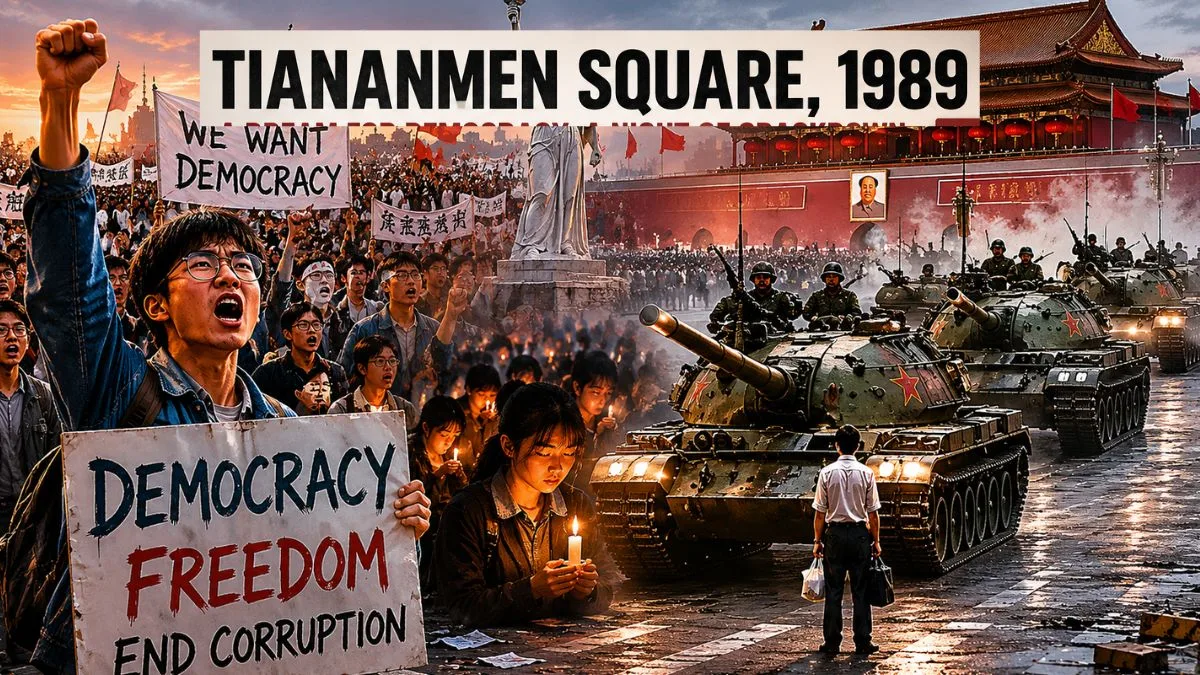
The Night China Opened Fire on Its Citizens Thirty-five years have passed, yet the memory of that square endures. On one night, unspoken but loud in its silence, power confronted protest with violence instead of dialogue; fear replaced courage. One event reverberated through decades, silencing voices before they could be heard. What took place there influenced lives long after it ended. On June 3, at the centre of Beijing, a sea of teenagers, some barely out of high school, sat quietly together.
Tiananmen Square Protests: A Democratic Upsurge
Tiananmen Square in Beijing took on the role of a focal point for a unique movement of people in the spring of 1989. Students started the movement to express their grief over the death of Hu Yaobang and soon evolved into a broader challenge against the authoritarian rule of the Chinese Communist Party. Soon enough, the protests spread out from there to become a nationwide pro-democracy movement.
The Great Hall of the People and the Monument to the People’s Heroes bordered Tiananmen Square. Not only was it a geographic space, but it was also an iconic symbol of ideology. It was the ceremonial center of the People’s Republic, established by Chairman Mao in 1949.
Thousands, and on some days as many as a million, filled the square demand the following
- An end to corruption
- Free press, freedom of expression
- Meaningful political reform
Hunger strikes were organised by students who placed banners and released public letters to the regime. Students were joined by workers, professors, as well as some lower-level members of the Communist Party.
In essence, the protest did not include any violence, with guard rails as well as a stage for speeches being built. Even the statue of “Goddess of Democracy” similar to America’s Statue of Liberty was established in order to signify democracy and civic integrity.
The international media covered pictures of unarmed protesters standing before lines of military troops. This movement exposed the deep contradictions and failures within the Chinese Communist system — a godless, materialist ideology that suppressed traditional cultural values and genuine national aspirations. It represented a spontaneous outburst of popular anger against decades of communist repression and ideological control.
The Chinese government used tanks and live ammunition against its own peaceful students and citizens demanding basic freedoms. This remains one of the starkest examples of the hypocrisy of communist rule, where the Party preaches equality and democracy but practices ruthless dictatorship and suppression.
Communist regimes always claim to represent the people and democracy. However, the Tiananmen Square massacre of June 3-4, 1989, clearly showed the opposite.
Symbol of Communist Brutality
The Tiananmen Massacre is a permanent symbol of how communist governments respond to demands for reform with tanks and bullets instead of dialogue. It proved that when people ask for basic rights, the Chinese Communist Party chooses power over people.
1 million+ Protesters gathered at Tiananmen peak. Thousands Estimated civilian deaths 35+ Years Of state silence and censorship. How It All Began To understand Tiananmen, we must look back a bit. When Mao Zedong died in 1976, China struggled through chaos. Years of harsh rule – including the Great Leap Forward and the Cultural Revolution – devastated the economy and scarred society.
Many lives vanished without a trace. Speaking out? Always silenced. Deng Xiaoping came to power with an idea that surprised many – allowing market forces to shape China’s economy while maintaining one-party rule.
Imagine letting a business thrive under free-market principles but preventing workers from having a say. Growth surged for certain groups under this system; meanwhile, corruption spread through government ranks. Costs rose steadily, and everyday citizens began feeling deeply wronged. Some young people in China started feeling restless. Though they saw little foreign news, new ideas took hold. Better jobs weren’t enough anymore. They wanted a voice in decisions about the nation.
The Tiananmen Massacre was not an exception but a natural continuation of the consistent anti-human and anti-constitutional character of leftist ideology throughout history.
The Government’s Deadly Decision
Not everyone in the Chinese Communist Party agreed on how to respond. Some top officials thought talking to the students might help. Others viewed the demonstrations as a threat so serious it had to be crushed. Peaceful marches didn’t change their view. Neither did logical requests from protesters. Victory went to the hardline faction. That evening, June 3rd, brought the official announcement: military rule would now take effect, and troops were moving in.
The army rolled into the urban streets, tanks leading, followed by armored vehicles, weapons loaded. Dialogue was never part of their mission. That night, people in Beijing stood their ground—linking arms, pulling cars into the streets, pleading with troops to stop.
Nothing changed. Before dawn on June 4th, soldiers marched into the square and surrounding avenues anyway. Bullets tore through the crowds. Some fell after being hit just steps away. Heavy trucks crushed a few beneath their weight. In the week that followed, jail cells filled with thousands taken into custody. One image from that night burned into global memory—one unknown figure standing in front of a line of armored vehicles, grocery bags dangling from his fingers, motionless.
That moment, though frozen in time, changed how people think of courage. Bystanders pulled him back before things escalated. His name remains unknown. His fate, unclear. Within China’s borders, you will never see this moment. Not once.
The Cover-Up After
Still uncounted, the real death toll remains hidden on purpose. Beijing states that about two hundred civilian lives were lost, along with military personnel. Reports from outside sources, watchdogs, journalists, and officials from other countries keep estimating the figures in the thousands. Hidden piece by piece, the complete picture never surfaced. Weeks passed after the bloodshed when the Communist Party began erasing traces of it. Images disappeared without warning.
Reporters either left or stopped their coverage. Mentions of ‘June 4th’ vanished from print, textbooks, and online spaces. Those who challenged authority found themselves imprisoned. Officials who supported change were quietly removed. Memory faded under pressure.
The “Pillar of Shame”
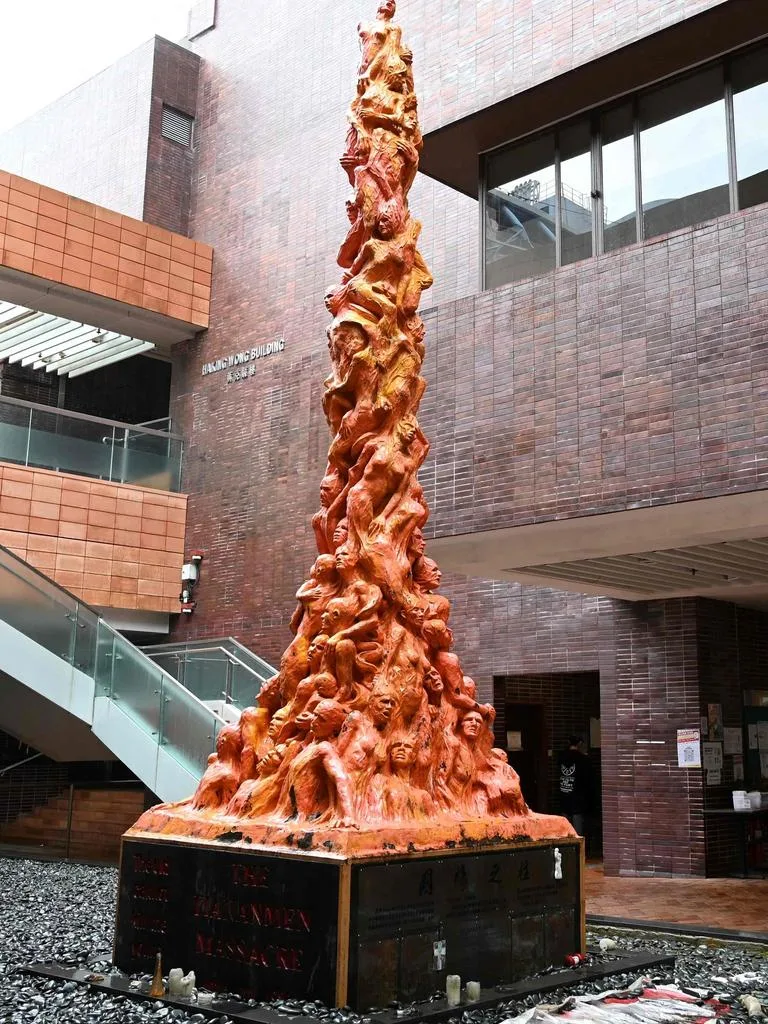
8-metre “Pillar of Shame” commemorates the victims of the Chinese Communist Party’s brutal crackdown on the 1989 Tiananmen Square protests. The statue at the University of Hong Kong depicts a mass of torn and twisted bodies piled together. It was installed in Hong Kong in 1997 during an annual candlelight vigil to remember the massacre. Until 2019, large outdoor vigils were held every year on the anniversary. However, Hong Kong authorities, under pressure from Beijing, have banned these vigils in recent years, citing various excuses, and removed the statue.
What Happened Next?
After the Tiananmen Square crackdown in 1989, China tightened its control over society and politics. The government increased censorship, surveillance, and restrictions on free speech, making it difficult for people to openly criticize the Communist Party. Political protests and opposition were not tolerated, and many activists faced arrests or other forms of punishment. Critics argue that the crackdown marked a turning point that reduced hopes for democratic reforms in China and strengthened the country’s one-party system. Since then, the Communist Party has continued to maintain strict control over public life, education, media, and political expression.
Legacy of Communist Atrocities
The Tiananmen Square protests and massacre put the Chinese Communist Party in an ideological and political crisis. The Communist Party was torn between democratic reform and absolute political control of the Chinese state, and ultimately opted for the latter.
- Red Terror (1918–1922) – Suppression of millions of opponents after the Bolshevik Revolution under Lenin which witnessed mass executions (tens of thousands to hundreds of thousands), arrests, and suppression of opponents
- Great Terror (1936–1938) – Stalin’s Great Purge, which caused an estimated 20 million deaths
- Great Leap Forward (1958–1962) – Mao Zedong’s Great Leap Forward and Cultural Revolution, which led to the deaths of tens of millions of Chinese people
Establishment of Communist Rule in China
After Mao Zedong’s death in 1976, Deng Xiaoping introduced economic reforms that opened China to foreign investment and market-oriented policies, helping revive the economy. While these reforms improved living standards and accelerated growth, the Communist Party retained strict control over politics, media, and public life.
At the same time, corruption, inflation, and social inequalities grew, leading to increasing public discontent. Exposure to ideas such as democracy, human rights, and political freedom further highlighted the gap between China’s economic progress and its tightly controlled political system. The death of reform-minded leader Hu Yaobang in April 1989 became the spark that triggered massive pro-democracy protests across Beijing and other Chinese cities.