
One-Dish Weddings, Billion-Dollar Tanks: Why Pakistan Curbs Citizens While Selling Defence to Gulf & Sponsoring Terror
October 9, 2026
  • Read Ecopy
  • Circulation
  • Advertise
  • Careers
  • About Us
  • Contact Us
Android AppiPhone AppArattai
Organiser
  • ‌
  • Bharat
    • Assam
    • Bihar
    • Chhattisgarh
    • Jharkhand
    • Maharashtra
    • View All States
  • World
    • Asia
    • Europe
    • North America
    • South America
    • Africa
    • Australia
  • Editorial
  • International
  • Opinion
  • RSS @ 100
  • More
    • World Hindu Congress 2026
    • Op Sindoor
    • Analysis
    • Sports
    • Defence
    • Politics
    • Business
    • Economy
    • Culture
    • Special Report
    • Sci & Tech
    • Entertainment
    • G20
    • Azadi Ka Amrit Mahotsav
    • Vocal4Local
    • Web Stories
    • Education
    • Employment
    • Books
    • Interviews
    • Travel
    • Law
    • Health
    • Obituary
  • Subscribe
    • Subscribe Print Edition
    • Subscribe Ecopy
    • Read Ecopy
  • ‌
  • Bharat
    • Assam
    • Bihar
    • Chhattisgarh
    • Jharkhand
    • Maharashtra
    • View All States
  • World
    • Asia
    • Europe
    • North America
    • South America
    • Africa
    • Australia
  • Editorial
  • International
  • Opinion
  • RSS @ 100
  • More
    • World Hindu Congress 2026
    • Op Sindoor
    • Analysis
    • Sports
    • Defence
    • Politics
    • Business
    • Economy
    • Culture
    • Special Report
    • Sci & Tech
    • Entertainment
    • G20
    • Azadi Ka Amrit Mahotsav
    • Vocal4Local
    • Web Stories
    • Education
    • Employment
    • Books
    • Interviews
    • Travel
    • Law
    • Health
    • Obituary
  • Subscribe
    • Subscribe Print Edition
    • Subscribe Ecopy
    • Read Ecopy
Organiser
  • Home
  • Bharat
  • World
  • Operation Sindoor
  • Editorial
  • Analysis
  • Opinion
  • Culture
  • Defence
  • International Edition
  • RSS @ 100
  • Magazine
  • Read Ecopy
Home World

One-Dish Weddings, Billion-Dollar Tanks: Why Pakistan Curbs Citizens While Selling Defence to Gulf & Sponsoring Terror

Citizens get a "one-dish" cap at weddings, early market shutdowns, and relentless fuel cuts. Meanwhile, the military establishment commands record trillion-rupee budgets and billion-dollar hardware. Can a state survive when its people are forced to finance geopolitical grandstanding through domestic starvation?

Lakshmi RanjithLakshmi Ranjith
Sep 18, 2026, 09:00 pm IST
inWorld, Analysis, Asia, International Edition
Follow on Google News
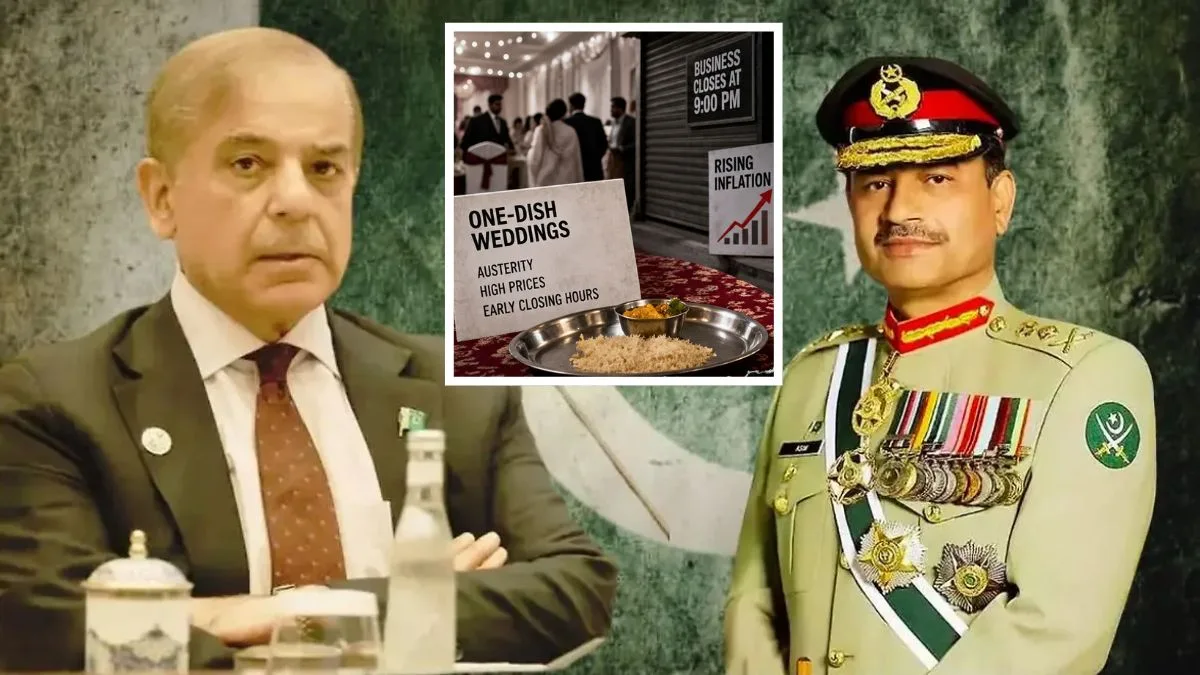
One-Dish Weddings, Billion-Dollar Tanks: Why Pakistan Rations Citizens While Selling Defence to Gulf| Austerity Paradox

Prime Minister Shehbaz Sharif and Field Marshal Asim Munir

Facebook
Twitter
WhatsAppTelegramEmail

Islamabad quietly pulled the plug on its own comforts this week. A Cabinet Division order that went into effect Thursday slashed fuel for government vehicles by half, froze any new purchases of official cars, and grounded ministers and bureaucrats from foreign travel for the next three months — economy class only, if a trip absolutely can’t be skipped. No more official dinners unless a foreign delegation is in town. No government-funded conferences or training junkets either. Bureaucrats face a 50% fuel cut, office equipment procurements are frozen, even markets and restaurants have been told to pull their shutters down earlier to save on fuel. Provincial governments have been nudged to follow suit. These come amid high fuel prices linked to Middle East disruptions and ongoing fiscal pressures.

Officials are blaming the world for this one — another flare-up in the Middle East has sent oil prices climbing again, and Pakistan, which imports most of what it burns, doesn’t have much room to absorb that. It’s not even the first time this year: a nearly identical round of austerity was imposed back in March, lifted in June once a US-Iran deal calmed prices, and now it’s back because the calm didn’t hold. Public austerity has become a recurring policy tool for Pakistan

When a state codifies economic survival by legally restricting its citizens’ wedding celebrations to a single dish, shuttering markets at 9:00 PM, and slashing civilian fuel by half, it confesses to absolute fiscal exhaustion. However, while ordinary Pakistanis absorb punishing inflation and state-enforced commercial curfews to conserve dollars, Rawalpindi continues to market billion-dollar hardware, combat troops, and mutual defense umbrellas to wealthy Gulf monarchies.

This jarring contrast exposes the regime’s defining transaction. Pakistan is not asserting geopolitical power abroad from a foundation of domestic strength; it is running an international security concession. By starving internal governance and policing banquet buffets, the ruling elite preserves its military export value, trading combat readiness for the Gulf bailouts, central bank deposits, and deferred-oil credit facilities required to keep an insolvent state afloat.

Pakistan Defence Budget 2026-27 Crosses Rs 3 Trillion, Procurement Spending Jumps 40%

At the same time of this austerity layers, we have to note that, the defense allocation for FY 2026-27 was raised to roughly Rs 3 trillion—an increase of about 17.6–18% over the prior year’s ~Rs 2.55 trillion (itself up ~20% the year before). This is the first time it has crossed the Rs 3 trillion mark; it represents ~16% of the federal budget outlay and a bit over 2% of projected GDP. While officials cited security concerns, the move also appears aimed at strengthening Pakistan’s ability to support its oil-rich allies when they face security or regional challenges. Military pensions are budgeted separately.

Pakistan remains under an IMF program that requires fiscal discipline, revenue measures, and subsidy adjustments. These have contributed to price increases (including fuel) that ordinary citizens feel. Federal development spending has been kept relatively constrained (around Rs 1 trillion in the same budget) while defense and debt servicing take large shares. So the contrast the statement highlights—public/civilian austerity measures alongside rising and protected defense outlays—is grounded in the actual numbers and policy choices.

1, Bigger Question: Where Does Pakistan’s Military Spending Go Amid Persistent Terrorism?

The increase in Pakistan’s defence budget, along with the exemption of the military from several austerity measures, has been officially justified by security concerns along the Afghan border and persistent militant violence inside Pakistan. At the same time, Pakistan’s security forces have been engaged in operations against the Balochistan Liberation Army (BLA), while critics and Baloch activists accuse the state of using force to suppress the political voice of the Baloch people.

At the same time, Pakistan is also engaged in terror activities and also faces threats from groups such as the Tehrik-e-Taliban Pakistan (TTP), meaning that the country’s security apparatus is building militants with the help of army. But there is another side to this security equation.

For years, international assessments have documented the presence and activity of Pakistan-based groups targeting India, including Lashkar-e-Toiba and Jaish-e-Mohammed. The US State Department has previously reported that such groups operated from Pakistani territory and that Pakistan had struggled to dismantle all terrorist organisations without discrimination. India has consequently maintained that elements of Pakistan’s security establishment have supported or enabled anti-India terrorist networks — an allegation Pakistan rejects.

The important question, therefore, is not simply how much Pakistan spends on defence, but what strategic purpose that enormous allocation serves. The country says that it is confronting militant violence internally, while critics allege that its military establishment has also been used to sow terror against its enemy country while maintaining a large military establishment and facing persistent allegations over the activities of anti-India terror networks operating from its territory.

2, Pakistan’s Global Power Image Meets Its Domestic Financial Reality

For anyone inclined to view Pakistan’s foreign posturing skeptically, there’s an obvious punchline sitting right there. This is a country that has, at various points, offered to send troops to defend Saudi Arabia, talked up its “brotherly” defense ties with Turkey, and generally likes to present itself as a serious regional security player. And yet its own ministers currently can’t get a government car filled up all the way or a plane ticket abroad approved. Buying oil from overseas, also exposed to the same Middle East volatility — which hasn’t had to send its cabinet home early or ration its own diplomats to keep the country running. The gap between the image Pakistan projects abroad and what it can actually afford at home is, to put it mildly, striking.

Strategic Mirage: Projecting Strength on Rationed Fuel

Pakistan’s civilian administrative machinery is subjected to a 50% fuel slash, a ban on vehicle procurement, and early commercial curfews to conserve imported energy.

In contrary, offering expeditionary military assistance or mutual defense pacts to wealthy powers like Saudi Arabia and Turkey requires vast, fuel-heavy logistics, sustained supply chains, and high-readiness deployment fleets. Pledging to back foreign allies while rationing banquet plates and civil servants’ fuel exposes an unsustainable gap between domestic capacity and external commitments.

Ground Reality: Pakistan’s Military Ties Meet Its Economic Crisis

Pledging military assistance to Riyadh or Ankara is not charity; it is a financial survival tactic. Facing severe foreign exchange crunches and mandatory budget reductions, the military establishment offers troop commitments, tactical training, and air defense cooperation in exchange for oil credit facilities, central bank deposit rollovers, and direct financial bailouts.

This dynamic explains why Clause (i) of the gazette notification explicitly protects the operational vehicles of the Armed Forces from fuel rationing. The military’s operational mobility is preserved precisely because it functions as the regime’s primary geopolitical export and leverage tool.

The Burden Mismatch: Citizens Pay the Geopolitical Bill

While ordinary citizens are forced to accept single-dish wedding caps, commercial curfews at 9:00 PM, and spiraling inflation, federal resources continue to subsidize high-readiness expeditionary postures. A country that requires a gazette notification to ban buying office furniture and enforce economy-class commercial flights for ministers cannot credibly underwrite the national security of oil-rich kingdoms or NATO members. The military pledges regional security umbrella roles abroad while the home front experiences administrative paralysis.


Topics: Pakistan TerrorismPakistan PM PM Shehbaz SharifGeneral Asim Munir
Lakshmi Ranjith
Lakshmi Ranjith
A digital journalist with over 18 years of experience in mainstream media, she began her career in television news before expanding into print, social media, and digital platforms. She has travelled extensively across India to cover elections, political developments, and major business events, reporting on issues ranging from politics and governance to business and social affairs. Her key strengths include sharp analysis of national and state politics, as well as international relations. Over the years, she has worked with The Times of India, Google, News24 Digital, MMTV, TV News, and the Ministry of Information & Broadcasting. She currently serves as Assistant News Editor at Organiser, overseeing digital platforms. She is Committed to continuous learning; she maintains high editorial standards and a strong commitment to ethical journalism in a rapidly evolving media landscape. [Read more]
Share
Tweet
SendShareSend
✮ Subscribe Organiser YouTube Channel. ✮
✮ Join Organiser's WhatsApp channel for Nationalist views beyond the news. ✮
Previous News

Hyderabad NIA Court sentences 9, including 8 Bangladeshis, to life imprisonment in human trafficking case

Next News

HAL hands over LCA Tejas Trainer & HTT-40 to IAF; Reflects India’s indigenous airpower & military capabilities

Related News

LeT’s Imran Liaquat Bhatti rattles off threats against India, claims Kashmir, Gujarat, Hyderabad & Northeast will be liberated

LeT terrorist Imran Liaquat threatens India, says ‘Delhi will be made a bride’ and Pakistani flag will fly over Mumbai

POJK Burns (This is an AI generated image)

POJK Boils Over: Rs 1 crore bounty on JAAC leaders as anti-government protests intensify

The Global Terrorism Index 2026 puts the claim, “Terrorism has no religion?”, to the test and reveals stark global terror patterns

Terror Has No Religion? 2026 global indices challenge the claim, exposing patterns in Islamist violence worldwide

A representative image

Operation Sindoor Impact: Indians cancel holidays to Pakistan’s allies Turkey and Azerbaijan; Travel drops 70%

Defence Minister Rajnath Singh(File Photo)

Rajnath Singh slams the ‘dump truck’ analogy of Asim Munir as ‘confession of failure’, rebukes nuclear threat

Field Marshall Asim Munir

Renewed Nuclear Blackmail by Pakistan: Existential crisis for a failed General

Load More

Latest News

Union Minister Sarbananda Sonowal meets Saudi Arabia’s Suliman Almazroua (left), Belgium’s Annick De Ridder (centre) and Bhutan’s Lyonpo Chandra Bahadur Gurung in New Delhi. Photo: X/@sarbanandsonwal

Sagarmanthan 2026: India becomes 2nd largest global seafarer hub, boosts ties with Saudi Arabia, Belgium and Bhutan

PM Modi calls for free, open and rule-based global maritime order for peace and progress

Sagarmanthan 2026: India seeks free, open, secure, rules-based maritime order: PM Modi

Pakistan Denies NYT Report on PAF Jet Deployment Against Houthis in Saudi Arabia

Pakistan debunks NYT Report on PAF Jets used against Houthis attacking Saudi Arabia amid Makkah Defence Pact

West Bengal SIR Data Questions TMC Manipulation Claims

TMC’s ‘Vote Chori’ charge fails SIR data test: Five highest-deletion seats won by Trinamool, five lowest by BJP

Beyond Ram Mandir: Ashok Singhal’s vision with five aspects for Ayodhya

India to Clamp Down on Deepfakes: Centre to roll out AI regulatory framework within a month

The SIR controversy has raised questions over street pressure on constitutional institutions and judicial decision-making

Democracy or Mobocracy: Can street pressure influence constitutional institutions and judicial outcomes in India?

Swami Vigyananand, Joint General Secretary of Vishwa Hindu Parishad(VHP) and Initiator of the World Hindu Congress(WHC)

World Hindu Congress 2026: 60 countries, 4000 delegates & Hindu Expo; Hindu leaders unite for civilisational resurgence

Ajin, a CPM councillor in the Tiruvananthapuram Municipal Corporation (File Photo)

Keralam govt orders vigilance probe against Tiruvananthapuram CPM councillor Ajin over Rs 10 lakh bribe demand video

The banking community realised that UFBU was using bank workers as fodder and collateral damage in this process. Hence, most workers had already abandoned the strike calls

Bank Strike: When the call is louder than the support

Load More
  • Privacy
  • Terms
  • Cookie Policy
  • Refund and Cancellation
  • Delivery and Shipping

© Bharat Prakashan (Delhi) Limited.
Tech-enabled by Ananthapuri Technologies

  • Home
  • Search Organiser
  • Bharat
    • Assam
    • Bihar
    • Chhattisgarh
    • Jharkhand
    • Maharashtra
    • View All States
  • World
    • Asia
    • Africa
    • North America
    • South America
    • Europe
    • Australia
  • Editorial
  • Operation Sindoor
  • Opinion
  • Analysis
  • Defence
  • Culture
  • Sports
  • Business
  • RSS @ 100
  • Entertainment
  • More ..
    • Sci & Tech
    • Vocal4Local
    • Special Report
    • Education
    • Employment
    • Books
    • Interviews
    • Travel
    • Health
    • Politics
    • Law
    • Economy
    • Obituary
  • Subscribe Magazine
  • Read Ecopy
  • Advertise
  • Circulation
  • Careers
  • About Us
  • Contact Us
  • Policies & Terms
    • Privacy Policy
    • Cookie Policy
    • Refund and Cancellation
    • Terms of Use

© Bharat Prakashan (Delhi) Limited.
Tech-enabled by Ananthapuri Technologies