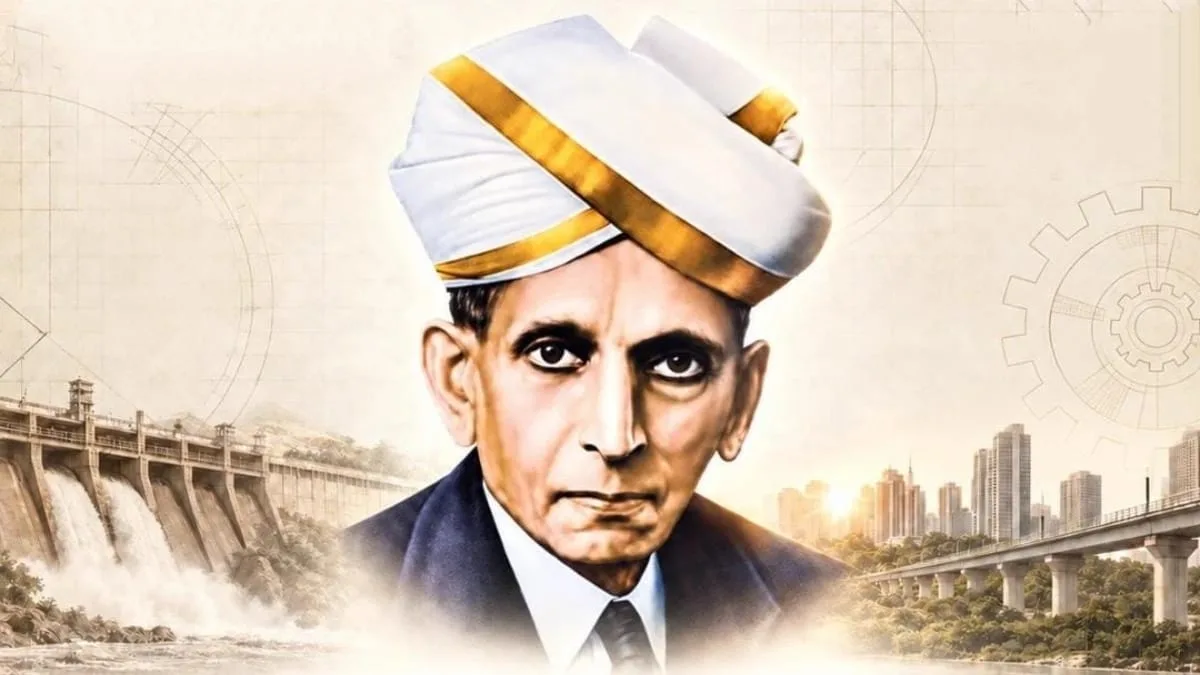
NEW DELHI: India celebrates Engineers Day on September 15 every year to honour the birth anniversary of Bharat Ratna Mokshagundam Visvesvaraya, one of the country’s most distinguished engineers and statesmen. His pioneering contributions to engineering, water management and nation-building continue to inspire generations of engineers.
Happy Engineers Day!
India honours the legacy of Bharat Ratna Sir M. Visvesvaraya, whose pioneering work continues to benefit millions.
From the Krishnaraja Sagar Dam to the Chenab Bridge, Atal Tunnel, Statue of Unity and New Pamban Bridge, India’s engineers continue to push… pic.twitter.com/XQWa28G46c
— DD News (@DDNewslive) September 15, 2026
Born in 1861, M. Visvesvaraya played a significant role in developing irrigation and water-supply systems. His work demonstrated how engineering could be used to address practical challenges and contribute to economic and social development. The Krishnaraja Sagar (KRS) Dam in Karnataka remains among the projects associated with his engineering legacy.
From Visvesvaraya to modern engineering marvels
More than a century after Visvesvaraya’s pioneering work, Indian engineers continue to undertake projects that demonstrate the country’s growing technological and infrastructure capabilities.
The Chenab Bridge in Jammu and Kashmir stands as one of the most remarkable examples of modern Indian engineering. Built over the Chenab River, the railway bridge is the world’s highest railway arch bridge and forms an important part of the rail connectivity network in the region.
The Atal Tunnel in Himachal Pradesh is another major engineering achievement. Constructed beneath the Rohtang Pass, the tunnel provides all-weather connectivity between Manali and the Lahaul-Spiti region while significantly reducing travel time.
Similarly, the Statue of Unity in Gujarat demonstrates the scale and precision involved in modern structural engineering. Standing at 182 metres, it is the world’s tallest statue and has become a prominent landmark.
The New Pamban Bridge in Tamil Nadu represents another significant milestone in India’s infrastructure development. Built as a modern rail link across the Palk Strait, the bridge incorporates advanced engineering features and is designed to improve connectivity to Rameswaram.
Engineering for a changing India
India’s engineering journey is no longer limited to traditional infrastructure. Engineers are increasingly working across fields such as space technology, renewable energy, artificial intelligence, semiconductor manufacturing, defence technology, transportation and sustainable infrastructure.
These developments reflect the changing role of engineering in a rapidly evolving country. Engineers today are expected not only to design and construct but also to find solutions that are efficient, sustainable, resilient and suited to India’s diverse needs.
Learning, adapting and building for the future
Engineers Day is therefore more than a celebration of past achievements. It is an opportunity to recognise the people who transform ideas into practical solutions and contribute to the country’s development.
The legacy of M. Visvesvaraya continues to underline an important principle: engineering must ultimately serve society. As India expands its infrastructure and technological capabilities, the focus must remain on continuous learning, adapting to new challenges and building solutions for the future. From dams and bridges to tunnels, railways and emerging technologies, India’s engineering story reflects a long journey of innovation and the engineers of today are shaping the next chapter.