NEW DELHI: For decades, the dark heaps standing outside Indian steel plants were a liability; they swallow the land, raise dust, and quietly degrade water and soil without adding a rupee earned. On September 12, 2026, one such heap collected a Guinness World Record.
At a ceremony in New Delhi, Union Minister of State (Independent Charge) for Science and Technology and Earth Sciences, Dr Jitendra Singh, said Steel Slag Road Technology can reduce road construction costs by around 40 per cent while delivering four times the strength of conventional roads, with major maintenance required only after roughly fifteen years in suitable applications.
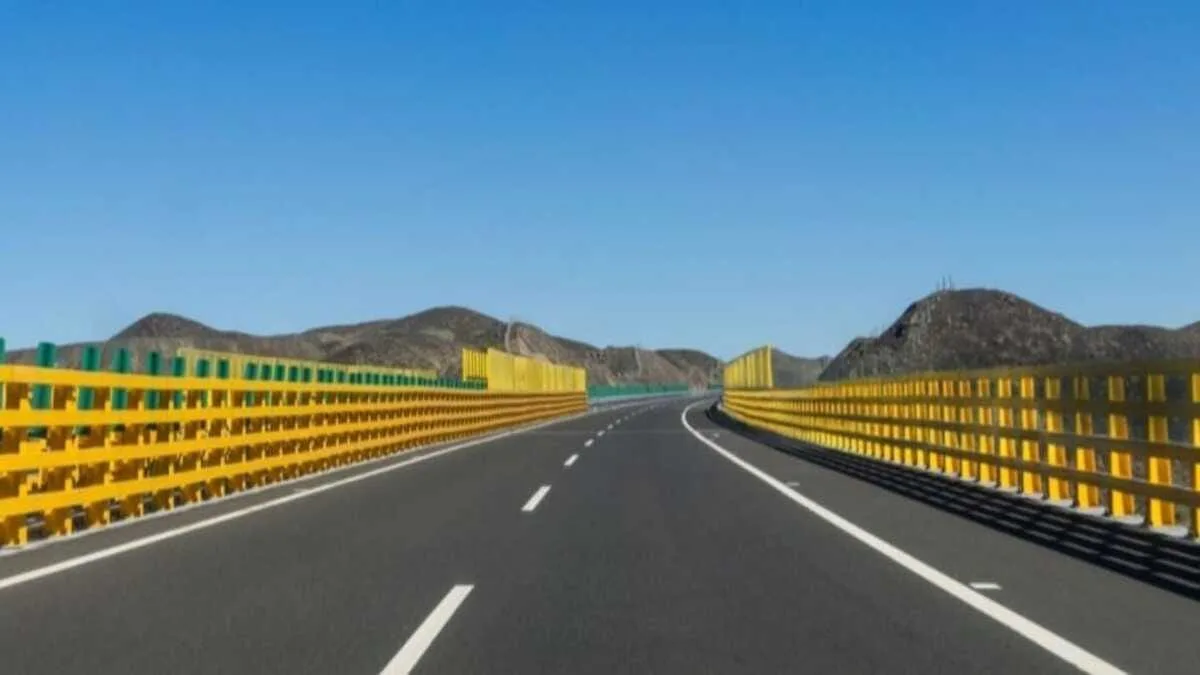
The Guinness World Record for the World’s Longest Road Built with Processed Steel Slag Aggregates, a 1.85-km four-lane divided stretch at Raigarh, Chhattisgarh, developed jointly by CSIR-Central Road Research Institute (CSIR-CRRI), New Delhi and Jindal Steel Limited. The road consumed approximately 200,000 tonnes of processed electric arc furnace slag and is engineered for a design traffic of 65 million standard axle repetitions.
The same event also mentions a technology transfer agreement signed between CSIR-CRRI and Jindal Steel, the launch of the “Steel Grit” brand, the virtual inauguration of the road and the release of a scientific documentary. The Minister repeated what the Prime Minister has used repeatedly: this is Waste to Wealth, executed in bitumen and stone.
What a steel slag road actually is
Slag is not steel; it is the non-metallic residue skimmed off when iron ore or scrap is converted into steel, a fused mass of calcium, silicon, magnesium and iron oxides that separates from the molten metal and is tipped out as waste.
Raw slag cannot simply be shovelled onto a road bed. It carries free lime and free magnesia, which swell on contact with moisture and can heave a pavement apart. It holds entrapped metallic iron. Its structure is vesicular, and there are legitimate questions about pH and heavy-metal leaching.
The CSIR-CRRI contribution is precisely the treatment that neutralises these problems. Slag is put through controlled ageing and stabilisation so that expansive compounds react and settle before the material ever reaches a road. Entrapped metal is recovered and returned to the plant. The residue is crushed, screened, graded and subjected to physical, mechanical, geotechnical and environmental testing before use.
Slag particles are angular and dense; they interlock rather than roll against one another the way rounded river stone does. That yields higher stiffness, better skid resistance and greater load-bearing capacity, with the engineering basis for the durability claims now being made.
The proof trail from Surat to Raigarh
India’s first 100 per cent steel slag road was built at Hazira, Surat, connecting the industrial estate to Hazira Port, using about one lakh tonnes of processed aggregate across every pavement layer. It was designed for 100 million standard axle repetitions over a twenty-year life and has carried 1,000 to 1,200 commercial vehicles a day hauling 30 to 40 tonnes each, while being built roughly a third thinner than a conventional bituminous road of comparable duty.
From there, the technology moved to the national highway network, with approximately 80,000 tonnes of processed slag used on a one-kilometre, four-lane section of the NH-66 Mumbai–Goa corridor. A 1.1-km road inside Hazira Port now links the multi-purpose berth to the coal yard, proving the material in one of the harshest logistics environments available. Heavy-duty applications have been executed in Arunachal Pradesh, including in the strategic border belt.
And the record is already being overtaken. Dr N. Kalaiselvi, Secretary, DSIR and Director General, CSIR, had announced that CSIR-CRRI has received a work order for a 40-km road in Odisha from Jindal Steel’s Angul plant, a twenty-fold jump from the stretch that won the title, arriving as CSIR approaches its 85th year.
The saving is not a discount on materials. It is a saving on geometry. Because slag aggregate is stiffer and stronger, engineers can design a thinner pavement for the same traffic load. The Hazira road was built with roughly 32 per cent less thickness than a conventional equivalent; the Raigarh pavement is about 35 per cent thinner. Every millimetre removed is granular sub-base, base course and bituminous mix that never has to be bought or laid.
Three further economies compound it: the raw material sits at the plant gate rather than at a quarry sixty kilometres away, so haulage collapses. The steel producer converts a disposal cost into a saleable product, turning a standing disposal liability into a revenue line. And a pavement that needs major intervention only around year fifteen shifts a recurring maintenance burden off state budgets.
It is worth noting, for accuracy, that the figure has moved. In 2022, CSIR-CRRI scientists put the Surat saving at about 30 per cent. The 40 per cent now cited reflects a larger, four-lane project with an integrated mine-to-metal supply chain.
The resource question India has not asked in the last government
India maintains the world’s second-largest road network, and feeding it takes roughly 1.2 billion tonnes of natural aggregate every year for construction and maintenance. That demand is met by quarrying and mining hillsides, riverbeds and forest margins, with consequences for topography, hydrology and biodiversity that rarely appear in a project cost sheet.
India, the world’s second-largest steel producer, generates around 19 million tonnes of steel slag annually. With the national target of 300 million tonnes of steel capacity by 2030, slag generation is projected to reach 60 million tonnes a year.
Two problems, one solution. The Raigarh road alone has substituted 100 per cent of its natural aggregate requirement, sparing roughly 200,000 tonnes of virgin stone from extraction. Multiply that logic across 60 million tonnes and the arithmetic of Indian infrastructure changes character: the country stops mining new hills to build roads and starts building them from what it has already dug up once.
This is what a circular economy looks like when it stops being a conference theme. As the Isha Upanishad counsels, the earth is to be used with restraint, not grasped at a principle Indian civilisation articulated long before “sustainability” acquired a carbon accounting framework.
Monsoon, mountains and the strategic frontier
Dr Jitendra Singh drew on his seven-year association with the Northeast to make a point that maps do not show. In high-rainfall regions, the construction window is often only four or five months; stretches laid in one season can fail before the next cycle begins. A stronger, thinner, faster-setting pavement is not a marginal improvement there; it is the difference between a road that survives and one that must be rebuilt annually.
The same logic holds for rural roads whose traffic profile has outgrown their design. A village link built for tractors and two-wheelers now carries loaded trucks as the surrounding belt industrialises. Slag pavements meet that upgraded duty without a full reconstruction.
And in border infrastructure, the Arunachal deployments are the template: durability under load in difficult terrain is a matter of strategic capability, not only a civil engineering marvel.
From one project to many States
The Minister’s instruction was unambiguous: move “from one project to many projects, from one State to many States.” Road building is not the preserve of the Ministry of Road Transport and Highways. The Railways build heavy-duty infrastructure. So do ports, defence agencies, state PWDs, municipal bodies, private builders and industrial estate operators. Each is a potential adopter, and each needs engineers who know the material exists and know how to specify it.
The enabling framework is in place. CSIR-CRRI processing protocols, scientific guidelines and quality-control regime give implementing agencies a defensible basis for adoption, and the technology transfer route is now commercially live. What remains is awareness among the inter-ministerial, inter-State and down to the district engineer writing the tender.
There are conditions worth stating plainly. Slag roads make economic sense where the plant and the project are within sensible haulage distance. Ageing and stabilisation must be done properly, every time, or the expansion problem returns. Leachate testing cannot become a formality. Long-term instrumented monitoring of existing stretches should continue and be published.
Those are the terms of responsible scale-up, not arguments against it. What Raigarh demonstrates is that India is no longer merely inventing indigenous technology; it is taking indigenous technology to scale. A by-product became an aggregate, an aggregate became a road, and a road became a world record. The next milestone is 40 kilometres in Odisha. The one after that should be a national norm.