A Dindori Sessions Court in Madhya Pradesh convicted seven people in a case arising from a religious-conversion gathering at the house of Suday Singh Maravi in Pipariya village on April 27, 2024. The court found that the accused had gathered to promote Christianity, attempted to persuade people to leave Hindu dharma by offering money and relief from poverty and suffering, and made statements insulting Hindu religious beliefs and deities.
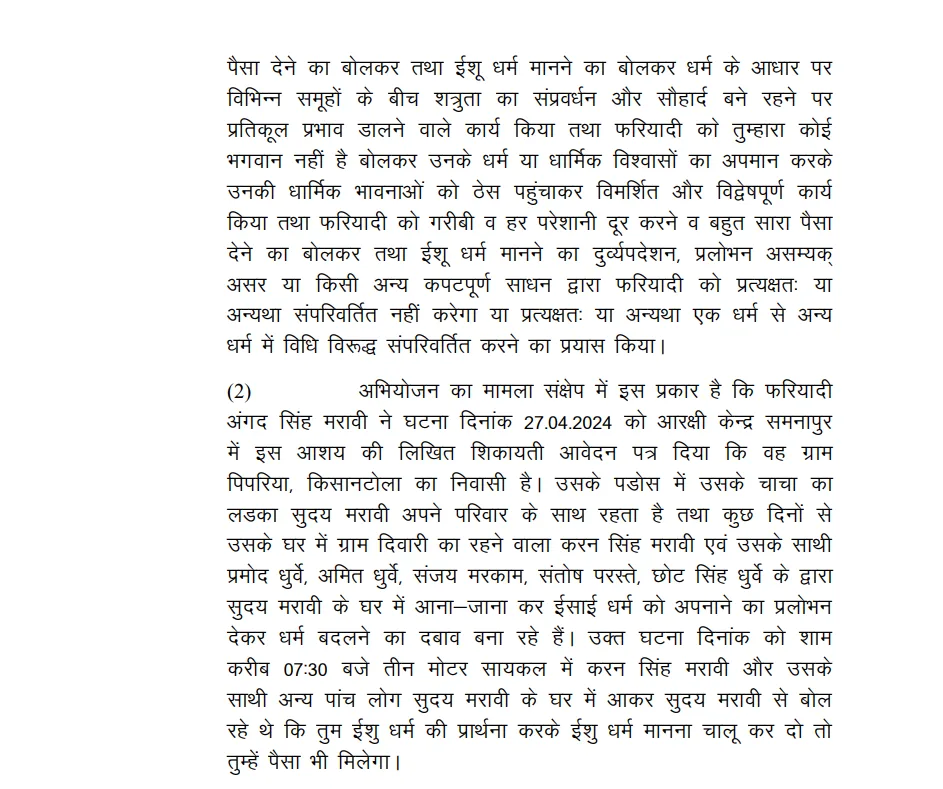
The seven accused are Santosh Paraste, Sanjay Markam, Amit Kumar, Pramod, Karan Singh Maravi, Chhot Singh Dhurve and Jeet Singh. The first six are residents of Diwari village, while Jeet Singh is from Pipariya.
The Second Additional Sessions Judge, Dindori, Shiv Kumar Kaushal, announced judgement in the case on June 12, 2026.
The case had initially been registered as FIR No. 210/2024 at Samanapur police station under Section 153A read with Section 34 of the IPC, Section 295A read with Section 34 of the IPC, and Sections 3 and 5 of the Madhya Pradesh Freedom of Religion Act, 2021. The court ultimately convicted all seven accused under these provisions.
How the case began
The case was registered after Angad Singh Maravi submitted a written complaint concerning activities taking place at the house of his uncle’s son, Suday Maravi, in Pipariya. For several days before April 27, 2024, Karan Singh Maravi and the other accused had been visiting Suday’s house and attempting to persuade him to adopt Christianity.
The accused told Suday that he should start praying to Jesus and accept Christianity because he would receive money and his poverty and difficulties would disappear. The accused threatened that if he did not accept Christianity, they would create so much trouble that he would eventually have to join them.
The gathering on April 27 became the immediate basis of the criminal case. Angad Singh Maravi said he learned that the accused were conducting Christian religious activity inside the house and went there with his father, uncle and another relative. When they objected to the activity, he said the accused continued with it, following which the village sarpanch and other people were called to the spot.
The gathering was not simply a prayer meeting but an attempt to persuade people to abandon Hindu dharma.
The witnesses told the court that the accused were saying that Christianity was the best religion, that those who followed it were the largest or happiest group, and that accepting Christianity would protect people from disease and suffering.
The accused told the people present that Hindu dharma was inferior and that they should throw out their Hindu gods, stop their puja and accept Jesus instead.
The money, poverty and “relief from suffering”
The prosecution repeatedly referred to promises that people would receive money, become free from poverty and see their troubles disappear if they accepted Christianity.
One of the witnesses described the accused as telling Suday to join Christianity because he would get money and his poverty and problems would end. The same evidence included a threat that those refusing to accept Christianity would eventually be forced to do so.
What happened inside Suday Maravi’s house
Witnesses said the accused were inside the house conducting Christian religious activity. When objections were raised, the door was closed from inside. Suday’s wife, Kaushalya, called the police through the emergency number 100. Police arrived and opened the door before taking the people inside to Samanapur police station.
The court observed that even if the defence version that a birthday celebration was taking place were accepted, the evidence of several witnesses still consistently established that the accused were promoting Christianity, offering inducements and insulting Hindu religion at the spot.
The allegation involving Hindu idols and a place of worship
Angad Singh Maravi testified that before the case was registered, murtis of Hindu deities and other puja material at the family’s place of worship had been thrown away. He also said that his uncle had told him that the accused had urinated at the family’s worship place.
The accused had allegedly thrown away idols and other worship material and urinated at the worship place. This allegation formed part of the evidence the court considered while examining the charge under Section 295A, which deals with deliberate and malicious acts intended to outrage religious feelings.
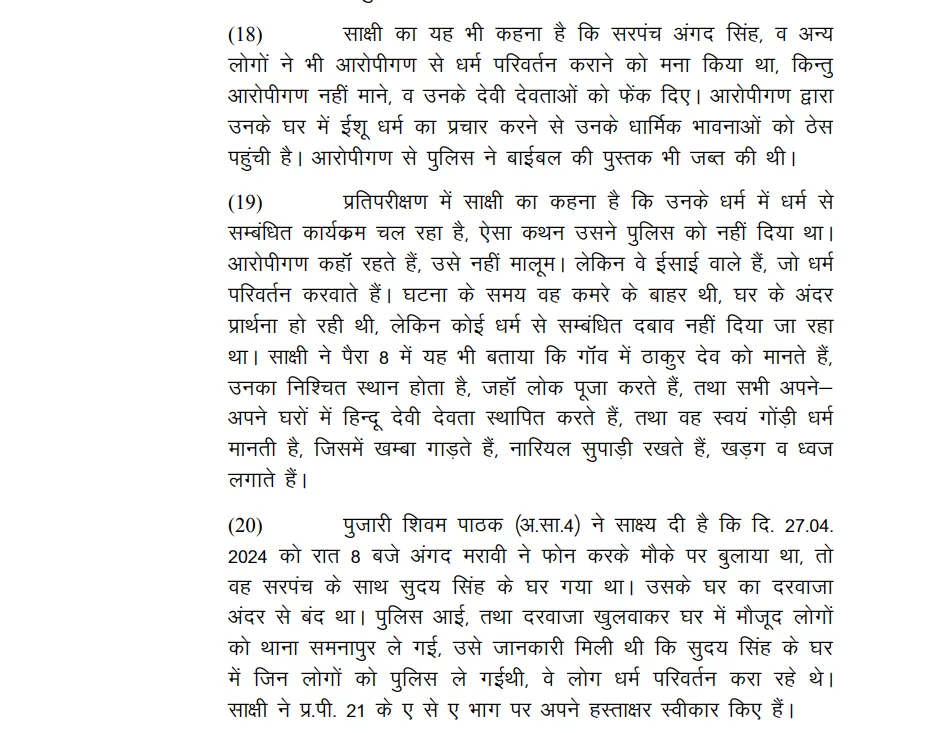
The court therefore did not view the incident simply as competing religious preaching. It treated the alleged conduct toward the Hindu place of worship and the statements made about Hindu gods as part of a larger course of conduct that had the potential to hurt religious sentiments and create hostility between communities.
What the police seized
The case record lists a written complaint, the FIR, a spot map, seizure documents, arrest documents and statements recorded during the investigation. Police seized Christian religious books, several mobile phones, a notebook, a diary and other material.
The judgment specifically records a book produced by accused Pramod Dhurve which contained writing describing his house as a place of prayer for people of all castes. Other material was seized from Pramod, Amit Kumar, Sanjay Markam and Santosh Paraste.
The police also seized mobile phones from the accused. The court records that the seized articles were produced before it and marked as exhibits. The investigation officer testified about the seizures and the documents prepared during the investigation.
What the court said about the law
The judgment separately examined the three main legal questions together because they arose from the same incident.
The first concerned whether the accused had, acting together, attempted to induce conversion to Christianity by offering money, promising relief from poverty and suffering and using other prohibited means. The second concerned whether they had insulted Hindu religion and religious beliefs. The third concerned whether they had attempted unlawful conversion through inducement, undue influence, threat or other prohibited means under the Madhya Pradesh Freedom of Religion Act.
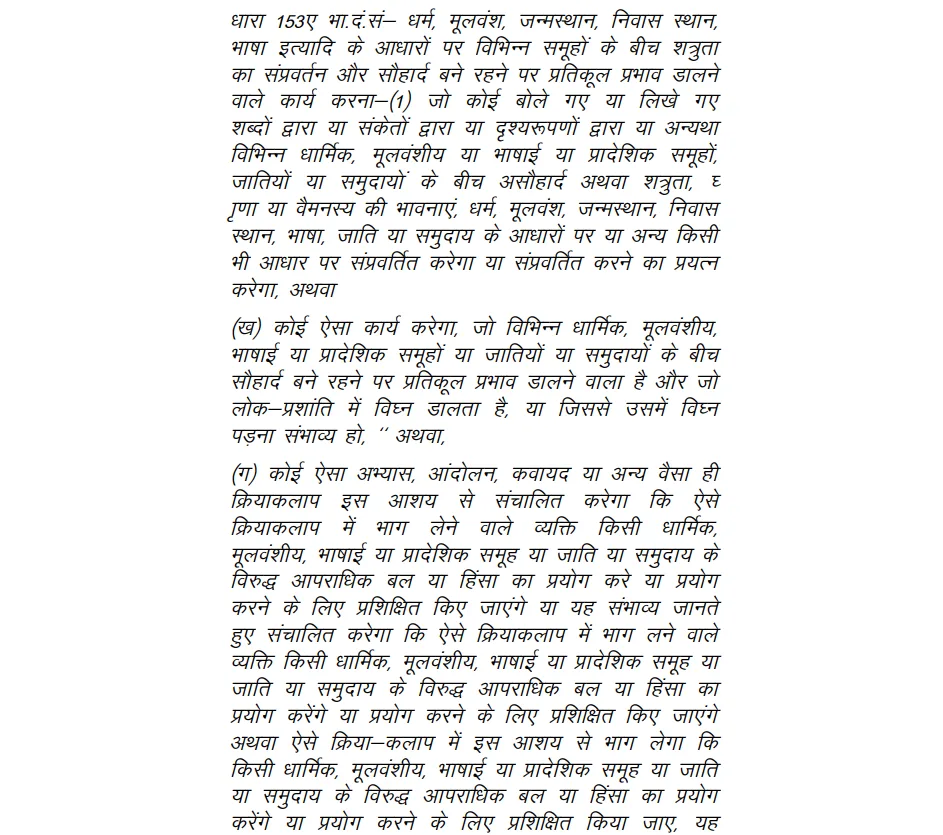
The court reproduced the relevant portion of Section 153A of the IPC dealing with promoting enmity between different groups on grounds including religion and acts prejudicial to maintenance of harmony. It also referred to conduct that could adversely affect public tranquillity.
It then reproduced Section 295A, which covers deliberate and malicious acts intended to outrage the religious feelings of a class by insulting its religion or religious beliefs through words, written material, signs, visible representations or other means.
Most importantly for this case, the judge examined Section 3 of the Madhya Pradesh Freedom of Religion Act, 2021. The judgment explains that the provision prohibits conversion from one religion to another through misrepresentation, force, undue influence, coercion, allurement, fraudulent means, marriage or other prohibited means, and also prohibits attempts, abetment and conspiracy relating to such conversion.
The court’s final finding on the conduct
The judge concluded that the prosecution evidence, documentary evidence, seized material and statements made during the investigation established that all seven accused were present at Suday’s house at about 8 pm on April 27, 2024.
The judgment records the court’s finding that they told Suday and others that Christianity was superior, that Hinduism and Hindu gods were of no use, and that people should throw their Hindu gods out and stop performing puja.
It found that the accused told people that accepting Jesus would remove their problems and suffering, that they would get money and that poverty would disappear. It also found that they said Jesus was the greatest God and that those who refused could be forced to accept Christianity.
The judge described the oral evidence as sufficiently clear and reliable to prove the prosecution’s case.
The court concluded that the accused had used the prohibited forms of inducement and undue influence referred to in the 2021 Freedom of Religion Act. It further held that they had attempted to increase hostility and enmity between groups on religious grounds, insulted Hindu deities and Hindu religious beliefs and caused damage to the Hindu place of worship.
The court’s next conclusion was that the acts had not been carried out accidentally or independently. It found that all the accused acted with a “common intention” and that their collective conduct amounted to an attempt to persuade the complainant and others to leave Hinduism and adopt Christianity. The judgment specifically says that the attempt was directed not only at Suday but also at other people present, including Angad Singh Maravi, Angad Singh Banwasi, Matia Bai, Dineshwar Rajput and Shivam Pathak.
All seven convicted
On June 12, 2026, the court formally convicted all seven accused: Santosh Paraste, Sanjay Markam, Amit Kumar, Pramod, Karan Singh Maravi, Chhot Singh Dhurve and Jeet Singh.
They were convicted under Section 153A read with Section 34 IPC, Section 295A read with Section 34 IPC and Sections 3 and 5 of the Madhya Pradesh Freedom of Religion Act, 2021.
The court then heard both sides on the question of punishment. Defence counsel argued that the accused were first-time offenders, were young, were poor and had families dependent on them. The defence requested that they be given the minimum possible punishment, arguing that a long prison term would adversely affect their families.
The prosecution, on the other hand, asked for the maximum possible punishment.
Why the court refused probation
The court did not accept the request for probation.
The judge said that considering the manner in which the offence had been committed, the benefit of probation was not appropriate. The court went further and said there was a possibility that such conduct could damage the “social, religious and family structure” and create mutual hostility within families and society.
The judgment states that the conduct was capable of increasing social discrimination and religious hostility and harming religious freedom, and that such conduct was not appropriate for a secular nation.
Five years’ rigorous imprisonment and Rs 1 lakh fine
Each of the seven accused was sentenced to five years’ rigorous imprisonment and a fine of Rs 1 lakh under Sections 3 and 5 of the Madhya Pradesh Freedom of Religion Act, 2021.
For the IPC offences, the court imposed three years’ rigorous imprisonment and a fine of Rs 1,000 under Section 153A read with Section 34, and another three years’ rigorous imprisonment and Rs 1,000 fine under Section 295A read with Section 34. The order specifies six months’ additional imprisonment for default of each Rs 1,000 fine.
For the Freedom of Religion Act conviction, the default sentence for non-payment of the Rs 1 lakh fine is one additional year of imprisonment.
Who are the seven accused?
The judgment identifies Santosh Paraste, aged 22, Sanjay Markam, aged 20, Amit Kumar, aged 24, Pramod, aged 28, Karan Singh Maravi, aged 40, and Chhot Singh Dhurve, aged 49, as residents of Diwari village. Jeet Singh, aged 48, is identified as a resident of Pipariya village.
The larger legal significance
The Dindori judgment is significant because the court drew a clear line between ordinary religious activity and what it found to be unlawful conversion activity. In the court’s reasoning, the decisive issue was not the promotion of Christianity by itself but the alleged combination of inducement, pressure, threats, denigration of Hindu beliefs and an attempt to persuade people to abandon one religion for another.
The judgment also shows how the court built its conclusion from several layers of evidence rather than relying on a single witness. The oral testimony of villagers was considered alongside the FIR, statements recorded before a magistrate, seizure documents, religious literature, mobile phones, notebooks and diaries, and the evidence of the investigating officer. The court expressly said that these materials corroborated one another.
The strongest finding comes from the court’s own words: it held that the accused had acted with a common intention and had attempted to induce the complainant and other people to leave Hinduism and adopt Christianity. It also found that their conduct could increase religious hostility and damage social and religious harmony.
The judgment was pronounced on June 12, 2026, in Sessions Trial No. ST/29/2025 arising from Crime No. 210/2024 of Samanapur police station.