Lucknow: There is a date circled on every transport department calendar in northern India. From 1 November 2026, in line with directions issued by the Commission for Air Quality Management to curb pollution in the National Capital Region, only CNG, electric and BS-6 vehicles will be permitted to enter Delhi. For most operators, that date represents a deadline. For Uttar Pradesh, it has become a starting line.
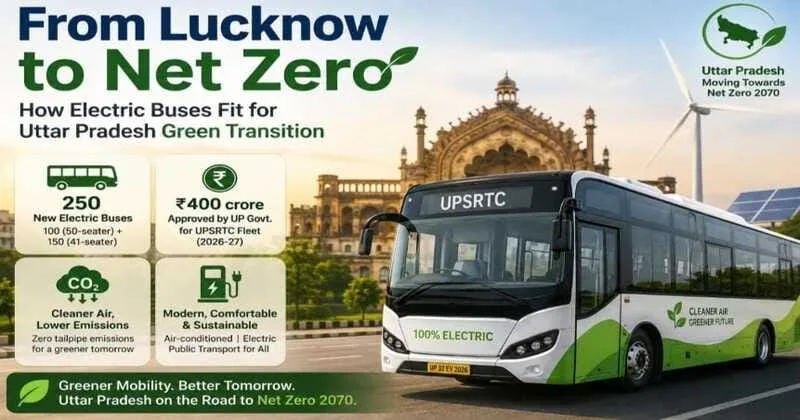
On 25 August, the Cabinet chaired by Chief Minister Yogi Adityanath approved an expenditure of Rs 40,000 lakh and an extra Rs 400 crore for strengthening the bus fleet of the Uttar Pradesh State Road Transport Corporation in the financial year 2026-27. The money will buy 250 new electric buses, and the government’s own note is explicit about the purpose; this proposal will help ensure timely compliance with the CAQM directions. Timely compliance, in this case, means arriving early.
What the Rs 400 crore buys
The composition of the order tells its own story about who these buses are for. Of the 250 vehicles, 100 will be 50-seater air-conditioned buses of 12 metres, built to a 3×2 Type-II configuration. The remaining 150 will be 41-seater air-conditioned buses, also 12 metres in the more spacious 2×2 Type-III layout. Every one of them is air-conditioned. Every one of them is electric.
The total financial outlay on the purchase is estimated at Rs 42,550 lakh, or Rs 425.50 crore. The state government is providing Rs 400 crore of that. The balance of Rs 2,550 lakh, Rs 25.50 crore, will be borne by UPSRTC from its own resources, a signal that the corporation is not merely a passive recipient of a green mandate but a participant in financing it. The provision was already made in the annual budget for 2026-27. The Cabinet decision converts a budget line into a purchase order.
A commitment that begins in Glasgow
To understand why a bus order matters, it helps to zoom out. At the COP26 climate summit in Glasgow in November 2021, India committed to achieving net-zero carbon emissions by 2070, alongside a set of near-term targets on non-fossil energy capacity and emissions intensity. That national commitment can only be delivered through state action, and no state carries more weight in that arithmetic than Uttar Pradesh, the most populous state in the country, with the largest public transport network to decarbonise.
Transport is among the harder sectors to abate. Electricity generation can be greened at the source; road transport has to be greened one vehicle at a time. Which is why every diesel bus retired and replaced with an electric one is a measurable, permanent subtraction from the state’s emissions ledger, repeated across every kilometre that vehicle runs for the next decade and more.
The government note frames the outcome plainly: the operation of new air-conditioned electric buses will give the public pollution-free and modern, comfortable travel alongside environmentally friendly journeys.
The road already travelled
The arrival of 250 buses sits on top of a policy structure that Uttar Pradesh has been assembling for the better part of five years. The foundation is the Uttar Pradesh Electric Vehicle Manufacturing and Mobility Policy, 2022, notified in October 2022. Among its central provisions is a 100 per cent exemption from road tax and registration fees for electric vehicles purchased and registered within the state during the policy’s initial window, with an extended exemption period for electric vehicles manufactured within Uttar Pradesh. The design intent was twofold: to make EVs cheaper to own and to make Uttar Pradesh a place where they are built rather than merely bought.
Alongside demand-side incentives, the state has been steadily electrifying its urban bus fleets. Under the Centre’s FAME-II scheme, electric buses were sanctioned for city services across a large group of Uttar Pradesh cities, among them Lucknow, Kanpur, Agra, Varanasi, Prayagraj, Ghaziabad, Meerut, Mathura-Vrindavan, Gorakhpur, Jhansi, Aligarh, Moradabad, Bareilly, Saharanpur and Shahjahanpur, making the state one of the largest single beneficiaries of the programme nationally. The subsequent PM e-Bus Sewa scheme, announced in 2023 with a national target of 10,000 electric buses across 169 cities, extended the same logic to smaller urban centres.
The result is that electric buses are no longer a novelty on Uttar Pradesh roads. They are an established, tested part of city transport in more than a dozen cities. What the 25 August decision does is take that experience out of the municipal sphere and put it into the inter-city fleet of UPSRTC, the long-haul, high-mileage services where the emissions savings per vehicle are greatest.
Clean power behind the clean vehicle
An electric bus is only as green as the electricity that charges it, and here too Uttar Pradesh has been building the other half of the equation. The Uttar Pradesh Solar Energy Policy, 2022 set an ambitious trajectory for renewable capacity, with a headline target in the region of 22,000 MW of solar capacity and dedicated development of solar parks in the Bundelkhand region Jhansi, Chitrakoot, Lalitpur and their neighbours where land availability and irradiance both favour large installations. Ayodhya has been developed as a model solar city, with rooftop and public space installations designed to showcase what a fully solar-powered municipal identity looks like. Set the solar build-out against the electric fleet expansion, and the two form a single strategy. The generation gets cleaner, the vehicles that draw on it multiply. The emissions saved compound.
Faith, tourism and a quieter journey
The Cabinet note makes a specific connection that is easy to overlook. New air-conditioned electric buses, it says, will bring better transport services to the major religious and tourist destinations of Uttar Pradesh. This is not incidental. Uttar Pradesh has emerged as the country’s leading destination for domestic tourism, driven overwhelmingly by pilgrimage to Ayodhya, Kashi, Mathura-Vrindavan, Prayagraj, Chitrakoot, Naimisharanya. The Maha Kumbh at Prayagraj drew crowds on a scale without precedent anywhere in the world.
Those destinations share a problem and now share a solution. Dense pilgrim traffic in compact temple towns produces exactly the kind of localised air pollution that damages heritage structures, degrades air quality for residents and diminishes the experience for visitors. Mathura-Vrindavan has already seen a sustained push towards electric and non-polluting vehicles in its core zones. Clean, quiet, air-conditioned buses moving pilgrims between these centres serve the environment and the visitor at the same time. The same Cabinet meeting cleared the extension of the Ganga Expressway to Haridwar, linking two Kumbh cities through an access-controlled network. Modern roads and modern buses are being commissioned in the same breath.
The green jobs dividend
Environmental policy is often discussed as a cost. The government’s note presents this decision as the opposite. Expansion of the bus fleet, it records, will create new employment opportunities for drivers, conductors and for skilled and unskilled workers engaged in technical maintenance. Electric vehicles bring their own trades: battery diagnostics, charging infrastructure operation, and high-voltage systems maintenance, which are precisely the skills the state’s ITI and skill-development network is positioned to supply.
Beyond the depot, the note points to multi-dimensional employment linked to dhabas, restaurants and passenger facilities along the routes. More buses running more services means more traffic at every stop along the way, and that traffic supports livelihoods that no emissions inventory captures but every roadside economy depends on.
There is a manufacturing dimension too. The 2022 EV policy extended incentives for vehicles built inside the state means that public procurement on this scale creates a demand signal for domestic manufacturers, the state buying the product it also wants made within its borders.
Two hundred and fifty buses will not, on their own, decarbonise a state of 240 million people. No single decision could. What they represent is something more useful for a demonstration that a large public transport corporation can move to clean propulsion on a fixed timeline, co-finance the transition from its own resources, meet a regulatory deadline ahead of schedule, and deliver a visibly better product to the passenger while doing it. The buses will be air-conditioned. The air over the routes they run will be cleaner.