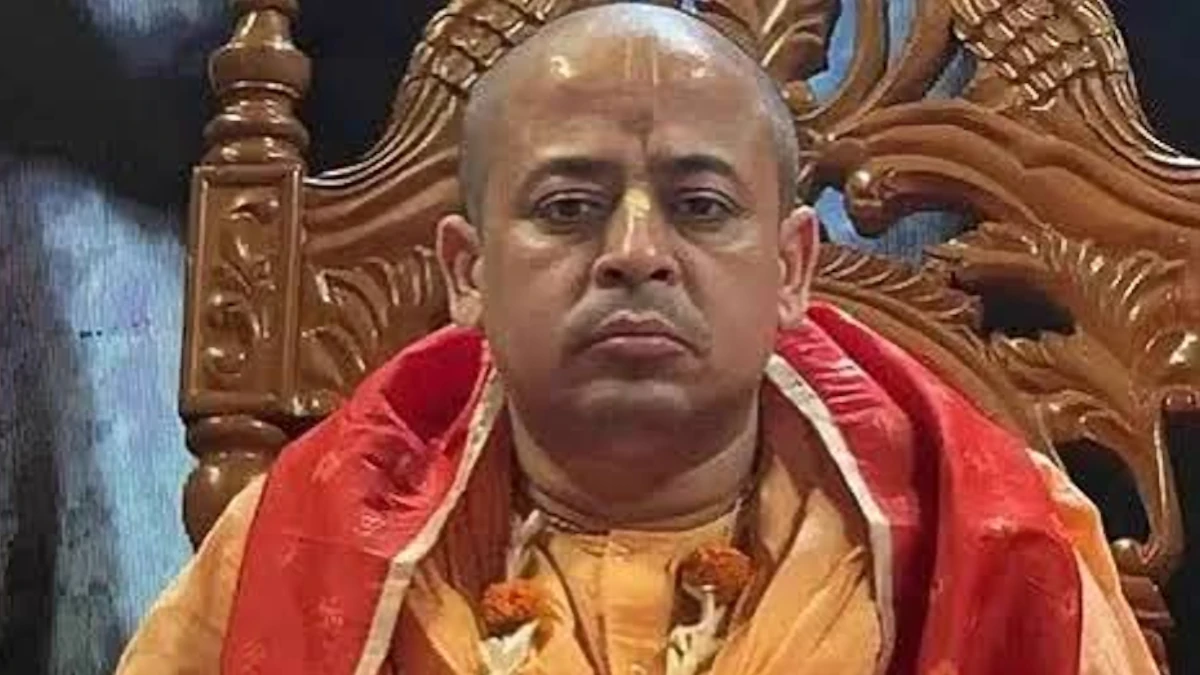
Do you know Chinmoy Prabhu? He is a Bengali monk. But perhaps one more prefix matters in today’s Bengal: he is a Hindu Bengali monk. And perhaps that is precisely why many of our self-proclaimed “Bangali-premi” intellectuals have remained conspicuously silent about his plight.
For years, we have been told that Bengali identity transcends religion. We celebrate Bengal’s language, literature, culture and shared heritage, and rightly insist that being Bengali cannot be reduced to religious identity. Yet when a Bengali Hindu faces persecution, imprisonment or violence, some of the loudest champions of Bengali identity suddenly become silent. So the uncomfortable question remains: Is Bengali solidarity truly universal, or is it selective?
Chinmoy Krishna Das, popularly known as Chinmoy Prabhu, is a Hindu monk in Bangladesh whose detention has become a matter of serious concern for many people. Whatever one’s political or ideological position, the basic question should be simple: does every citizen deserve dignity, due process and protection from violence? The human tragedy surrounding his case makes that question even more painful.
Sandhya Rani Dhar, 71, reportedly died at her son’s ashram in Chittagong without being able to see her jailed son, despite that being her final wish. A mother dying without seeing her imprisoned child should, at the very least, evoke basic human sympathy.
Yet where was the outrage? Where were the statements from those who routinely speak about humanism, minority rights and the Bengali conscience? The silence becomes even more striking when compared with the enthusiasm with which certain sections of the intellectual class respond to other issues. Bengali emotion can pour out when debates arise over food habits during Durga Puja or questions about Bengali cultural identity. But when Hindu religious sites or Durga idols are vandalised, the response often becomes hesitant and qualified.
This is where secularism’s credibility is tested. Secularism cannot mean defending minorities only when doing so fits one’s political worldview. If a Muslim is attacked, we should speak. If a Christian is persecuted, we should speak. If a Buddhist is targeted, we should speak. And if a Hindu is attacked, we must speak with the same conviction. Otherwise, what we are practising is not universal humanism but selective empathy.
A similar contradiction appears in how political language is sometimes used around terrorism. The expression “Saffron Terrorism” has been used in political discourse to associate terrorism with Hindu or nationalist identity.
Yet terrorism must be judged by evidence, perpetrators and ideology—not by the identity of an entire community. At the same time, whenever Islamist terrorism is discussed, we are rightly reminded that terrorism has no religion and that ordinary Muslims must not be blamed for the crimes of extremists. But consistency demands that we apply the same standard everywhere. If a Muslim should not be blamed for a terrorist’s crime merely because the terrorist claims an Islamic justification, a Hindu should likewise not be treated as collectively responsible for the actions of someone claiming to act in the name of Hinduism.
A Hindu living as part of a minority community in Bangladesh cannot simply be discussed through the lens of India’s Hindu majority. Minority status is contextual. The safety of a Hindu in Bangladesh is a legitimate human-rights question, just as the safety of any other minority anywhere is. This is where the hypocrisy of wokeism becomes impossible to ignore. Those who loudly champion minority rights, intersectionality and social justice often become strangely silent when the victim does not fit their preferred narrative. Their outrage appears selective, their empathy conditional, and their principles negotiable. If injustice matters only when the victim belongs to the “right” identity group, it is not justice; it is ideology.
And Bangladesh is not some culturally disconnected land for Bengalis on the other side of the border. Its history is deeply connected to the civilisation of Bengal. The Dhakeshwari Temple remains an important symbol of that heritage, while revolutionaries such as Masterda Surya Sen and Ananta Singh belong to the region’s shared historical memory. But heritage cannot merely be celebrated in speeches and commemorations. It must also be reflected in how people belonging to that heritage are treated. A civilisation is not protected merely by preserving its monuments; it is protected when the people who inherit its traditions can live with dignity and without fear.
This is not a demand for special privileges for Hindus. It is a demand for equality. Chinmoy Prabhu is Bengali. He is a monk. He is a Hindu. None of these identities contradicts the others. The real test of Bengali intellectualism is not whether it can celebrate Bengali culture when doing so is politically convenient. The real test is whether it can defend a Bengali Hindu when that defence challenges its preferred narrative.
If our compassion has conditions, it is not compassion. If our secularism has favourites, it is not secularism. And if our love for Bengal disappears the moment the Bengali in question happens to be a Hindu, then perhaps we should ask ourselves what exactly we mean when we say “Bangali-prem.” Silence is not neutrality. Silence, when injustice is visible, is a choice.