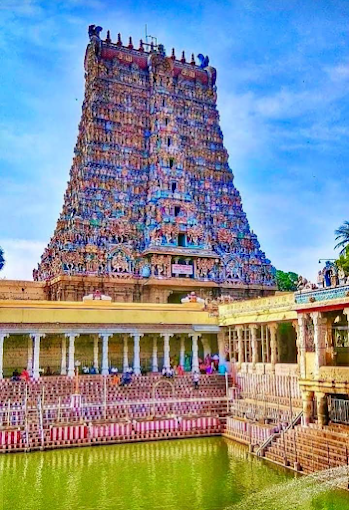
The Madras High Court has dismissed two petitions seeking equal use of Tamil hymns alongside Sanskrit during the September 17, 2026 Kudamuzhuku at Madurai’s Meenakshi temple, holding that in the absence of a law or delegated legislation mandating such a practice, the Writ Court cannot create the requirement itself. The Court also held that questions concerning Agamic practices and wider participation in the rituals are governed by pending legal proceedings and existing procedures.
Justice C. Saravanan, in a common order pronounced on September 3, 2026, dealt with W.P.(MD) Nos. 11386 and 12387 of 2026. The temple’s Kudamuzhuku is scheduled for September 17, 2026, with the connected rituals commencing on September 6 with Vigneshwara poojai.
The dispute involved two related but distinct demands: one seeking the use of Tamil spiritual mantras and hymns along with Sanskrit on an equal footing in specified parts of the ceremony, and the other seeking permission for D. Sureshbabu, who was not a temple employee, to perform Velvi Kundam Nigalvugal — the raising of the sacred fire — while chanting Tamil mantras.
The judgment is significant for the way the Court navigated the competing claims involving Tamil devotional traditions, existing temple customs, Agamic practices, constitutional rights and the limits of the High Court’s writ jurisdiction.
What the petitioners wanted
In W.P.(MD) No.11386 of 2026, Tamil Rajendiran @ R. Rajendiran sought directions to the Hindu Religious and Charitable Endowments Department to obtain the report of an Expert Committee and implement it by permitting Tamil spiritual mantras and Tamil hymns along with Sanskrit in the Yaga Saalai, Karuvarai and Gopura Vimaanam, on an equal footing. His request specifically covered the Meenakshi Temple Kudamuzhuku scheduled for September 17.
In the second petition, W.P.(MD) No.12387 of 2026, D. Sureshbabu challenged the March 11, 2026 order of the Joint Commissioner/Executive Officer of the temple, which had rejected his request to perform Velvi Kunda Nigalvugal during the Kudamuzhuku.
Sureshbabu claimed that he had undergone training in Tamil devotional worship and had been conferred Asiriyar Tirumuzhaku (Aacharya Abisekam). He also stated that he had been performing Velvi Kunda Valipadu Poojai, involving the raising of sacred fire, for more than two decades in the presence of various Aadeenams.
His contention was that Tamil hymns should not merely be recited separately by Othuvars. According to him, Tamil should receive equal importance with Sanskrit in the actual Velvi proceedings, including through Tamil Velvi Asiriyargal performing Velvi/Yagam and other proceedings in Tamil.
What the temple authorities said
The temple administration opposed the demand for an expanded role in the ritual proceedings.
It said that the temple followed the Kaarana and Kaamiya Aagamas in its rituals and that the Kudamuzhuku had to be conducted according to the Agamas followed by the temple. It also relied on Section 28 of the H.R. & C.E. Act, 1959, concerning administration of religious institutions according to their trust, usage and lawful directions. The administration referred to the Supreme Court’s decision in Seshammal v. State of Tamil Nadu in support of the importance of institutional usage.
At the same time, the administration maintained that it was not opposed to Tamil hymns.
The judgment records that Tamil Othuvars had traditionally been engaged and that Tamil hymns were already part of the temple’s practices. During previous Kudamuzhukus, including the 2009 ceremony, Tamil Othuvars had recited the Panniru Thirumurai and other Tamil devotional works.
The administration’s position, therefore, was not that Tamil had no place in the ceremony, but that the petitioners were seeking to create a new entitlement to conduct particular ritual proceedings.
The Court examined the unresolved Agama question
A crucial part of Justice Saravanan’s reasoning was that the Court could not simply assume that every existing ritual practice at the temple was conclusively established as an Agamic requirement.
The judgment observed that it was not clear whether the earlier temple structure had been rebuilt in accordance with the Agamas or whether subsequent additions and renovations were carried out according to the Agamas.
The Court further noted that the rituals presently followed appeared to have been in practice since the Nayak period.
But whether Sanskrit recitation during consecration and Kudamuzhuku was actually required by the Agamas, and, if so, which of the 28 Agamas applicable to Shiva temples governed the temple, was a matter that could be determined only through archaeological and architectural findings using appropriate scientific methods.
Likewise, whether the present practice of Sanskrit recitation inside the Sanctum Sanctorum was supported by a specific Agamic text required proper examination and findings.
In simple terms, the Court was saying that it could not decide the ritual question merely on assertions about what was or was not “Agamic”. The underlying question of which Agama applied to the temple itself was still subject to determination.
Earlier court orders had already created two separate tracks
The Court then traced earlier litigation concerning Tamil hymns in temple ceremonies.
One important proceeding was W.P.(MD) No.19115 of 2020, filed by D. Ponnusamy concerning the consecration of the Arulmigu Kalyana Pasupatheeswarar Swamy Temple at Karur.
On August 19, 2021, a Division Bench directed the creation of a committee comprising Tamil scholars, devotees and believers to identify and consolidate important ancient Tamil hymns. The earlier order contemplated Tamil hymns, verses and Thirumurai being recited along with Sanskrit hymns and Vedas during Kudamuzhuku.
A committee was subsequently constituted, but the present judgment recorded that its report was still awaited.
Separately, another committee had been constituted following the First Bench’s order dated August 22, 2022, in W.P. No.17802 of 2021. Its task was different: to identify which temples were constructed according to the Agamas.
The High Court stressed this distinction. One committee was dealing with Tamil hymns and hymns in languages other than Sanskrit, while the other was dealing with the Agamic status of temples.
The Supreme Court proceedings became another constraint
The High Court also noted that the broader issue was pending before the Supreme Court in Civil Appeal No.7692 of 2023.
The Supreme Court had extended the time for completing the exercise of identifying temples in Tamil Nadu governed by Agamas until February 2027. The matter was last listed on August 5, 2026, according to the High Court’s judgment.
That pending proceeding was important because the High Court did not want to decide questions that overlapped with issues already before the Supreme Court.
Constitutional rights were considered — but not finally decided
Justice Saravanan also examined Articles 16(5), 25 and 26 of the Constitution.
The judgment noted that Articles 25 and 26 protect not merely belief but also religious acts, including rituals, ceremonies and modes of worship that are integral parts of a religion. It also referred to the Supreme Court’s observation that whether a particular practice is an essential part of religion has to be examined with reference to the doctrine and practices of the particular religious community.
The Court also referred to the Supreme Court’s decision in N. Adithayan v. Travancore Devasom Board, which held that a custom cannot be accepted as a source of law when it violates human rights, dignity, social equality or the Constitution.
But the High Court did not use these principles to immediately order the changes sought by the petitioners.
Instead, it said that even if Sureshbabu possessed the necessary qualification to chant Tamil hymns, his claim to participate in the manner sought could not simply be granted through an Article 226 proceeding. The Court observed that denial of an opportunity could potentially raise an Article 14 question, but that issue would have to be tested in appropriate proceedings in light of Seshammal.
Why Sureshbabu could not claim the right to conduct the ritual
The Court drew a clear distinction between being a devotee participating in the ceremony and claiming an independent legal right to perform part of the ritual.
It held that unless rules were framed, a person who was not an employee of the temple could not independently seek permission to recite hymns during the Velvi Kundam Nigalvugam forming part of the Kudamuzhuku.
However, the Court clarified that Sureshbabu, like other devotees, could participate in the September 17 Kudamuzhuku.
The distinction was central to the judgment.
The Court’s central reasoning: a writ court cannot create a new right
Ultimately, the Court repeatedly emphasised the limits of its role under Article 226.
It held that a petitioner can seek relief only according to the procedure established by law and that a Writ Court is intended to implement and declare the law, not make the law.
The Court found that Tamil spiritual mantras and Tamil hymns, including recitation by Othuvars, were already being practised in temples. But the specific demand for equal recitation with Sanskrit in the Yaga Saalai, Karuvarai and Gopura Vimanam could not be granted unless supported by legislation or delegated legislation.
The Court therefore left the larger policy question to the appropriate authorities and the pending judicial process.
It observed that it was for the Legislature or Executive to decide whether the time had come to allow others to participate in events such as Kudamuzhuku, keeping in view the progress made since the Constitution was adopted on November 26, 1949.
It also clarified that there could be no deviation from the existing procedure unless that procedure was successfully challenged before an appropriate forum.
Final finding
The Court’s final position was that, where a temple is established to have been constructed according to the Agamas, its rituals have to be followed according to those Agamas. But the determination of which temples fall into that category remained with the committee constituted for that purpose.
The issue of Tamil hymns, meanwhile, remained subject to the recommendations of the separate committee constituted following the August 19, 2021 order and to the orders of the Supreme Court.
Since those questions remained pending, the High Court held that the relief sought by Sureshbabu could not be granted at that stage.
It ultimately dismissed both writ petitions, with the above observations, and made no order as to costs.
The judgment thus stopped short of deciding whether Tamil should ultimately receive equal status with Sanskrit in every stage of the Meenakshi Temple’s Kudamuzhuku. Instead, it held that such a change could not be imposed through these writ proceedings while the questions concerning Agama, existing temple practice, committee recommendations and the Supreme Court proceedings remained unresolved.