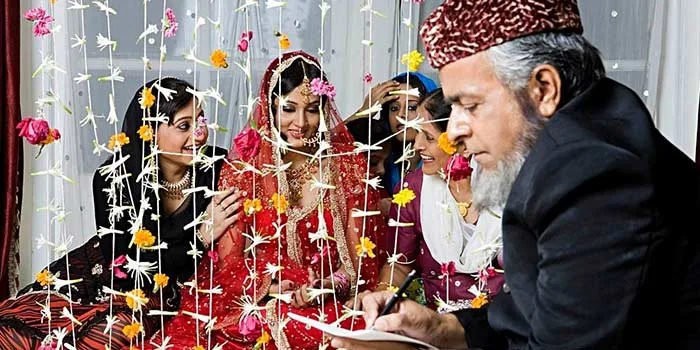
The Uttarakhand Waqf Board is preparing a framework under which Muslim marriages in the state could be solemnised only by authorised qazis or maulvis registered through the Waqf system.
The proposal is scheduled to be discussed with the state’s UCC panel on Wednesday. The Waqf Board and the panel are expected to examine the draft before it is finalised and implemented across Uttarakhand.
If approved, the move would introduce a formal identification system for religious functionaries involved in solemnising Muslim marriages.
Qazis to receive Unique Identification Numbers
Uttarakhand Waqf Board Chairman Shadab Shams said qazis and maulvis would be assigned a Unique Identification Number (UIN).
According to the proposed system, the numbers would be issued by management committees of mosques, madrasas and other religious institutions functioning under the Waqf Board. This would create a record of the persons authorised to solemnise nikah.
Shams said the system was intended to establish accountability and help prevent instances of injustice.
One of the key changes would be that the identity of the qazi conducting the nikah would be recorded, making it easier for authorities to establish who solemnised a particular marriage.
Special Marriage Act option for interfaith couples
Shams also said that couples from different faiths would be able to marry under the Special Marriage Act without either partner being forced to convert.
He argued that the proposed system would also help address concerns surrounding cases commonly described as “love jihad”, particularly allegations involving religious conversion and changes of names before marriage.
The proposal, however, has triggered opposition from Muslim personal law representatives.
AIMPLB opposes proposed changes
The All India Muslim Personal Law Board (AIMPLB), which has challenged Uttarakhand’s UCC in the High Court, has criticised the proposed framework.
Muhammad Sulaiman, an AIMPLB founder member, alleged that the system could result in the government or ruling BJP favouring certain qazis.
He also expressed concern that members associated with the Muslim Rashtriya Manch (MRM) could be given preference for registration.
Sulaiman questioned the need for government intervention in the solemnisation of nikah, arguing that there had been no such requirement earlier.
AIMPLB says qazi is not mandatory for nikah
Sulaiman also pointed out that, under Islamic practice, the presence of a formally appointed qazi is not necessarily mandatory for a nikah.
He said that in the past, district-appointed qazis could authorise naib qazis during busy marriage seasons, but argued that the proposed registration system could create difficulties.
According to him, an elderly relative or another suitable person can also perform the role of qazi during a nikah.
The AIMPLB has announced plans for protests beginning September 17 at Jantar Mantar over what it describes as attempts to interfere with Muslim personal law.
Aadhaar details proposed for bride, groom and witnesses
The proposed revised nikahnama is also expected to introduce additional documentation requirements.
Under the draft framework, Aadhaar cards would have to be submitted for the bride and groom, as well as their representatives and witnesses to the marriage.
The proposed document would also be aligned with the UCC’s provisions on marriage.
No provision for second, third and fourth marriages
Another significant change would be the removal of columns relating to second, third and fourth marriages from the nikahnama.
The change is linked to the UCC’s prohibition of polygamy. Uttarakhand became the first state in India to implement a Uniform Civil Code, bringing personal law-related matters, including marriage and divorce, under a common legal framework.
The proposed qazi registration system is therefore being presented by the Waqf Board as an administrative measure to ensure that Muslim marriage documentation conforms to the state’s UCC framework, while opponents view it as an intrusion into religious and personal-law practices.
What happens next?
The Uttarakhand Waqf Board and the UCC panel are expected to review the draft proposal before a final decision is taken.
If implemented, the system could significantly change the way Muslim marriages are documented and solemnised in the state, particularly by creating an official database of qazis and introducing additional identity and documentation requirements.