
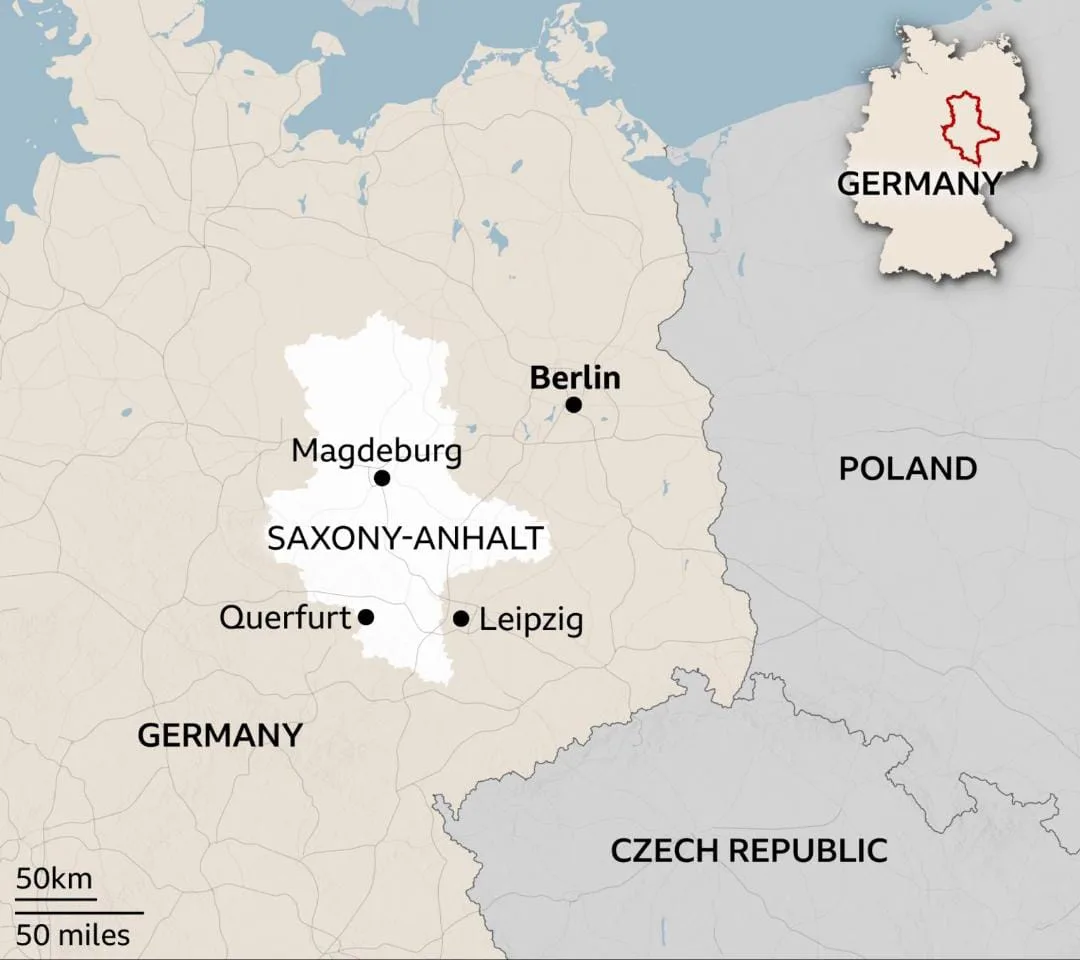
Germany’s Alternative for Germany (AfD) has delivered a political earthquake in Saxony-Anhalt, winning 43.8% of the vote and 39 of the 83 seats in the state parliament in Magdeburg. The nationalist party more than doubled its 20.8% share from 2021 and finished more than 26 percentage points ahead of Chancellor Friedrich Merz’s Christian Democratic Union (CDU), which collapsed to 17.2%. The AfD needed 42 seats for an outright majority, leaving it just three seats short.
The result is the strongest state-election performance in the AfD’s history and a major setback for Germany’s established political order. With 77.8% turnout,.the highest in Saxony-Anhalt since reunification, the election produced a clear message of voter dissatisfaction with the existing political direction.
AfD lead candidate Ulrich Siegmund said voters had given the party a mandate for political change, while national co-leader Alice Weidel described the result as “sensational”. Yet the immediate challenge is government formation. The AfD has 39 seats, while the CDU, SPD, Greens, Left and BSW together hold 44. Existing parties have ruled out a conventional coalition with the AfD, leaving the state facing difficult negotiations.
Migration, Islam and the new German political agenda
The significance of the AfD victory extends well beyond the arithmetic of the Saxony-Anhalt Landtag. Migration, asylum, Islam, national identity and deportation have become central issues in the party’s political programme and the election has demonstrated the electoral strength of those themes.
The AfD has campaigned for tighter immigration and asylum controls, arguing that Germany must regain control over its borders and reduce pressure on public services, housing and security. In Saxony-Anhalt, its programme calls for stronger deportation enforcement against rejected asylum seekers and a specialised deportation structure.
The party also advocates what it calls “remigration”, particularly concerning people without a legal right to remain. Critics argue that the concept could eventually extend beyond illegal migration, while the AfD insists that its focus is on enforcing existing immigration law.
For Germany’s large Syrian Muslim population, therefore, the result carries particular political significance. Germany has become home to one of Europe’s largest Syrian-origin Muslim populations since the refugee influx of 2015. State governments cannot abolish federal asylum protections, but they have important responsibilities in accommodation, integration, education and implementation of deportation decisions.
BIG NEWS – HISTORIC Win for Right Wing in Germany.
Far-right Alternative for Germany party wins big in regional election but falls short of majority.
The anti-migration and Russia-friendly Alternative for Germany's candidate for governor said that "we have written history" and… pic.twitter.com/4nFhKG4Spy
— News Arena India (@NewsArenaIndia) September 7, 2026
Islam is another major area in which the AfD seeks a policy shift. Its Saxony-Anhalt programme states that Islam does not belong to Germany or Saxony-Anhalt and proposes restrictions concerning mosque construction, public calls to prayer and Islamic religious education. The party also advocates replacing university chairs in Islamic theology with non-confessional Islamic studies. Such proposals are likely to become part of Germany’s broader national debate over Islam and integration.
Palestinian and Muslim organisations have reacted with concern. Nazih Musharbash of the German-Palestinian Society argued that a stronger AfD would increase pressure on Palestinians, Muslims and Arabic-speaking communities. These reactions are likely to intensify Germany’s already heated political debate over migration, Gaza, Islam and national identity.
At the same time, the AfD maintains that it does not oppose every migrant or Muslim. Its leadership says people who work, pay taxes, obey German law and contribute to society are welcome, while illegal and uncontrolled migration should be stopped.
Saxony-Anhalt signals a wider European shift
The AfD victory comes at a moment when migration and asylum have become increasingly important electoral issues across Europe. Nationalist and anti-immigration parties have gained support in several European countries, turning border control, deportation, asylum reform and national identity into mainstream political questions.
The Saxony-Anhalt result strengthens that trend. Even without an AfD government, winning 43.8% means that policies once treated as politically marginal now command the support of a very large section of the electorate in a German state.
🚨🇩🇪 Antifa is preparing for violence in Magdeburg, Germany, where the AfD is set to take power!
Hundreds of far-left extremists led by Antifa, along with transgender maniacs, are taking to the streets to overturn the election results!
All of this is part of the EU and…
— Mario ZNA (@MarioBojic) September 6, 2026
The political shockwaves are already extending beyond Germany. French political figures have described the result as a serious moment for Europe, while the German election is being closely watched by nationalist parties elsewhere on the continent. The result is therefore being interpreted as another indication that Europe’s political debate is moving towards stricter migration control and stronger demands for national sovereignty.
The next major test comes on September 20, when voters in Berlin and Mecklenburg-Western Pomerania go to the polls. The AfD is already competitive in Mecklenburg-Western Pomerania, while Berlin presents a more fragmented contest involving the CDU, AfD and Left. A second strong AfD performance could increase pressure on Germany’s established parties and further reshape the national political debate.
The defeat of the CDU is particularly significant. The party governed Saxony-Anhalt for 24 years and fell from 37.1% in 2021 to 17.2% this time. The SPD received 9.3%, the Greens 8.9%, the Left 8.6% and BSW 5.3%.
The AfD has not yet secured power in Saxony-Anhalt. But its 43.8% victory has already changed the political equation. Migration, illegal immigration, asylum, Islam, national identity and deportation are now firmly at the centre of Germany’s political debate.