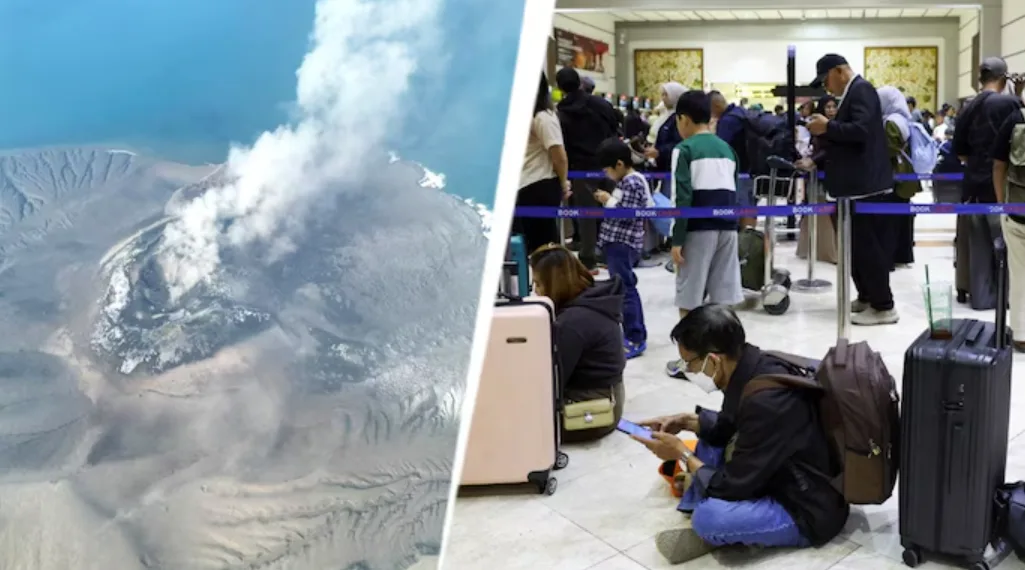
Jakarta: Indonesia’s Mount Anak Krakatau erupted repeatedly and destructively over the weekend, sending towering plumes of volcanic ash into the surrounding airspace. The wild volcanic eruption has triggered widespread disruption to air travel across western Indonesia. More than 2,000 flights were grounded, leaving around 2,70,000 passengers stranded. Meanwhile, authorities extended airport closures and imposed safety restrictions amid continued dangerous volcanic eruption.
The volcanic mountain, located in the Sunda Strait between Java and Sumatra and about 150 km from Jakarta, began erupting late on September 4, Friday. Its activity intensified over the weekend, with lava fountains, powerful explosions and ash plumes reaching several kilometres into the atmosphere. The ash drifted towards major flight corridors, forcing authorities to suspend operations at several airports, including Jakarta’s Soekarno-Hatta International Airport.
Ash clouds force airport closures, disrupt regional flights
Indonesia’s airport authority extended the suspension of operations at Soekarno-Hatta and other affected airports into September 7, Monday as volcanic explosions flamed. Indonesia’s Transport Ministry said that more than 2,000 flights had been disrupted, while earlier figures put the number of affected operations at 1,558 across eight airports and the number of passengers impacted at about 170,000.
The disruption affected more than 900 flights at Soekarno-Hatta airport alone. Other airports affected included Husein Sastranegara International Airport in Bandung and Radin Inten II International Airport near Bandar Lampung. Airports serving cities such as Semarang and Surabaya were prepared to receive diverted flights and provide alternative landing options.
Airlines across the region scrambled to revise schedules. Garuda Indonesia and AirAsia cancelled or rescheduled services, while Singapore Airlines cancelled nearly 20 flights between Singapore and Jakarta and warned that further disruptions could occur as ash clouds shifted with changing weather conditions.
Authorities said airport teams were conducting regular runway and airspace assessments to determine whether conditions were safe enough for operations to resume. Volcanic ash presents a major aviation hazard because fine particles can damage aircraft engines, impair visibility and contaminate critical systems.
Schools shift to online classes amid health risks; Shipping operations halted
The eruption’s impact extended beyond aviation. Authorities in Jakarta announced that schools would move classes online from September 7, Monday amid concerns over the heightened volcanic activity and ash pollution. In Bandar Lampung, volcanic ash was reported covering vehicles and roadsides.
Shipping operations in the Sunda Strait were also placed under tighter restrictions. Authorities established a 3-km exclusion zone around Anak Krakatau and prohibited vessels from approaching the volcano. Geology officials warned residents and visitors against entering the restricted area, citing the danger posed by falling volcanic material and continuing eruptions.
Despite the heightened activity, Indonesian authorities confirmed that there was no tsunami warning associated with the latest eruptions. However, officials have stressed that the situation remains dynamic. Indonesia’s Geological Agency warned that the probability of further eruptions remains high, while Transport Minister Dudy Purwagandhi said authorities could not predict when the disruptions would end because ash movement depended heavily on changing weather conditions.
The meteorological agency BMKG reported that volcanic ash had reached around 6,000 metres on the Java side of the volcano and up to 15,000 metres over Sumatra and parts of western Banten.
Anak Krakatau’s deadly legacy of dangerous volcanic eruptions
The latest eruption has renewed attention on Anak Krakatau’s dangerous history. The volcano, whose name means “Child of Krakatoa”, emerged from the sea in the early 20th century inside the caldera created by the catastrophic 1883 eruption of Mount Krakatoa.
The 1883 eruption was among the most destructive volcanic events in recorded history, killing an estimated 35,000 people, largely through tsunamis generated by the eruption. Anak Krakatau itself became infamous in December 2018 when part of its volcanic flank collapsed into the Sunda Strait, triggering a tsunami that struck coastal communities in Java and Sumatra. More than 400 people were killed and thousands were injured or displaced.
Indonesia sits along the Pacific Ring of Fire, a vast tectonic zone stretching roughly 40,000 km around the Pacific Ocean and characterised by frequent earthquakes and volcanic eruptions.