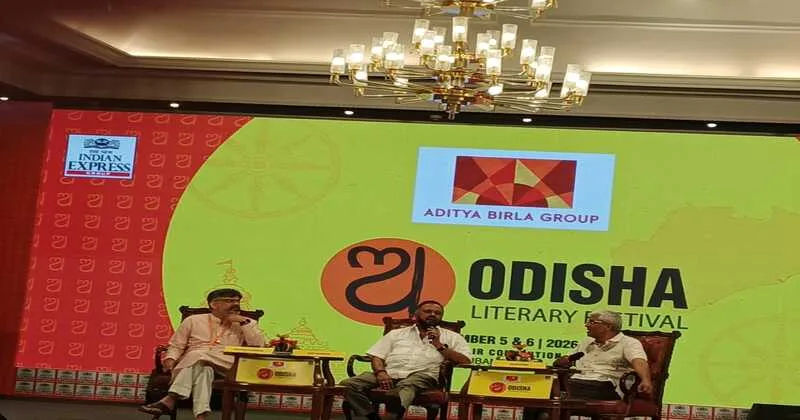
Bhubaneswar: Editor of Organiser Prafulla Ketkar on September 5 questioned the basis for categorising people born after 1996 as “Gen Z”, arguing that Indian youth should not allow algorithms, technology companies or market-driven categories to define their identity, aspirations and social consciousness.
Speaking at the Odisha Literary Festival organised by The New Indian Express at a hotel in Bhubaneswar, Ketkar said the present generation should have the freedom to define itself rather than being placed into categories created by others.
“Who decided that post-1996 born is Gen Z?” Ketkar asked, adding that he personally believed the present generation did not want to be defined by anybody.
Referring to the Y2K phenomenon, he said, “Y2K was a movement that was created again by computer giants,” and argued that the terminology surrounding “Gen Z” has also been popularised by major corporate firms.
Ketkar further pointed to the emergence of labels such as Generation Alpha and Generation Beta, questioning whether society should allow corporations and market forces to determine how successive generations are characterised.
“Should we allow our generations to define their characteristics on the basis of the market created by these companies?” he asked.
“This is the question that we need to answer. And this is a very, very serious question irrespective of ideological differences.” He added
Ketkar said the growing influence of technology and social media had fundamentally changed the way young people experienced movements, debates and public discourse.
He said that algorithms increasingly determine which movements gain visibility and which remain unnoticed. According to him, technology platforms also influence what users see and what they do not see.
This, he said, raises an important question about whether individuals should allow algorithms and large technology companies to shape their understanding of social and political issues.
Ketkar pointed to what he described as an irony in the use of generational and ideological labels, saying that even students associated with political groups on the Left or with the Aam Aadmi Party use categories created by large technology companies to describe themselves.
Referring to different forms of youth participation, he said young people involved in various social and political organisations, those participating in Krishna bhajans during Janmashtami celebrations, people undertaking Kanwar Yatras and young entrepreneurs building businesses were all part of India’s youth.
He cited the large startup ecosystem in India, noting that around 2.3 lakh startups represent young people who believe in contributing to India’s development and its aspirations of becoming a global power.
He argued that putting an entire age group into one bracket and claiming that it represents the sole character of Indian youth would be unfair.
“Present-day youth want to speak for themselves,” he said, adding that technology had provided the younger generation with new tools of communication and mobilization.
Ketkar said youth-led movements were not a new phenomenon in India, but technology had significantly altered their scale, speed and visibility.
He referred to several movements and periods of political mobilisation in independent India, including the anti-Congress movement of the late 1960s, the anti-Emergency movement, the Bofors controversy and later anti-corruption movements.
According to Ketkar, the major difference between earlier movements and those witnessed today is the technology available to mobilise people and amplify messages.
Ketkar highlighted the widening communication gap between generations, saying technological change had created significant differences in how people consume information and understand the world.
He referred to an experiment involving 500 young people who had completed Class 10 or Class 12 before and after the COVID-19 pandemic, with 250 participants from each group.
According to him, the perceptions of the two groups about themselves, their families, institutions and the wider world were “drastically different”.
He attributed much of this difference to changes in patterns of information and content consumption.
Ketkar said society had moved through several technological generations—from the “telegram generation” and the landline generation to the remote-control generation, followed by the Google, Facebook, Twitter, Snapchat and Instagram generations.
All these generations, he said, now coexist within the same society.
Ketkar said the challenge before society was to establish effective communication channels across these generations.
He also referred to youth outreach activities by the Rashtriya Swayamsevak Sangh (RSS), saying the organisation had been working to engage with young people through programmes and camps.
According to Ketkar, RSS-linked programmes had reached large numbers of young people over the past year, including through training camps for those in the 14–24 age group.