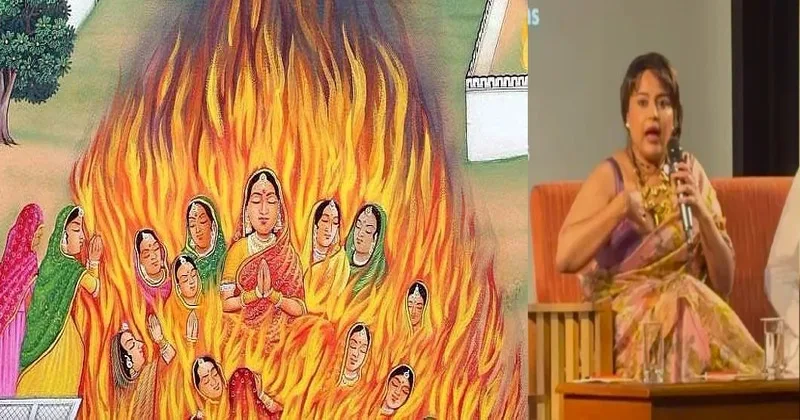
The recent remarks by Swara Bhasker about the jauhar scene in Padmaavat have once again opened a difficult but important conversation about women, honour, survival and history. Speaking at an event in Delhi, Bhasker recalled watching the scene depicting hundreds of women performing jauhar. She said that, if she were a rape survivor watching it, she might feel: “I would feel like a coward. That I didn’t kill myself to save my honour”.
The fundamental historical problem with connecting the situation of a modern rape survivor with the situation of women facing the imminent capture of a medieval fort. They are not the same situation. Before we judge jauhar through a 21st-century lens, we should first try to understand the world in which these women lived.
When a fortified city was about to fall, the choice facing women was not necessarily simply: “Live or die”.
The choice could instead have been: “Face capture or choose death before capture”.
And capture in medieval warfare could have consequences very different from what the word “capture” means to us today. It could involve enslavement, separation from family, loss of autonomy, sexual violence and being taken away from one’s home and community.
The fear of capture and what capture could entail was part of the historical circumstances in which some women made the decision to participate in jauhar.
It is Indian history, a fact, a choice of royal women These were real women, living in a world with ideas of dharma, maryada, swabhiman, abhiman.
To understand their decision, we have to understand what those values meant to the women themselves. For them, swabhiman was not simply self-respect. It could also mean control over their life—the belief that a woman had the right to decide what happened to her own body, her own life and her own dignity.
They were treated with samman/respect in their kingdom. They were royal queens and women who did not wanted to be treated as slaves or possession of victor after being captivated.
The first is a woman who has suffered a crime.
The second involves women confronting the consequences they associated with military defeat and captivity.
These should not be treated as two versions.
If survival of women who faced sexual violence was not considered important, would Shivaji Maharaj have punished Ranje Patil or the women who suffered sexual voilence?
If survival and dignity of women were considered unimportant, why would Shivaji Maharaj’s administration punish those who dishonoured or harmed women?
The Ranje Patil episode is often cited in Marathi historical tradition as an example of such accountability and of the principle that a woman’s dignity was not to be violated with impunity. This reflects an important distinction: the woman who suffered sexual violence was not dishonoured by the crime; the dishonour belonged to the person who committed it.
What does “survival” mean? This brings us to perhaps the most important question.
When we ask: “Why didn’t they simply survive?”
We need to ask:
“What did survival mean to them?”For these women, survival did not simply mean continuing to breathe and remain alive; it meant having a life with purpose, dignity, and the freedom to determine their own fate. If capture meant losing that freedom and being reduced to an object for the captor’s pleasure, then mere physical survival could no longer represent the life they wished to live. Their decision, therefore, can be understood not as a rejection of life itself, but as a refusal to live without dignity, and self-respect.
Jauhar was not simply “suicide”
Jauhar should not simply be collapsed into the modern concept of individual suicide.
Jauhar generally refers to the collective self-immolation associated with women in a fort surrounded by enemy army, often in the context of an imminent military capture, and is historically associated with the subsequent saka — the final sortie by the men who remained to fight. It therefore needs to be understood as a particular wartime phenomenon rather than simply described using a modern psychological category.
The fear went beyond rape
Dr. Omendra Ratnu, author of Maharanas: A Thousand Year War for Dharma, discusses what he describes as not only sexual slavery but also necrophilia — sexual violation of the bodies of dead women and children. His book presents this as part of the extreme fear surrounding not just live capture but even dead bodies and as part of the historical rationale he attributes to the development of jauhar.
Women in Indian history did not all respond in the same way
It is also important not to create a false choice between jauhar and helplessness. Indian history contains numerous examples of women who chose armed resistance.
Rani Durgavati fought Mughal forces under Asaf Khan in 1564. The Government of India’s historical account records that she personally led resistance and defeated Mughal forces multiple times before her much smaller force was overwhelmed. She continued fighting after being wounded and ultimately chose death rather than surrender.
Rani Abbakka Chowta fought the Portuguese in the 16th century. There are records of her resistance to repeated Portuguese attacks and her counterattack against Portuguese forces at Ullal.
Rani Lakshmibai fought the British during the uprising of 1857 and died fighting British forces in 1858. Government and cultural institutions continue to record her as one of the principal figures of the resistance.
Ancient and even modern soldiers have sometimes chosen death over capture
Masada offers a striking example outside India: Josephus records that, during the Roman siege in 73–74 CE, the defenders chose collective death rather than captivity, including women and children. A similar account comes from the fall of Carthage in 146 BCE, where Appian describes Hasdrubal’s wife entering the flames with her children rather than face captivity.
These accounts show that choosing death over captivity was not unique to India or to medieval times.
Similar extreme choices occurred in modern warfare as well. During the Battle of Saipan in World War II, thousands of Japanese soldiers and civilians died by suicide rather than surrender or face capture.
These examples should not be equated with jauhar, but they demonstrate that captivity can be perceived as an intolerable fate in wartime.
The important question, therefore, is not whether such choices conform to modern values. It is whether we can understand the circumstances, fears and values that shaped the choices of people living in a very different historical world.
A woman who survives rape has survived a crime committed against her; she has nothing to be ashamed of. But that truth does not require us to reinterpret every historical act of jauhar as though it were a modern rape survivor making a comparable choice. The circumstances, perceived alternatives and meaning of captivity were fundamentally different.
A modern rape survivor should never be made to feel ashamed for surviving. At the same time, medieval women should not be judged as though they were living in the same circumstances, with the same choices and the same understanding of captivity that we possess today.
Understanding a historical choice is not the same as endorsing it. And rejecting a historical practice is not a reason to erase the agency of the people who lived through it. Modern women are intellectual enough to understand the choices made by women who did Jauhar practice and also accept and support the women who are surviving rape.