New Delhi: India has stood firm on its decision to continue purchasing Russian oil, with External Affairs Minister S. Jaishankar making clear that stopping Russian crude imports would not end the Russia-Ukraine war. Speaking in Kyiv on September 3, Jaishankar said the conflict would not be resolved by countries buying or not buying Russian oil, but through “dialogue and diplomacy”.
He also stressed that India’s energy security and the challenge of ensuring fuel supplies for its 1.4 billion people remained important national priorities.
Jaishankar defends India’s Russian oil policy in Kyiv
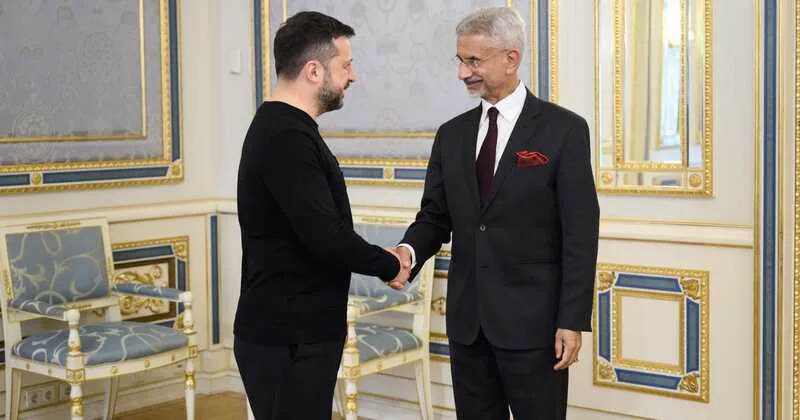
Jaishankar made the remarks during his bilateral visit to Kyiv, Ukraine, where he met Ukrainian Foreign Minister Andrii Sybiha and later called on Ukrainian President Volodymyr Zelenskyy. Responding to a media question after his meeting with Sybiha, Jaishankar defended India’s continued purchase of Russian oil despite criticism from Western countries and Ukraine.
“This conflict, which is today in its fifth year, will not dissolve because somebody is buying or not buying oil or alumina or minerals or metals,” Jaishankar said on September 3.
He underlined that the Russia-Ukraine war would instead be solved through “dialogue, diplomacy and negotiations”, adding that India would encourage such an approach.
Jaishankar said he respected Ukraine’s position on Russian oil purchases but expected Ukraine to respect India’s position as well. For India, Russian oil has become an important source of crude for domestic refiners, particularly amid disruption and uncertainty in global energy markets. India has maintained that securing affordable and reliable energy supplies for its population is a national priority.
EAM S. Jaishankar SHUTS DOWN a Ukrainian journalist asking whether India will STOP buying Russian oil if the US imposes a 100% tariff.
“Ukraine has its perspective, which we respect. India has ours, which I expect you to respect.”
=> India will decide what’s best for 1.4…
— Megh Updates 🚨™ (@MeghUpdates) September 3, 2026
The External Affairs Minister also reiterated India’s broader position that the Ukraine conflict cannot be resolved on the battlefield. He said India had consistently maintained that this was not an era of war and that solutions should emerge through diplomacy. He added that India was ready to “help in any manner” to contribute to ending the Russia-Ukraine war.
PM Modi’s ‘endless war’ message and India’s diplomatic balancing
Jaishankar’s remarks came just days after Prime Minister Narendra Modi called on Russian President Vladimir Putin to move from “endless war” towards an “end of war”. PM Modi made the appeal during his meeting with Putin on the sidelines of the Shanghai Cooperation Organisation (SCO) leaders’ summit in Bishkek on August 31.
PM Modi is also scheduled to meet Putin at the BRICS summit in New Delhi on September 12–13, adding another significant diplomatic engagement between the two leaders. Jaishankar’s visit to Ukraine therefore reflects India’s effort to maintain communication with both Russia and Ukraine while protecting its independent foreign and energy policy.
Jaishankar had accompanied PM Modi during the Prime Minister’s visit to Ukraine in August 2024, but his September 3 visit was his first dedicated bilateral visit to Ukraine as External Affairs Minister. Sybiha welcomed Modi’s call to move from an “endless war” towards an “end of the war” and said that Ukraine “stands ready for diplomacy”.
Zelenskyy also thanked India for its commitment to ending what he described as Russia’s “unjust war” against Ukraine. He said peace was needed and expressed hope that major world powers would take a clear position that the war must end and that a reliable peace should be achieved.
Black sea shipping, food security and India-Ukraine cooperation
The discussions in Kyiv also focused on the wider consequences of the Russia-Ukraine war, particularly attacks affecting commercial shipping in the Black Sea. Jaishankar said Indian seafarers serve on ships flying many flags and have been among those affected by the conflict. He noted that disruptions to international shipping were creating consequences for countries across the Global South, including shortages and higher pressures involving fuel, fertiliser and food.
Jaishankar was referring to the deaths of Indians, including five Indian seafarers since July 2026, amid exchanges of fire between Russia and Ukraine. He said the safety of civilian shipping and the wider impact on global energy and food security were important concerns for India.
Zelenskyy said India and Ukraine had discussed the situation in the Black Sea, including threats to civilian shipping and the need to restore freedom of navigation. He argued that disruptions to Ukrainian ports, food corridors and supplies were affecting global relations and called for international efforts to guarantee maritime security.
Beyond the war, Jaishankar and Sybiha discussed strengthening India-Ukraine bilateral cooperation in infrastructure, pharmaceuticals, agriculture, fertilisers, machinery, chemicals, consumer goods, technology and digitalisation. Jaishankar noted that bilateral trade had faced disruption during the past four years because of the war and logistical challenges, but said there had also been resilience and new possibilities.
Jaishankar highlighted India’s progress in digital capabilities, innovation, startups and artificial intelligence, saying these areas could create new opportunities for cooperation with Ukraine in health, education, agriculture and governance. He invited Sybiha to India for the next meeting of the Intergovernmental Commission, signalling that despite differences over Russian oil and the war, India intends to deepen its engagement with Ukraine while continuing to safeguard its energy security and independent foreign policy.