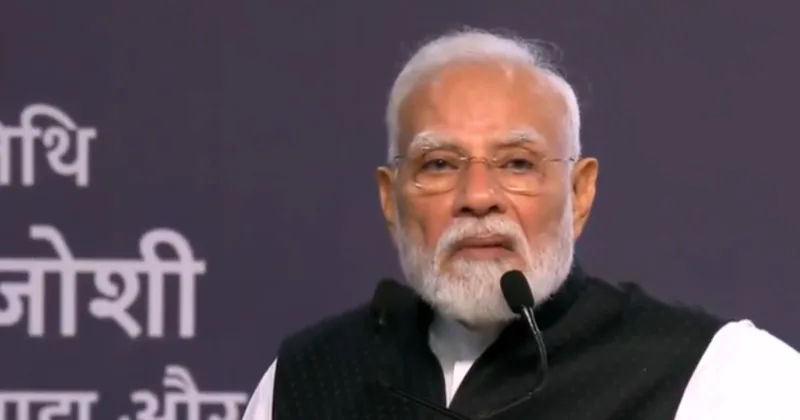
NEW DELHI: Participating in the historic 100th-anniversary milestone of Shri Ram College of Commerce (SRCC) on September 5, Prime Minister Narendra Modi offered a scathing critique of critics and ideologues while reflecting on India’s administrative transformation over the past two decades.
Speaking on Teachers’ Day to an audience of students, faculty, and distinguished alumni, the Prime Minister revisited his Independence Day address from the ramparts of the Red Fort, where he had highlighted the challenge posed by “Dimagi Naxals”.
“You may have heard my speech from Red Fort. I gave a homeopathic pill from the Red Fort—’Dimagi Naxal’. According to the principles of homeopathy, when you begin homeopathic treatment, the disease initially gets worse. That is the nature of homeopathy,” PM Modi said. “Similarly, as soon as I gave the ‘Dimagi Naxal’ homeopathic pill, all the ‘Dimagi Naxals’ started coming out one after another. And now the public is also seeing the true colours of those who are promoting this illness.”
Contrasting Crisis Governance: Past vs. Present
Beyond political commentary, the Prime Minister reflected on the evolution of crisis management in Indian governance, pushing back against perceptions that navigating global disruptions is straightforward.
Modi urged the student audience to recall historical policy responses to national crises, referencing the handling of the 2013 Kedarnath disaster, the 2008 global financial meltdown, and the 2008 Mumbai terror attacks. He asserted that past administrations showed a lack of institutional courage, leaving the banking sector on the brink of collapse and coming under external pressure following cross-border terror strikes.
In contrast, PM Modi highlighted the multiple compound shocks faced by his administration over the past six years—including the COVID-19 pandemic, the Russia-Ukraine conflict, the weaponisation of global trade supply chains, and ongoing instability in West Asia.
Resilience Powered by Citizens
Addressing expectations surrounding national stability during international crises, the Prime Minister noted that critics frequently anticipated the country’s economic or administrative stumble during global downturns.
“Every time, people said, ‘Now India will not survive.’ And those who are my biggest admirers were happy, thinking, ‘Now Modi is trapped. Now Modi has fallen. Now they will crush him,'” he remarked. “But the blessings of the people of my country have so much strength, so much strength, that every wish of those who want India to fail is being left unfulfilled.”
The address marked PM Modi’s return to the SRCC campus 13 years after his famous 2013 “Glass Full” address, reconnecting with the nation’s youth on the institution’s centenary year.