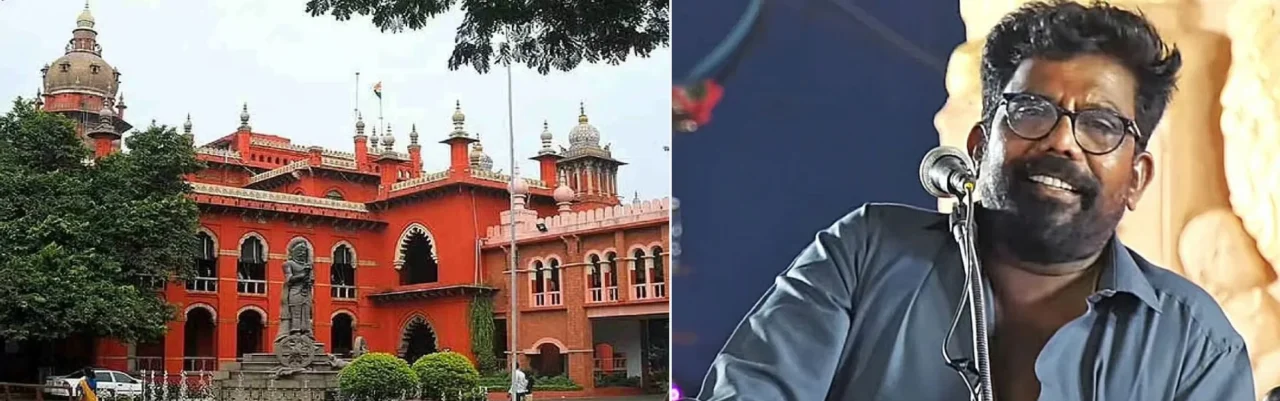
CHENNAI: In a significant reaffirmation of the distinction between legitimate criticism and deliberate religious provocation, the Madras High Court has quashed criminal proceedings against V Kanal Kannan, State President of the Art and Culture Wing of Hindu Munnani, over a social-media post concerning foreign religious culture.
Justice R Vijayakumar of Madurai Bench of Madras High Court, held that the ingredients necessary to prosecute Kannan under Sections 295A and 505(2) of the Indian Penal Code were not attracted. The Court consequently quashed the charge sheet pending before Judicial Magistrate-II, Nagercoil, observing that continuation of the proceedings would amount to an abuse of the process of law.
The prosecution arose from a video posted by Kannan on his X account on June 18, 2023. The video showed a foreign pastor dancing with a woman. Along with it, Kannan posted a caption stating that the video depicted the true condition of foreign religious culture and called upon Hindus to reflect upon it.
A member of the Christian community found the post offensive and lodged a complaint. This resulted in the registration of Crime No.16 of 2023 and, subsequently, a charge sheet accusing Kannan of deliberately insulting religious feelings and promoting enmity between communities.
Appearing for Kannan, Senior Advocate Karthikeyan submitted that the video was genuine and had not been fabricated or manipulated. He argued that no obscene caption had been added and that the post lacked the deliberate intention required to attract the penal provisions. The complainant, despite service of notice, did not appear before the High Court.
The State maintained that Kannan had repeatedly uploaded such content and alleged that the post was capable of creating enmity among religious groups.
The High Court, however, examined the actual contents of the charge sheet rather than proceeding merely on the subjective offence claimed by the complainant. It noted that there was no allegation that the video was a deepfake. More importantly, the caption was addressed to Hindus and called upon them to think about what was depicted. It was not addressed to Christians.
This distinction lies at the heart of the decision. Section 295A does not criminalise every expression that causes displeasure to a religious individual. It requires a deliberate and malicious intention to outrage the religious feelings of a class. Similarly, Section 505(2) cannot be mechanically invoked without material demonstrating promotion of enmity or ill-will between communities.
A plural society cannot survive if the threshold of criminality is reduced to the personal sensitivity of the most easily offended individual. Members of every faith must retain the space to debate cultural influences, religious practices and competing worldviews. Calling upon Hindus to reflect upon foreign religious culture cannot, without the required criminal intent, be converted into an offence against communal harmony.
The decision therefore protects something larger than one social-media user. It safeguards the right of Hindu society to engage in internal reflection and civilisational dialogue without automatically attracting the coercive machinery of criminal law.
Case: V Kanal Kannan v State of Tamil Nadu, Crl OP (MD) No.13963 of 2025, decided on August 24, 2026.