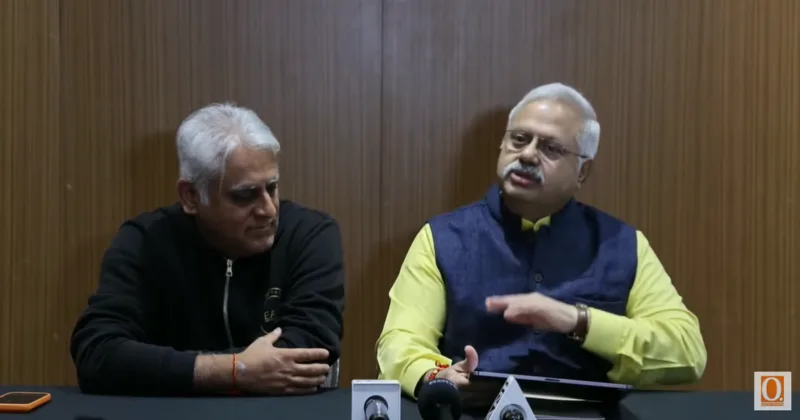
LONDON: “RSS Sarsanghchalak Dr Mohan Bhagwat’s ongoing UK visit is aimed at deepening civilisational and cultural dialogue, strengthening people-to-people relations and sharing the Sangh’s century-long experience with the world,” said RSS Akhil Bharatiya Prachar Pramukh Sunil Ambekar during a press interaction in London on September 4, 2026. Briefing the media ahead of Dr Bhagwat’s community leaders’ programme, Ambekar outlined the significance, objectives and key engagements of the Sarsanghchalak’s UK visit.
The visit has generated significant enthusiasm among British Hindus, with several community and social organisations coming together to welcome the RSS Sarsanghchalak and participate in the engagements planned during his stay.
Dr Mohan Bhagwat has arrived in the UK on September 2 and his UK tour will continue till September 7. He will return to Delhi after completing the UK leg of his 15-day tour to the United States, Canada and the UK, Sunil Ambekar informed.
He said the visit is taking place on the occasion of the centenary year of the Rashtriya Swayamsevak Sangh. “This is the tour on the occasion of the centenary year of RSS,” he said.
Explaining the significance of the centenary year, Ambekar said the Rashtriya Swayamsevak Sangh is the largest voluntary organisation based in Bharat and was founded by Dr Hedgewar in 1925. He said the Sangh completed 100 years last year and 2025–26 is being observed as its centenary year.
He said there has been extensive outreach across Bharat during the centenary year. The Sangh has reached people from different sections of society, different areas and professions, with dialogue taking place within society and communities at large.
He said the Sangh decided to undertake a global outreach during the centenary year to communicate the developments and positive changes that have taken place in Bharat over the last hundred years, particularly after Independence.
He added that the outreach aims to communicate the vision, mission and activities of the RSS, its journey over the last 100 years and the message emerging from its experiences for humanity and the world. “This outreach is communicated with the world directly,” he said, adding that during the centenary year, the Sangh is trying to reach important public personalities, associations and organisations for larger global peace and dialogue.
He added that there is also a need for civilisational and cultural relations at large. “As the largest voluntary organisation based on culture and civilisation, RSS definitely can play an important role at the world level,” he said.
He said the global outreach was initiated in April this year with the tour of RSS Sarkaryavah Dattatreya Hosabale. He said Hosabale Ji travelled to the United States, Germany and the UK and met different types of think tanks, people from politics, business and academia.
He said the response to the visit was very good and the present tour has been initiated to continue the same civilisational dialogue.
Sunil Ambekar said the Sangh believes that, apart from diplomatic dialogue at the government level, there is a need for people-to-people dialogue as well as civilisational and cultural relations. As the largest voluntary organisation rooted in culture and civilisation, the RSS can play an important role at the global level.
Giving details about the RSS and its organisational expansion, Ambekar said the Sangh is specifically grounded and well-rooted in Bharat. He said the RSS has spread its basic units, known as Shakhas, across the country. “More than 88,000 local daily gatherings, we call Shakha, are going on,” he said. He added that apart from these, there are weekly and monthly gatherings, taking the total number to 134,000.
Ambekar said RSS swayamssevaks are engaged in social service. He explained that the Shakhas are mainly focused on character building and, through character building, organising society.
He said the networking of people with good character, devotion for the country and commitment to serving people has enabled the RSS to initiate several service projects for those in need, including people requiring economic or social assistance.
He said there are different types of service projects in areas including education, self-employment, empowerment, employment, healthcare and women’s empowerment. He added that whenever a new requirement emerges, the Sangh initiates new types of projects.
Ambekar said the RSS has an outlook centred on civilisational values, unity in diversity and social harmony. He said the work of the Sangh has been intended to organise society and promote social cohesion while rejecting divisiveness, radicalism and violence in all forms.
He said that specifically on the occasion of the centenary, the RSS has appealed to people to undertake five initiatives (Panch Parivartan).
Ambekar said that during the centenary year, the Sangh has reached more than 1,000 million households with its message.
Briefing about Dr Mohan Bhagwat Ji’s tour of the United States and Canada, Sunil Ambekar said the Sarsanghchalak was engaged in a civilisational dialogue from New York to Toronto and is now in London.
He said that on August 29, Dr Mohan Bhagwat addressed a Multifaith Leaders Meeting attended by numerous participants from different denominations and religions.
He said Dr Bhagwat also addressed the Universal Oneness Conference at Madison Square Garden, which was attended by more than 6,000 delegates from 853 cities and 39 US states.
He described it as a huge gathering filled with enthusiasm, representing more than 250 different organisations and associations.
He said all these organisations participated in the dialogue and that the Interfaith Leaders Meeting adopted a five-point call-for-action resolution. He said the initiative was aimed at world peace and was supported by the action taken by the RSS over the last 100 years. He added that the Sangh has now taken this initiative to the global level.
Ambekar said Dr Bhagwat in Canada addressed the ‘Hindu Vishva Bandhu’ gathering, conveying the message that Hindus are brothers to the whole world.
He said more than 2,000 delegates representing 175 organisations from all 10 Canadian provinces participated in the gathering.
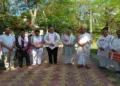
He said that during the UK visit, Dr Bhagwat will meet important people from public life and engage with different organisations. Dr Bhagwat had already visited the Swaminarayan Temple in London, including the Shri Swaminarayan Temple in Willesden, and the Khalsa Jatha British Gurudwara. He added that Dr Bhagwat is also scheduled to visit a Jain temple during his London visit.
Ambekar said these visits will strengthen dialogue, collaboration and long-term relationships within the UK as well as the relationship between the UK and India.
He said the visit is primarily oriented towards civilisational and cultural relations and developing dialogue along cultural and civilisational lines.
Ambekar said a major programme will be held for community leaders. He said the programme has been organised and initiated by the Hindu Swayamsevak Sangh (HSS) and is now supported by more than 310 organisations.
He said Dr Bhagwat will participate in the programme on September 6. He described it as a continuation of his US and Canada tour and said it will be a community leaders’ reception and civilisational dialogue under the theme ‘Celebration of Oneness’.
Ambekar said Dr Bhagwat Ji’s message is about uniting the world. “Yes, we have different nations, we have different systems, but certainly we have a common point to have a dialogue, to have an integration,” he said.
He said this dialogue carries India’s larger message of ‘Vasudhaiva Kutumbakam’—the world is a family. He added that this message will be translated into dialogues and collaborations in the UK as well.
He added that apart from the main programme, several formal and informal meetings are being held with important people, including those from academia, religious faith leaders and different walks of life, as well as politicians, business people and think tanks.
He said a function was also organised in the evening for prominent people from across the United Kingdom. Dr Bhagwat participated in a chat conducted by a professional moderator, who interviewed him for approximately 40 minutes.
He said the session was subsequently opened for questions and answers from the audience. He added that several interesting questions were raised on topics and issues that people in the UK are interested in understanding about the RSS, and Dr Bhagwat addressed all those points.
He said leaders from Parliament, including members of the House of Commons and House of Lords, business leaders were also present, along with representatives of corporations.
Responding to questions during the press briefing, he said RSS remains open to dialogue with people holding different views. He said differences of opinion are natural in a democracy and that the organisation is willing to engage with those who want to have a dialogue.
He clarified that the UK visit is not limited to engagement with the Indian diaspora. He said the delegation is also engaging with people from academia, think tanks and different walks of public life. On future engagement with the diaspora, he indicated that interaction would be a continuous process and not limited to a one-time visit.
On a question about whether the RSS is seeking to redefine Hindutva, he said Hindutva is a dynamic civilisational and cultural concept and can be contextualised according to contemporary times.
He said Hindutva is fundamentally about oneness, connectivity, caring for others and social cohesion, it seeks to emphasise unity and the interconnectedness of society.
Responding to the argument that Hindutva politics creates social divisions in Western societies, he said there are misconceptions arising from different misunderstandings of Bharat, nationhood and Hindutva.
He said Bharat should be understood primarily as a civilisational and cultural concept. He further said Hindutva respects different religious traditions and practices and should not be understood as a narrowly defined religious identity. He emphasised the principles of plurality, respect and social unity associated with the RSS’s understanding of Hindutva.
Ambekar said the RSS’s understanding of Bharat encompasses people following different religions and religious practices.
On the future direction of the RSS after completing 100 years, Ambekar said the centenary is an important milestone for the organisation. He said the RSS has spent the last 100 years working in Bharat, seeking to understand and reinterpret its history and past while envisioning the future Bharat. He described the journey as a growth story of how society can be reorganised from the grassroots level. “After the hundred years’ experience, I think it is the time to share these experiences with the world,” he said.
He added that if there are misconceptions about the RSS, clearing those misconceptions would also be part of the process.
When asked whether the RSS would expand internationally, Ambekar clarified that the RSS works in Bharat. He said the organisation would, however, continue its dialogue with people at the global level.
He added that Dr Bhagwat would also give a message to young people during his engagements in the UK. Ambekar clarified that there is no RSS membership structure, adding that the Hindu Swayamsevak Sangh (HSS) is an independent UK-based organisation.
Responding to a question about allegations that the RSS was involved in the violence in Leicester, Ambekar described the matter as a domestic issue. He said there is no question of RSS involvement. He said Hindus have always been a peace-loving community and have stood for cohesion.
When asked why the RSS refers to India as “Bharat” and whether there was a distinction between the two terms, he said that the Constitution itself recognises both names. “Already the Constitution has used India, that is Bharat,” he said, adding that there should be nothing surprising about the RSS using the term “Bharat”. When the journalist sought to know whether the RSS attached any distinct meaning to “Bharat” beyond the constitutional usage of “India”, he reiterated that the Constitution-makers had themselves used both terms.
As part of the Rashtriya Swayamsevak Sangh’s centenary-year global outreach, Sarsanghchalak Dr Mohan Bhagwat undertook a significant visit to the United States and Canada from August 25, engaging with the Indian diaspora, Hindu organisations, community leaders and professionals. Earlier, in New York, Dr Bhagwat addressed the Universal Oneness Celebration at Madison Square Garden on August 29.
In Canada, he addressed the ‘Hindu Vishwa Bandhu – Embrace the World in Friendship’ gathering in Toronto, attended by more than 2,000 delegates representing 175 organisations across Canada. He spoke about Bharat’s civilisational tradition of welcoming diverse communities and highlighted the principle of Vasudhaiva Kutumbakam.
Dr Mohan Bhagwat is now in the final leg of his three-nation visit, having arrived in London after completing engagements in the United States and Canada. In the UK, the RSS Sarsanghchalak is meeting Hindu and community organisations and will address the Indian diaspora, carrying forward the Sangh’s message of social harmony, selfless service. More than 100 British Hindu and community organisations have welcomed his arrival.