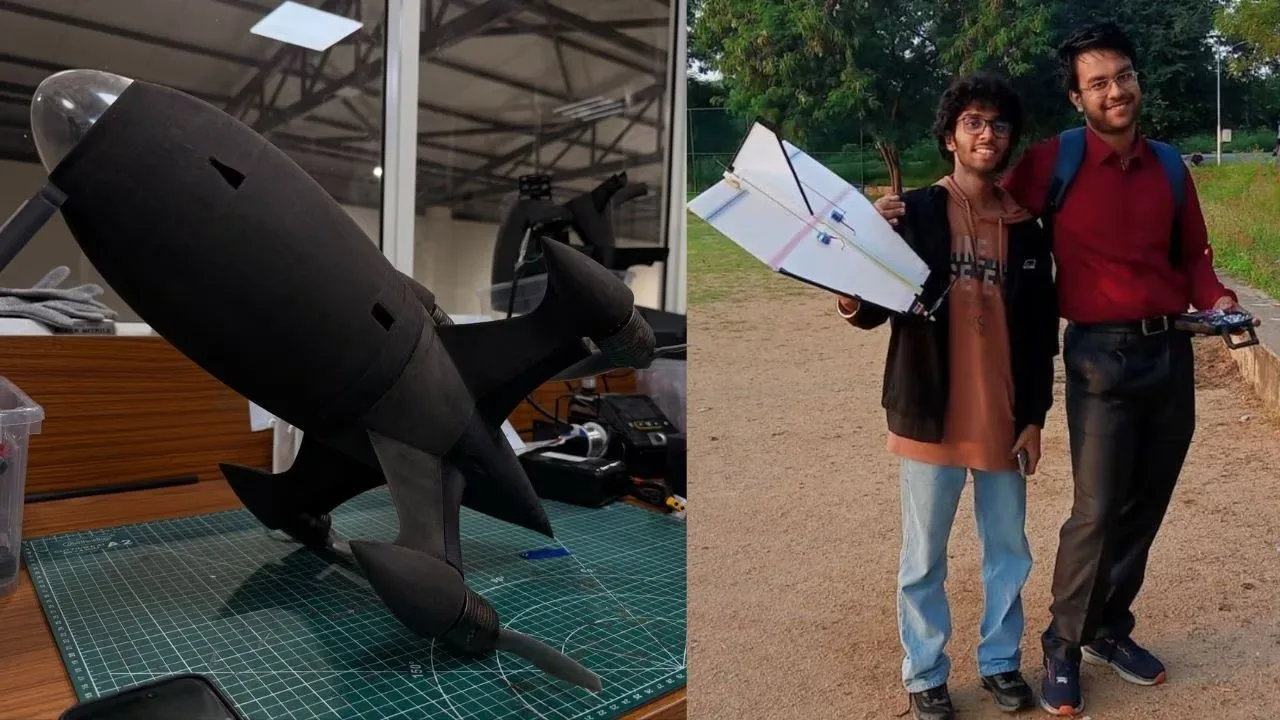
Hyderabad-based defence technology startup Apollian Dynamics has developed the Ahuti Mk-II, an interceptor drone that the company says has achieved a top speed of 498 kilometres per hour. The claimed record has been registered in the India Book of Records.
Apollian Dynamics founder Jayant Khatri announced the achievement on X, saying the Ahuti Mk-II had surpassed the company’s earlier prototype record of 325 kmph.
The development comes at a time when drones are playing an increasingly important role in modern warfare. From surveillance and reconnaissance to precision strikes, relatively inexpensive unmanned systems are being used extensively on battlefields, creating a growing requirement for affordable ways to detect and neutralise them.
Unlike conventional commercial drones designed primarily for photography, surveillance or transportation, an interceptor drone is built around speed, manoeuvrability and rapid engagement.
Ahuti Mk-II designed to intercept hostile drones
According to the company, the Ahuti Mk-II has been designed specifically to intercept incoming hostile drones and destroy them in the air.
The basic concept is similar to a rapidly moving aerial interceptor. Instead of relying exclusively on expensive conventional missiles to counter every hostile unmanned aircraft, a high-speed interceptor drone could potentially provide another layer of defence against certain aerial threats.
The need for such systems has become more apparent as militaries around the world increasingly encounter relatively inexpensive attack drones.
One example frequently cited in discussions around the changing nature of aerial warfare is the Shahed-136, a one-way attack drone widely associated with Iran and its use by Russia in the Ukraine conflict. Such systems have demonstrated how relatively low-cost unmanned platforms can force adversaries to spend considerably more on air-defence interceptors.
Speed increased from 325 kmph to 498 Kmph
The Ahuti Mk-II represents a significant increase over Apollian Dynamics’ previous reported speed record of 325 kmph.
The company says it spent around eight months redesigning and refining the platform to achieve the higher speed. Changes were reportedly made to the drone’s engine, motor and aerodynamic body design.
According to the company, around 10 different design iterations were developed during the process before arriving at the current configuration.
The drone reportedly draws up to 400 amperes of current during operation, helping deliver the power required for its high-speed flight.
The company had earlier supplied the Indian Army with drones capable of speeds of around 300 kmph, according to the information released about the project.
The cost of the Ahuti Mk-II has not been disclosed.
Tested with Indian army support
The interceptor drone has reportedly undergone testing with the Indian Army at the Babina and Gopalpur firing ranges.
Such testing is important because an interceptor intended for military use needs to demonstrate more than a high top speed. Its usefulness would ultimately depend on factors such as detection, tracking, manoeuvrability, reaction time, endurance, reliability and its ability to engage the intended target under operational conditions.
The company has positioned the Ahuti Mk-II as part of a broader effort to develop high-performance but relatively low-cost defence technologies.
The underlying proposition is straightforward: if hostile drones can be produced cheaply, the systems used to defeat them also need to be economical enough to prevent the defender from spending disproportionately more on every interception.
Why interceptor drones are different
Conventional drones are generally designed to remain stable in the air and may be optimised for surveillance, photography, mapping, communications or carrying payloads.
An interceptor drone has a very different design priority.
It needs to accelerate rapidly, manoeuvre at high speed and reach a target before the incoming threat reaches its intended destination. In that sense, the platform functions more like a reusable or expendable aerial interceptor than a conventional commercial drone.
The Ahuti Mk-II’s reported 498 kmph speed is therefore significant primarily because of the role for which the platform has been designed, rather than simply because of the number itself.
Looking beyond interceptor drones
Apollian Dynamics says its ambitions extend beyond high-speed drones.
The company reportedly aims to develop a much larger cruise-missile platform by 2032, capable of carrying a payload running into thousands of kilograms.
Professor M. Rama Manohara Babu, described as a former director of India’s Agni missile programme, is reportedly advising the company on the project.
If pursued successfully, such a programme would represent a substantial expansion from relatively compact unmanned aerial systems into much larger defence platforms.
For now, however, the Ahuti Mk-II remains the company’s most prominent development, with its reported 498 kmph performance highlighting the growing role of Indian startups in developing specialised technologies for the country’s evolving counter-drone requirements.