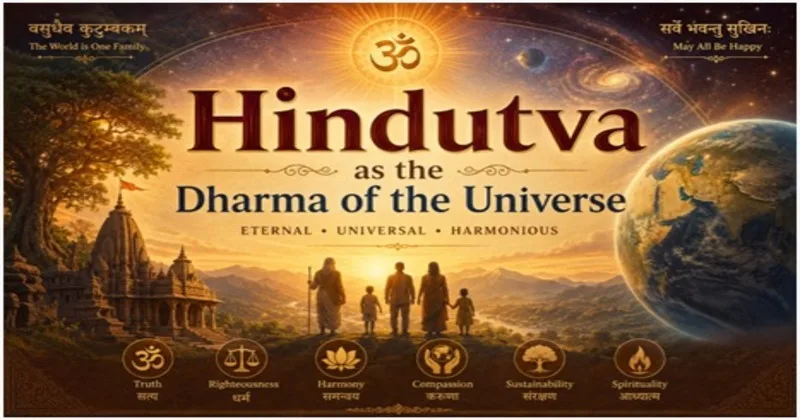
The word ‘Hindutva’ is often used to describe a political or sanskritik identity. Yet, when viewed through the broader civilisational philosophy of Bharat, it can also be understood as an expression of Dharma — the principle that sustains individual life, society, nature and the universe. In this broader sense, Hindutva is not merely a label of identity. It represents a way of seeing the world, grounded in responsibility, harmony, interdependence, self-discipline and universal well-being. It asks not only who we are, but also how we should live and what obligations we have towards others and the world around us.
The Hindu tradition does not begin with the assumption that humanity must follow one prophet, one scripture or one exclusive path. Instead, it recognises that truth may be approached in many ways. Its central concern is not simply what a person believes, but how that person lives, acts and contributes to the larger order of existence. This concern for the well-being of all provides an important foundation for understanding Dharma and, through it, the civilisational meaning associated with Hindutva.
Difference between dharma and religion
The English word ‘religion’ usually refers to a system of beliefs, doctrines, rituals and institutions connected with the worship of the divine. The Sanskrit word ‘Dharma’, however, carries a much wider meaning. Dharma is derived from the Sanskrit root ‘dhṛ’, meaning to hold, sustain or support. Dharma, therefore, refers to that which sustains and preserves the order of individual, social and cosmic life.
The Mahabharat expresses this idea in a well-known formulation: Dhaaranaat Dharmam ityahuh Dharmordhaarayate prajaah — It is called Dharma because it sustains; Dharma sustains all beings. Dharma cannot, therefore, be reduced to ritual or religious belief. It includes duty, ethical conduct, justice, compassion, responsibility, self-restraint and the ability to act appropriately in a given situation.
This distinction becomes especially important when Dharma is compared with the modern idea of religion. Religion may ask: What do I believe? Which tradition do I belong to? How do I worship? Dharma asks additional questions: How should I live? What do I owe to others? What action will preserve harmony?
The Bhagavad Gita states: Svadharme nidhanam shreyah Paradharmo bhayaavahah — It is better to perform one’s own Dharma, even imperfectly, than to perform another’s Dharma. (3.35) Here, Svadharma refers to one’s appropriate responsibility and righteous course of action. It is not simply a reference to religious affiliation.
Dharma is therefore at once personal, social, ethical and cosmic. It guides individual conduct, shapes social responsibility and connects human life with the larger order of existence.
The philosophical foundations
The Hindu worldview is not based on uniformity. It is built upon the idea of unity within diversity. Hindu thought accepts that people may approach ultimate reality through different paths and forms of spiritual practice.
The Rigveda declares: Ekam sat vipra bahudhaa vadanti — Truth is One; the wise speak of it in many ways. (1.164.46) This verse captures an important feature of Hindu thought: different spiritual paths need not be treated as enemies. The paths of Jnana (knowledge), Bhakti (devotion), Nishkaama Karma (selfless action), and Rajayoga (spiritual discipline), can coexist within a larger spiritual framework.
Another central principle is the recognition that the divine is present throughout existence: Ishavasyamidam Sarvam Yatkincha Jagatyan Jagat। Tena Tyaktena Bhunjitha Ma Gridhah Kasyasviddhanam।। — All this, whatever exists in this changing universe, is pervaded by the Divine. (Isha Upanishad 1) If the universe is understood as interconnected and pervaded by the same ultimate reality, then hatred, exploitation and careless destruction become contrary to Dharma.
From this perspective, Hindu thought emphasises on values such as: Dharma — righteous and responsible conduct, Satya — truth, Ahimsa — compassion, Seva — service, Tyaga — sacrifice, Samarasata — harmony, Vasudhaiva Kutumbakam — the world is one family and Lokasangraha — working for the well-being and stability of society. This teaching calls upon individuals to turn their inner values into responsible action. Spirituality should not remain confined to private belief; it must also influence the way people treat one another.
Dharma in everyday life
Hindus developed many institutions and practices through which Dharma could become a lived experience rather than an abstract idea. Samskaras (values) mark important stages in a person’s life and are intended to cultivate discipline, responsibility and character. Their purpose is not merely ritualistic. They reflect the belief that human beings require continuous refinement throughout life.
Parivar (family) has traditionally been one of the primary institutions through which values are transmitted. Respect for parents, care for elders, responsibility towards children and concern for relatives turn moral principles into everyday habits. The family, at its best, teaches that individual freedom is accompanied by responsibility.
Seva (service) gives practical expression to the ideal of universal well-being. Feeding the hungry, caring for animals, helping disadvantaged people, teaching children, preserving water sources and contributing to the local community can all become forms of seva. Service is not merely charity. It can also be understood as recognition of the dignity and interconnectedness of all life.
The Yoga tradition teaches that social transformation begins with self-transformation. The Yamas and Niyamas include principles such as truthfulness, non-violence, non-stealing, discipline, purity and contentment. These practices are important because a harmonious society depends not only on laws and institutions but also on individuals who can regulate their desires and actions.
Festivals, pilgrimages, collective worship, storytelling, music and traditional arts transmit philosophical ideas through shared experience. Stories from the Ramayan, Mahabharat and Puranas present ethical questions in forms that remain accessible to ordinary people. They also create a sense of belonging and connect individuals with a larger sanskritik memory.
Rivers, forests, mountains, trees and animals have long occupied an important place in Bharat’s cultural imagination. Sacred groves, reverence for rivers and respect for particular trees and animals reflect the idea that nature is not merely a resource to be consumed. When nature is treated as worthy of respect, environmental responsibility becomes more than a practical necessity; it becomes a moral obligation.
In this way, Dharma moves from: thought → habit → character → social behaviour
The evolution of Hindu society
The civilisation of Bharat has evolved through intellectual debate, spiritual movements, social change and changing historical circumstances. The Vedic tradition developed the idea of Rita, or cosmic order and emphasised harmony among human beings, nature and the divine. The Upanishads later explored deeper questions concerning the Self, consciousness and ultimate reality.
The epics and Puranas brought philosophical ideas into popular cultural forms. The Mahabharat, for example, does not present Dharma as a simple list of rules. Instead, it shows that moral decisions can be difficult and that Dharma often requires wisdom, discernment and sensitivity to circumstances.
Over the centuries, many traditions developed within the broader Bharatiya intellectual landscape. Shaiva, Vaishnava, Shakta and Smarta traditions interacted with Buddhist and Jain thought. Philosophical schools such as Vedanta, Sankhya, Yoga, Nyaya, Vaisheshika and Mimamsa offered different approaches to knowledge, reality and liberation.
The Bhakti movement further expanded access to spiritual expression. Teachers and sants such as Ramanuja, Basavanna, Jnaneshwar, Namdev, Kabir, Meerabai, Chaitanya and Tulsidas emphasised devotion, ethical living and the possibility of a direct relationship with the divine.
In modern times, figures such as Swami Vivekananda, Sri Aurobindo, Dr Hedgewar, Smt Laxmibai Kelkar, Dayananda Saraswati and many others interpreted Bharat’s civilisational thought in response to colonialism, modernity and social reform. This shows that Hindu society has evolved not by abandoning its foundations but by reinterpreting enduring principles in response to changing circumstances. The concept of Dharma itself allows for such development. Dharma requires people to consider time, place, circumstance and responsibility rather than applying rules mechanically.
The universe and universal brotherhood
One of the strongest reasons for understanding Hindutva as a universal Dharma lies in its expansive view of existence.
The well-known Sanskrit expression states: Ayam nijah paroveti gananaa laghuchetasaam/ Udaaracharitanam tu vasudhaiva kutumbakam।। — The narrow-minded distinguish between ‘this is mine’ and ‘that is another’s; for the broad-minded, the whole world is one family. The principle of Vasudhaiva Kutumbakam does not mean that all differences disappear. Rather, it suggests that differences exist within a larger framework of shared existence and mutual responsibility.
The Upanishadic vision goes further: Yastu sarvaani bhootaani aatmanyevaanupashyati। Sarvabhuteshu chaatmaanam tato na vijugupsate।। — One who sees all beings in the Self and the Self in all beings does not hate or reject anyone. (Isha Upanishad 6) This vision provides a philosophical foundation for universal brotherhood. It encourages people to look beyond narrow divisions and recognise the dignity of life in all its forms. The Hindu approach to the universe is not exclusively human-centred. It recognises relationships among human beings, animals, plants, rivers, mountains and the wider cosmos.
The Vedic peace prayer expresses this broad vision: Dyauh shantih antariksha shantih pruthivi shantih aapah shantih oshadhayah shantih। — May there be peace in the heavens, peace in the atmosphere, peace upon the earth, peace in the waters and peace in the plants. (Yajur Veda) Peace is imagined here at several levels of existence. Human prosperity cannot be separated from the health of nature and the balance of the wider world. This is a worldview of interdependence, in which the well-being of human beings is connected with the well-being of the earth.
Dharma in Practice: Our role models
The principles of Hindu Dharma can be understood more clearly through some examples. The life of Bhagwan Ram is traditionally presented as an example of Maryada (disciplined conduct) within the framework of Dharma. Whether read historically, spiritually or symbolically, the Ramayan raises an enduring question: how should a person act when personal desire conflicts with duty? Sri Ram’s story continues to matter because it presents responsibility not as an abstract idea but as a difficult choice that must be lived.
The Bhagavad Gita offers one of the clearest discussions of Dharma as action. Arjuna faces a moral crisis and wishes to withdraw from the conflict. Krishna teaches him that responsible action, performed without selfish attachment, can itself become a spiritual path. Karmanyevaadhikaaraste maa faleshu kadaachana। (Your right is to action alone, never to its fruits — BG 2.47) The teaching does not mean that the results of action are irrelevant. Rather, it asks people to act responsibly without allowing personal reward or fear to become the sole basis of their decisions.
The traditional story of Harishchandra emphasises Satya (Truth). His story presents the ideal that truth should remain important even in the face of severe hardship. Whether understood literally or symbolically, the story asks what values are worth preserving when circumstances become difficult.
Swami Vivekananda carried Bharat’s spiritual message beyond its geographical boundaries. His emphasis on service to humanity as service to the Divine illustrates how philosophical ideas can be transformed into social action. For Vivekananda, spirituality was not an escape from human suffering. It required education, strength, compassion and service.
The higher calling of dharma
To describe Hindutva as the Dharma of the Universe is to emphasise a philosophical vision in which existence is interconnected and human life carries responsibilities that extend beyond the individual. Its values become meaningful when expressed through family, education, service, self-discipline, social responsibility and respect for nature.
The evolution of Hindu society demonstrates that tradition and change need not be opposites. A civilisation can preserve its fundamental principles while adapting their expression to new historical circumstances. Most importantly, the Hindu vision does not limit its concern to one community.
In this sense, Hindutva understood as Dharma is not merely a declaration of identity; it is an invitation to a way of living — a life guided by responsibility rather than selfishness, harmony rather than hostility, service rather than exploitation and universal well-being rather than narrow self-interest.
Its highest aspiration is expressed in the prayer ‘Sarve bhavantu sukhinah…’ which wishes all beings to be happy, free from suffering, experience auspiciousness, and none afflicted by sorrow. Such a vision transforms Dharma from an abstract philosophical concept into a universal ethical responsibility.