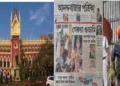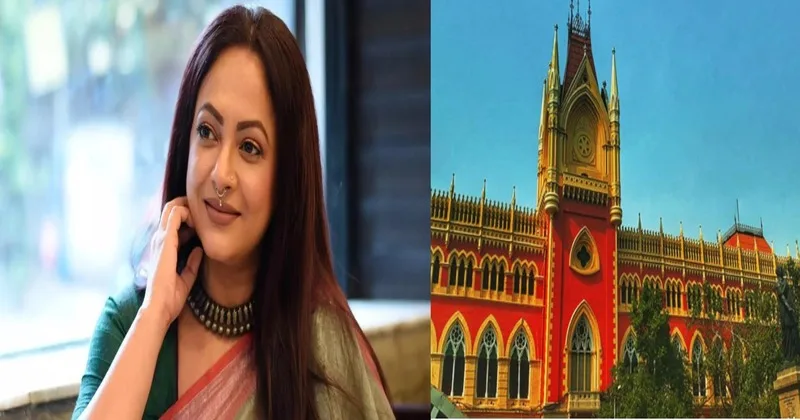
The Calcutta High Court has expressed strong disapproval of a derogatory poster depicting Prime Minister Narendra Modi allegedly displayed by Bengali actor Sreelekha Mitra during a student demonstration, observing that its contents “shocked the conscience” of the Court.
Justice Saugata Bhattacharyya questioned how a prudent and responsible citizen could participate in such conduct and declined to treat the offending depiction as an innocuous cartoon. While granting Mitra conditional interim protection from coercive action, the Court did not quash the FIRs registered against her.
The proceedings arose from Mitra’s participation in a student protest held in Kolkata on July 24 following the NEET-UG paper-leak controversy. During the protest, she was allegedly photographed holding a poster containing an objectionable depiction of the Prime Minister. Several complaints were thereafter lodged in different parts of West Bengal, leading to FIRs alleging, among other things, provocation likely to cause breach of peace and defamation.
Mitra approached the High Court seeking quashing of the criminal proceedings. Her counsel submitted that she had already appeared before the investigating authorities and would continue to cooperate.
After viewing the disputed material, however, the Court made it clear that the expression could not be trivialised merely by describing it as a cartoon. It reportedly characterised the poster as “distasteful” and “obnoxious” and asked why such an act had been committed. The Court further observed that indiscriminate quashing could encourage similar conduct and raised the fundamental question of where the line ought to be drawn.
At the same time, the Bench protected Mitra from coercive action until December 24, 2026, subject to her full cooperation with the investigation. Investigators were directed to give her at least 48 hours’ notice before requiring her appearance. The protection may be reconsidered if she fails to cooperate, and the investigating agency has been asked to submit a report detailing the steps taken.
The order maintains an important constitutional balance. Political leaders, including the Prime Minister, are not immune from criticism, satire or peaceful dissent. India’s democratic tradition permits forceful disagreement with those occupying public office. But freedom of expression does not require society to normalise every egregious representation as political humour.
Bharatiya public discourse has historically accommodated debate, dissent and even sharp intellectual confrontation. Shastrarth was never an invitation to abandon maryada. Rights acquire lasting legitimacy when exercised with responsibility, and democratic disagreement does not become weaker merely because it remains civilised.
Equally, the Court has not prejudged the criminal allegations. Its conditional protection ensures that investigation does not become immediate punishment, while its refusal to quash the FIRs preserves the legal examination of whether the poster crossed the permissible line.
The case therefore concerns neither blind reverence for political authority nor suppression of opposition. It concerns the preservation of dignity and constitutional restraint in public life. Criticism is integral to democracy but obscene depiction of someone who holds the highest office of the Bharat need not be romanticised as valiance.