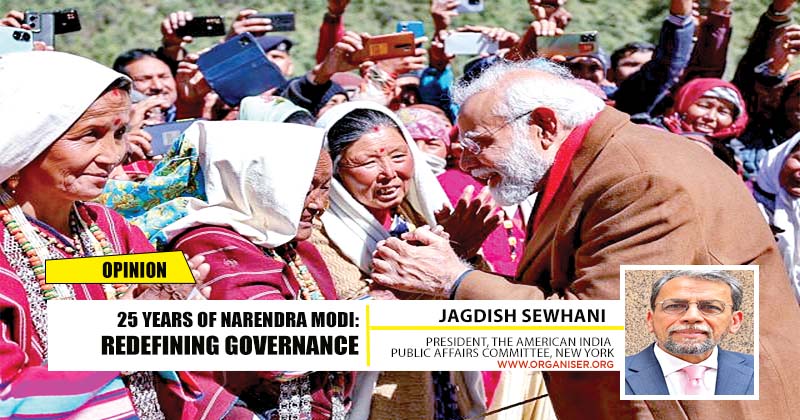
October 7 marks an extraordinary milestone in the public life of Prime Minister Narendra Modi. Twenty-five years ago, on October 7, 2001, he took the oath as Chief Minister of Gujarat. What began that day has become one of the most remarkable journeys in contemporary Indian public life — first leading Gujarat and, since 2014, serving as Prime Minister of India.
To me, one word best describes these 25 years: SEWA—SERVICE
Prime Minister Modi has repeatedly described himself not as a ruler but as a Pradhan Sevak, a servant of the people. Whatever one’s political persuasion, the extraordinary energy with which he has pursued public life is difficult to ignore. His work ethic, discipline and ability to connect public policy with the everyday aspirations of ordinary Indians have become hallmarks of his leadership.
“Time to devote ourselves completely to the service of the nation”
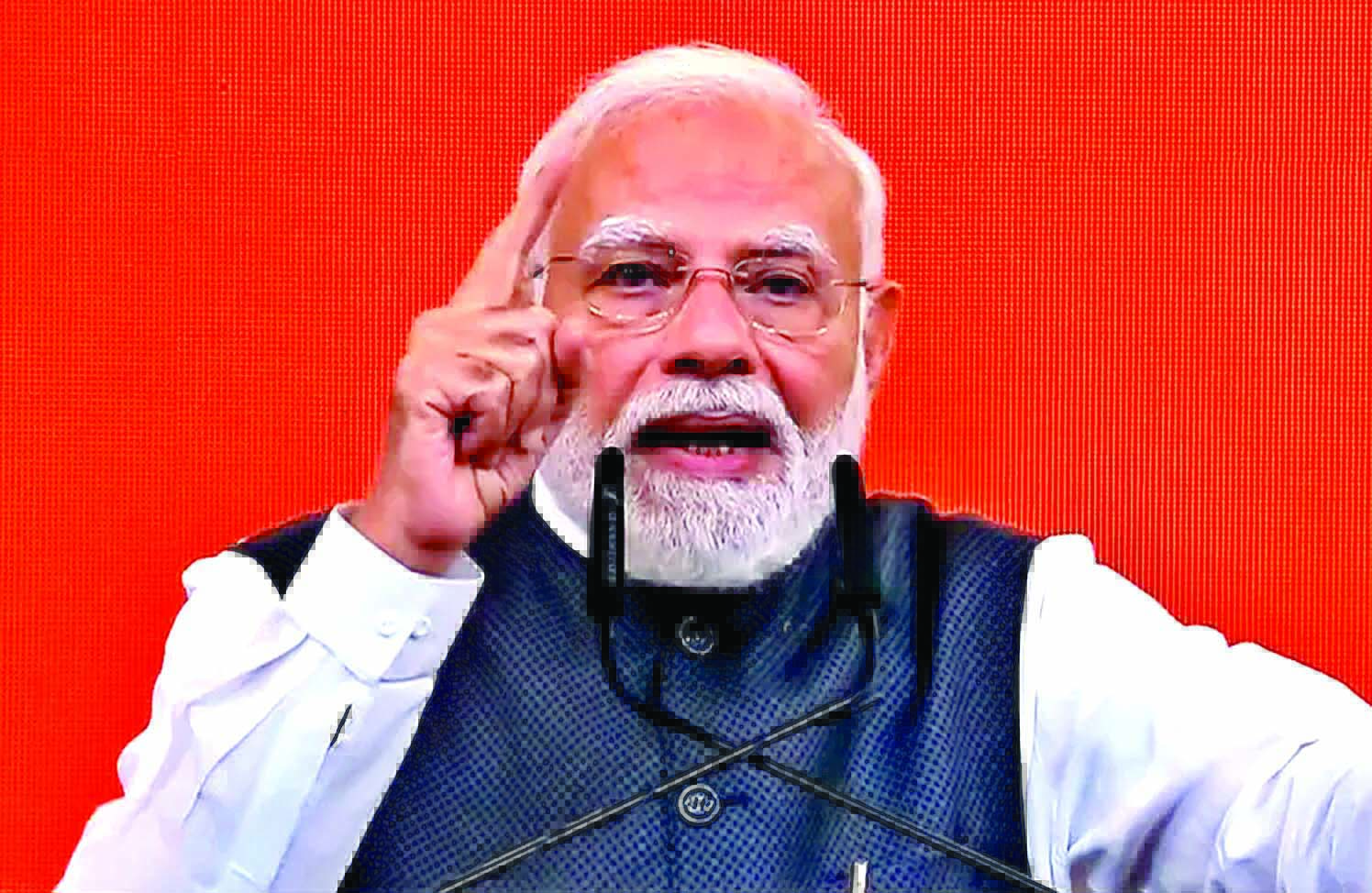
- Today marks 25 years since I began serving as the Head of Government. This is the result of the continued blessings of the people. I bow my head in reverence at the feet of the people of the country
- Whatever I am today, the greatest contribution to it has been made by the people. For me, the people are also a manifestation of God
- Today is a day to renew that promise and reaffirm that resolve – that we will accomplish it. We will do it
- A developed India by 2047- we will do it. Becoming the world’s third-largest economy- we will do it. A self-reliant India- we will do it. Hosting the Olympics – we will do it. Taking our presence into space- we will do it
- I have always been a person who lives not for ambition, but for a mission
- Those who made me win taught me to remain humble. Those who brought me down taught me how to rise again. Those who stood by me showed me the power of faith and trust
- Those who opposed me taught me the power of democracy. Chandrayaan taught me how to rise from failure. COVID taught me the importance of collective consciousness. The media, through its bitter and sweet experiences, inspired me to keep moving forward
- Every village and every poor person taught me that even when means and resources are limited, our dreams must be big and our courage must remain high
- I have had only one purpose in life: selfless action for the nation. For me, action is everything. Action is my duty and my dharma. ‘Sabka Saath, Sabka Vikas’ -the participation and development of all has been the foundation of good governance for me
- This is not a time to rest. This is a time to move forward with determination and vision. It is a time to devote ourselves completely to the service of the nation (Salient points of speech of Prime Minister Narendra Modi at “VIksit Bharat Sankalp Sabha – Seva Jyoti Yatra in New Delhi on October 7)
His concept of Sewa has also sought to give dignity to those who were too often at the margins of India’s development. A home for a poor family is not merely a roof. A toilet is not merely infrastructure. A bank account can mean financial inclusion and independence. Clean drinking water can transform the health of an entire family. Electricity, cooking gas and digital connectivity can change opportunities available to people, particularly women.
This is where Modi’s philosophy of service has been most visible: in attempting to translate large national ambitions into tangible improvements in people’s lives.
Extraordinary Transformation: Extends Beyond Borders
But the story of these 25 years extends well beyond India’s borders. As someone who has spent decades working with the Indian-American community, I have witnessed another transformation: the relationship between India and its diaspora.
Prime Minister Modi has made overseas Indians feel that while they may live thousands of miles from India, they remain an integral part of India’s story.
From Madison Square Garden in New York to gatherings in Houston, Washington and other cities around the world, his interaction with the diaspora has carried a consistent message — India values your achievements, takes pride in your success and considers you a partner in its future. That emotional connection matters.
For generations of Indians who built their lives abroad, India was always home in their hearts. Under Modi, the diaspora has increasingly been treated not simply as a community of expatriates, but as a bridge between India and the world.
At the same time, India’s stature internationally has risen significantly. Today, India participates in global conversations with greater confidence — whether on economic growth, technology, climate change, security, development or the concerns of the Global South.
Setting International Agenda
Modi’s leadership has also given India a larger role in shaping the international agenda. From India’s G20 presidency and the inclusion of the African Union as a permanent member of the grouping to strengthening partnerships with the United States, Europe, the Indo-Pacific and the Global South, he has sought to position India as a country capable of building bridges in an increasingly divided world. His engagement with leaders across geopolitical divides reflects a belief that India need not choose between competing centres of power, but can speak with confidence in its own voice. For millions of Indians at home and abroad, seeing India command that respect on the world stage has itself been a source of enormous pride.
Yet perhaps the most compelling expression of sewa has come when India has extended a helping hand beyond its own people.
During the COVID-19 pandemic, India supplied vaccines and medicines to countries around the world. During conflicts and natural disasters, India has undertaken humanitarian and evacuation missions, sometimes helping citizens of other countries alongside its own. India’s development partnerships across the Global South have similarly reflected the belief that progress acquires greater meaning when it is shared. This philosophy draws from an ancient Indian idea: Vasudhaiva Kutumbakam — the world is one family.
Twenty-five years is a long time in public life. Governments change. Political circumstances change. Nations themselves change. What is striking about Narendra Modi’s journey from Gandhinagar to New Delhi is the continuity of his central message: Public office must ultimately be about service.
There will, naturally, be different assessments of any leader who has governed for so long and attempted change on such a scale. That is the nature of democracy. But milestones also provide an opportunity to look at the larger arc of a public life.
For me, Modi’s 25-year journey is ultimately a story of sewa — service to the poor, service to India’s aspirations, service that reaches out to the Indian diaspora, and service that increasingly extends beyond India’s shores. On October 7, as Narendra Modi completes 25 years in elected executive office, India can look back at an extraordinary journey. But perhaps the more important question is what lies ahead. For a man who has made Sewa the vocabulary of his public life, the milestone should not be seen as a destination. It is another day in the service of India.