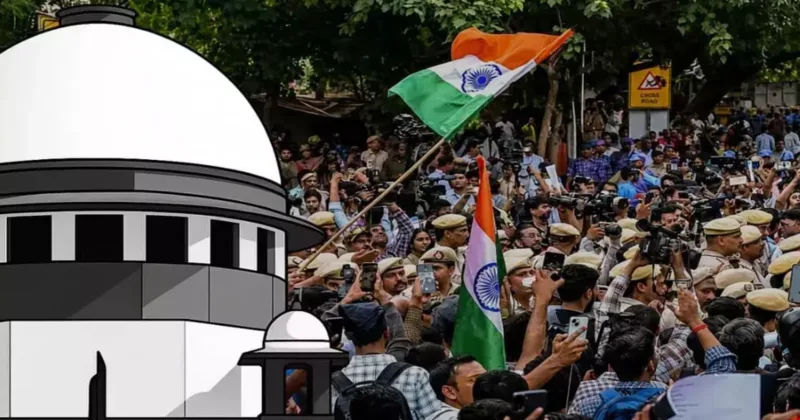
The Supreme Court has brought criminal proceedings arising from the July NEET protests spearheaded by Cockroach Janta Party (CJP) to an end across the country, invoking its extraordinary power under Article 142 of the Constitution. But the relief is not as unqualified as a bare “all FIRs quashed” headline might suggest.
A three-judge Bench comprising Chief Justice Surya Kant and Justices Joymalya Bagchi and V. Mohana was dealing with a batch of petitions concerning FIRs registered over protests held between July 20 and 25, 2026.
The Court was conscious that students and other young persons who had bona fide participated in peaceful demonstrations should not carry criminal cases for years merely because they joined a protest. It therefore directed closure of the FIRs placed before it and extended the protection to similar FIRs elsewhere in the country arising from the same protest events.
At the same time, the Court created a specific exception.
The Union informed the Bench that Delhi Police had identified 2,873 persons who, according to NCRB-based verification, allegedly had serious criminal antecedents and were prima facie present at the protest sites. The Court permitted Delhi Police to register a single fresh FIR and investigate whether any of these persons were actually involved in offences involving bodily harm or destruction of property during the demonstrations.
The distinction is important.
The Court did not brand all 2,873 persons as offenders. During the hearing, the Chief Justice himself clarified: “We don’t say they are offenders. Allegedly.” Nor did the Court hold that mere participation by such persons in a protest constituted an offence. Any fresh investigation has to concern identifiable acts involving violence or damage to property.
The order therefore represents neither a blanket prosecution of protesters nor a blanket amnesty.
The Court’s approach separates peaceful participation in a public demonstration from alleged criminal conduct committed under the cover of such a gathering. Bona fide students were protected from the long-term consequences of protest-related FIRs, while the State retained the ability to investigate specific acts of violence.
Another qualification is equally significant. The Bench made it clear that its exercise of Article 142 arose from the peculiar facts and circumstances before it and was not to be treated as a precedent. The order therefore cannot readily be converted into a general proposition that FIRs arising from mass demonstrations are liable to be quashed.
The proceedings also dealt with compensation for families of students who died by suicide in connection with the NEET controversy, with the Union being directed to formulate a pan-India framework within three months.
The fuller picture is therefore more nuanced. The Supreme Court protected peaceful protest and the future of young participants. It did not place alleged violence beyond investigation.
The line drawn by the Court was between protest as a democratic right and criminal conduct that may occur during a protest.