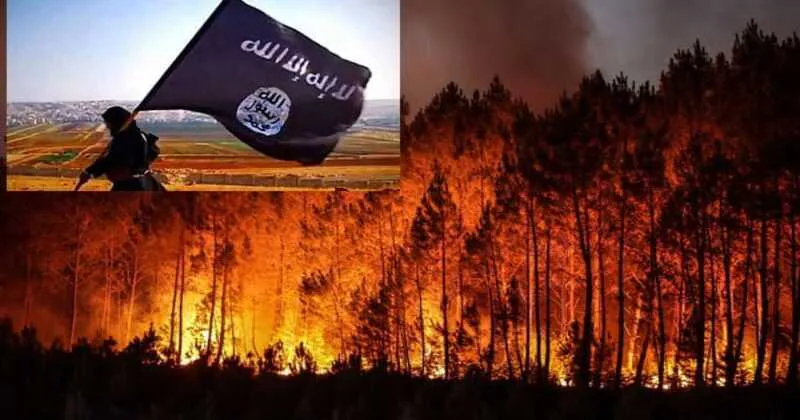
New Delhi: Islamic State supporters have been sharing material encouraging deliberate wildfires Jihad and arson attacks designed to overwhelm emergency services, according to an investigation by LBC published on August 28, 2026, as Britain battles an extreme wildfire threat and the political debate over climate change, leftist policies, migrants and national resilience continues to intensify.
LBC said it infiltrated an unnamed online forum containing Arabic and English extremist content, including Islamic State propaganda and discussions among supporters of the terrorist organisation. The broadcaster said it would not identify the website because some of the material contained practical instructions related to wildfire jihad, arson and avoiding detection.
Among the material was a guide titled “Burn down your first forest and exhaust the workers of the tyrant”, which encouraged supporters to exploit conditions in which wildfires could become particularly dangerous and place already stretched emergency services under greater pressure.
Islamic State propaganda and the wildfire jihad
Moustafa Ayad, Executive Director for Africa, the West Asia and Asia at the Institute for Strategic Dialogue and its Research Chair in Global Islamism and Counter-Terrorism, told LBC that Islamic State propaganda encouraging supporters to use arson was not new. He traced such material back to at least 2017, when the Islamic State’s Rumiyah magazine published content promoting arson as part of its “Just Terror Tactics” series.
Ayad said the Islamic State’s official al-Naba newsletter had, in April 2026, called for churches and synagogues in the United States and Europe to be set on fire over Easter. Islamic State propaganda also sought to exploit the devastating Los Angeles fires in 2025, while unofficial extremist outlets amplified calls for further fires.
🚨🇩🇿 Meanwhile in Algeria
Over 150 Different Fires have suddenly started today resulting in loss of life.
Now the sky is turning an orangey red – with reports of storms expected to carry 'Saharan Dust' towards Europe.
France, Italy, Spain and even the UK have just in the last… pic.twitter.com/Aakli0M686
— Concerned Citizen (@BGatesIsaPyscho) August 27, 2026
He described wildfire jihad and arson as a tactic requiring relatively limited capabilities while potentially producing extensive violence and disruption. Islamic State affiliates, he noted, have previously used fire during campaigns involving the burning of villages, churches and marshland.
The material uncovered by LBC explicitly portrayed wildfire jihad as a means of stretching firefighters, police, investigators and other emergency services. Discussions on the forum also referred to potential attacks on homes and public buildings.
Britain battles wildfires amid left’s climate change debate
The Islamic State-linked extremist material emerged as Britain faced severe wildfire conditions. Two weeks before LBC’s report, millions of people across England and Wales received emergency alerts warning them against activities that could trigger wildfires, including disposable barbecues, firepits, garden incinerators and fireworks.
The alerts were described by ministers as the most extensive use of Britain’s emergency warning system in response to an active incident. A devastating wildfire in Stourbridge, West Midlands, destroyed 19 homes and spread across more than 500 acres on what was described as the hottest day of the year so far.
West Midlands Fire Service said crews were called to “hundreds and hundreds” of incidents as temperatures rose, while dozens of fires continued to smoulder across the country. Prime Minister Andy Burnham, after visiting Stourbridge, described Britain as “a tinderbox” and said 37 fires were still smouldering across the country.
The wildfires have also intensified public and political discussions surrounding climate change, emergency preparedness and government policy. Leftist elites and political groups frequently link worsening wildfire risks to climate change. Debates involving Muslim migrants and migration have also become part of wider political arguments.
Defence, emergency services and online extremist threats
Around 100 personnel from the Queen’s Own Gurkha Logistic Regiment, supported by 22 Engineer Regiment, were deployed to South Wales for rescue and recovery operations. The deployment included four military water bowsers capable of carrying 20,000 litres each.
This is Algeria right now—apocalyptic scenes.
Our world is on fire. 552,437+ hectares burned in Europe this year—an area larger than Luxembourg.
We should start naming heatwaves after fossil fuel and oil companies, and wildfires after arms and defense industries. pic.twitter.com/yrYG9IuuBG
— Mohamad Safa (@mhdksafa) September 1, 2026
The Home Office said British police and security services take all terrorist threats seriously and have disrupted 19 late-stage terrorist attack plots since the beginning of 2020. It also highlighted counter-terrorism powers and the Online Safety Act, under which online services have responsibilities concerning illegal material, incitement to violence and terrorism.
Ayad warned that extremist forums could provide inspiration for individuals already radicalised. He said such threats should be taken seriously, particularly because propaganda can move between mainstream social media and smaller extremist websites.
An Ofcom spokesperson told LBC that discussion forums must take appropriate action against illegal content, although a law-enforcement response may be more appropriate where a site is potentially connected to a terrorist organisation.
As Britain confronts dangerous wildfires, climate change debates and mounting pressure on emergency services, the LBC investigation has highlighted how extremist Islamic State supporters may seek to exploit natural disasters and periods of extreme wildfire risk to promote terrorism and violence.