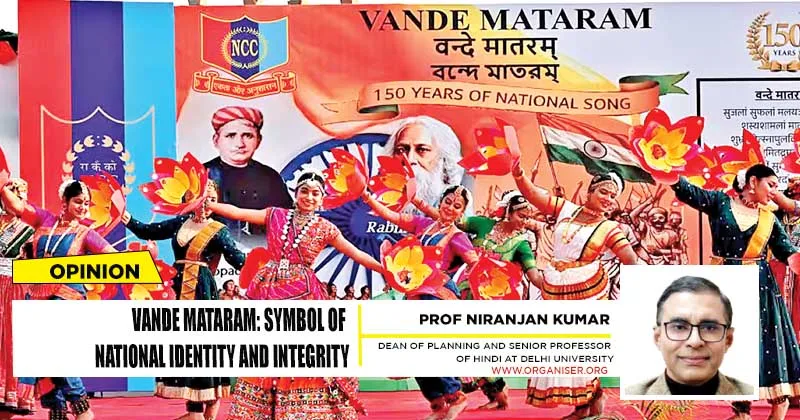
Every nation has national symbols rooted in its fundamental culture, history and identity. Bharat’s national flag, national anthem, national song, state emblem and various mottos are among these symbols, reflecting a cultural consciousness or subconscious, evolved over hundreds and thousands of years. For instance, the Ashoka Chakra at the centre of our national flag represents the Buddhist Dharmachakra, or Wheel of Dharma. Similarly, the motto of the Supreme Court of Bharat, Yato Dharmastato Jayaḥ, is drawn from a verse in the Mahabharata: Yataḥ Kṛiṣhṇo tato dharmo, yataḥ dharmaḥ tato jayaḥ (Where there is Bhagwan Krishna, there is Dharma, and where there is Dharma, there is victory). Our national song, Vande Mataram, likewise embodies elements of Bharat’s thousands-of-years-old Sanatan cultural heritage.
Unfortunately, driven by vested interests, Vande Mataram has once again been dragged into controversy. This controversy raises constitutional, legal, ethical, and ultimately, civilisational questions concerning the very future of Bharat.
Triggering Controversy: Political Agenda
The latest controversy began on July 26, when Parliament gave the national song Vande Mataram legal protection through legislation, similar to that accorded to the national anthem Jana Gana Mana. The Congress and the Samajwadi Party (SP), among other parties, opposed the move by walking out. Then, during the Independence Day celebrations at the Congress headquarters on August 15, a situation allegedly arose in which the singing of Vande Mataram was interrupted midway. Further, on August 19, the Congress Working Committee decided that only the first two stanzas of Vande Mataram would be sung at Congress events.
The Bharatiya Janata Party (BJP) has alleged that the opposition of the Congress and the SP to Vande Mataram reflects a politics of Muslim appeasement. Given the political history of these parties, this allegation cannot simply be dismissed. The Congress’s failure to implement the Uniform Civil Code (UGC) envisaged in the Constitution, the Nehru Government’s introduction of the Hindu Code Bill while refraining from comparable reforms to Muslim personal law, the Rajiv Gandhi Government’s legislative reversal of the Supreme Court’s judgement in the Shah Bano case in 1986, or opposition to the Ram Mandir are among the examples frequently cited in support of this charge.
Looking at the Vande Mataram song’s history, its literary and cultural significance, and how other countries preserve their ancient civilisational heritage, the perception that the Congress and the SP, engage in Muslim appeasement appears reinforced.
Ignoring Its History
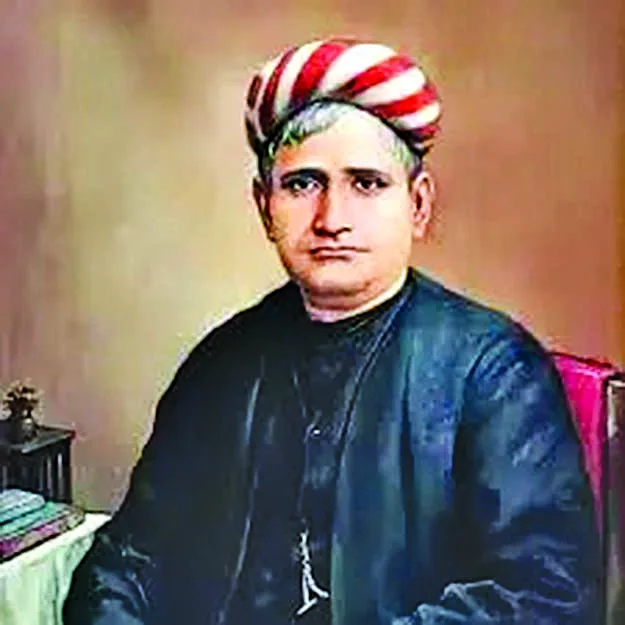
Bankim Chandra’s Vande Mataram was sung by Gurudev Rabindranath Tagore at the 1896 session of the Indian National Congress, whose president was a Muslim. During the anti-Partition movement of Bengal in 1905, Hindus and Muslims came together to sing Vande Mataram. From 1905 onward, it was sung at every Congress session, including in 1913, 1918, and 1921, when Muslim presidents led it. Its appeal was never confined to one community. In 1907, the Parsi revolutionary Madam Bhikaji Cama, who hoisted the first tricolour flag in Germany, had Vande Mataram inscribed on it. Bhagat Singh, associated with the Sikh tradition, used Vande Mataram as a salutation in his letters. The revolutionary Ashfaqulla Khan went to the gallows singing it. Former President A.P.J. Abdul Kalam, inspired by Vande Mataram, wrote a patriotic poem in Tamil bearing the same title. S.K. Rudra, a Christian and the first Bharatiya Principal of St. Stephen’s College, Delhi in 1907, and Joseph Baptista, a Christian and co-founder of the Home Rule League in 1916, were also enthusiastic supporters of the song. This history makes one point unmistakably clear: Vande Mataram never belonged to a single religion.
Despite being accepted by distinguished people from all faiths, the song was opposed in 1908 by the Muslim League because of religious conservatism. Under growing political pressure from the Muslim League led by Muhammad Ali Jinnah, a Congress committee chaired by Jawaharlal Nehru in 1937 fragmented the song by removing its final four stanzas. The truth, however, is that even after Independence, to appease Muslim fundamentalists, the Congress and later parties like the SP continued to avoid even the first two stanzas. The Congress’s principal objection to the song concerns its references to Goddesses Lakshmi, Saraswati, and Durga, overlooking the song’s deeper symbolism. Bharat Mata, or the motherland, is portrayed through three powerful cultural symbols — Lakshmi representing prosperity, Saraswati representing knowledge, and Durga representing power. Needless to say, wealth, knowledge, and strength are among the fundamental dimensions of human beings, which the Bharatiya intellectual tradition expresses through philosophical and spiritual symbolism.
Thus, Vande Mataram is not a religious hymn intended for worship or ritual; it is a poetic salutation to the motherland. Lakshmi, Saraswati, and Durga function as symbols and attributes of Bharat Mata. Mahatma Gandhi recognised this symbolism when he wrote in ‘Harijan Sewak’ in 1937 that “the many meaningful epithets that Bankim used for the motherland are entirely appropriate.” It is also significant that Jawaharlal Nehru had previously expressed no objection to the original song. In separate letters to Ali Sardar Jafri and Subhas Chandra Bose in 1937, Nehru argued that associating the words of the song with a Goddess was absurd. He also observed that communal elements had created the uproar against Vande Mataram.
There is an important contemporary irony here. Across Bharat, welfare schemes for the economic empowerment of women and girls operate under the name Lakshmi, such as “Ladli Lakshmi,” “Bhagya Lakshmi,” and “Lado Lakshmi.” Similarly, scholarships and educational initiatives for girls carry the name of Saraswati. If mere cultural references to Lakshmi and Saraswati make Vande Mataram unacceptable, should the same logic apply to these welfare initiatives, and should financial assistance bearing these names also be rejected?
Opposition to Vande Mataram, in fact, is not simply the result of half-baked knowledge of Bharat’s cultural symbols; it reflects something far more troubling—an unethical disregard for, and deliberate denigration of, the Sanatan cultural heritage that has shaped Bharat’s civilisational identity. Now that Vande Mataram has been granted legal protection, its rejection or opposition constitutes a legal offence under the Prevention of Insults to National Honour (Amendment) Act, 2026. More importantly, such rejection or opposition is also inconsistent with the spirit of Article 51A (b) of the Constitution, which calls upon citizens “to cherish and follow the noble ideals which inspired our national struggle for freedom.”
Opposition to Vande Mataram, on the ground that it contains elements of Sanatan Bharatiya culture, risks establishing a troubling precedent. If we accept such reasoning today, tomorrow the Dharmachakra, associated with Buddhism, on the national flag could be opposed. The next day, people may oppose the mottos associated with the nation or various constitutional and military institutions because they are rooted in Hindu scriptures. Indeed, even the very name of the country, ‘Bharat’, could be opposed on the grounds that it is mentioned in the Vishnu Purana and the Mahabharata. If this trend continues, it could ultimately call into question Bharat’s identity and civilisational existence.
Other countries’ experiences offer an important lesson. Indonesia, despite having a Muslim population of around 87 per cent, has preserved and celebrated many ancient cultural symbols associated with Hindu Dharma. Its national emblem is Garuda, associated with Bhagwan Vishnu, while an image of Bhagwan Ganesha appears on its currency. Statues of Bhagwan Krishna, Arjuna, Ghatotkacha, and Garuda are found in prominent public spaces, including the Parliament, and are integral to Indonesia’s cultural landscape. The Kakawin Ramayana (the Indonesian Ramayana) and the Mahabharata are recognised as important elements of Indonesia’s cultural heritage and are represented through public performances with Government support.
Shouldn’t Bharat’s so-called secular political parties draw a lesson from Indonesia, the country with the largest Muslim population in the world, which has preserved and celebrated its ancient cultural heritage despite its religious demography? Ultimately, this is not merely a debate over a song; it is a question of Bharat’s cultural identity, civilisational existence and our future.