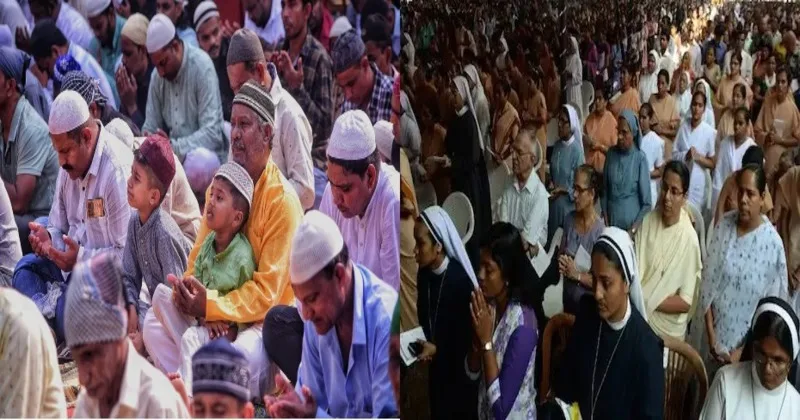
Panaji: As Goa prepares to introduce its Prohibition of Unlawful Conversion of Religion Bill, 2026, Opposition parties and Church organisations are questioning why the State needs a dedicated law when, according to them, there is no evidence of widespread forced conversion in Goa.
But the argument overlooks a larger question: should a State wait for religious tensions, coercive practices or demographic pressures to reach an irreversible stage before putting legal safeguards in place? The Goa Cabinet has approved the proposed legislation ahead of the Assembly session beginning August 31. Chief Minister Pramod Sawant has said the Bill will be discussed in the Assembly, while PWD Minister Digambar Kamat has said that those not involved in conversion need not fear the legislation.
Church organisations, however, have demanded withdrawal of the Bill. The Council for Social Justice and Peace and the Catholic Association of Goa have objected particularly to provisions concerning “allurement”, “undue influence” and conversion associated with marriage. Opposition leaders have similarly demanded evidence establishing the need for the legislation.
That raises a question for the Opposition: is the government required to wait until unlawful conversion becomes a large-scale social phenomenon before creating a legal framework to address it?
Goa’s changing religious profile cannot be ignored
Goa’s own demographic history provides an important backdrop to the debate. According to the Goa Government’s Economic Survey, based on Census data, the Muslim population’s share increased from 1.95 per cent in 1960 to 8.33 per cent in 2011. In absolute numbers, the Muslim population rose from 11,505 in 1960 to 121,564 in 2011.
During the same period, the Christian share declined from 38.07% to 25.10%, while the Hindu share increased from 59.92 per cent to 66.08 per cent.
The progression of the Muslim share is particularly notable:
- 1960: 1.95 per cent
- 1971: 3.33 per cent
- 1981: 4.10 per cent
- 1991: 5.25 per cent
- 2001: 6.84 per cent
- 2011: 8.33 per cent
The official Census records independently confirm the religious distribution for 2001 and 2011. These figures do not merely describe a static religious landscape. They show that Goa’s religious composition has undergone substantial change over successive Census periods.
That fact makes it legitimate to ask what safeguards the State should have when legislation specifically concerns religious conversion, inducement, coercion and undue influence.
The question is not whether Muslims should be treated differently. They should not. The question is whether Goa should have a neutral legal framework protecting individuals of every religion from unlawful methods of conversion.
Why is the Kerala experience relevant to Goa?
The Opposition has attempted to keep the debate confined to whether Goa currently has a large number of documented forced-conversion cases.
But religious and demographic issues do not develop in isolation from wider social trends. Kerala provides a particularly relevant example because the State has a large Christian population and has witnessed several disputes involving religious identity, conversion concerns and property rights.
The most prominent recent example is the Munambam land dispute, in which hundreds of families—predominantly Christian—have faced prolonged uncertainty over property that the Kerala Waqf Board has claimed as Waqf land.
The dispute concerns around 400 acres and approximately 610 families in the Munambam-Cherai area. Residents say they purchased the properties through registered transactions and have possessed the land for decades. The Waqf Board’s claim has nevertheless produced prolonged legal and administrative uncertainty.
The issue has been serious enough for Christian church bodies to intervene. The Mananthavady Roman Catholic Diocese’s pastoral conference demanded legislative and political remedies for Waqf-related property disputes, while Catholic leadership has participated in discussions seeking a resolution to the Munambam issue.
More importantly, the dispute has not been confined to political rhetoric. Different Muslim organisations have themselves taken different positions on whether the Munambam property constitutes Waqf. While Muslim organisations led by the Indian Union Muslim League called for a settlement protecting the residents, the EK faction of Samastha subsequently insisted that the disputed land was Waqf property and called for a religious resolution. Another Samastha faction also supported reclaiming Waqf land.
That distinction matters.
It demonstrates why legal definitions and property protections cannot be left to political assurances alone.
Kerala’s ‘Love Jihad’ debate also came from within the Catholic establishment
The Opposition may object to the use of the term “Love Jihad”, but the fact remains that the concern was not invented by Hindu organisations alone.
In January 2020, the Syro-Malabar Synod, the apex body of one of India’s largest Catholic churches, publicly expressed concern over what it described as the growth of “Love Jihad” in Kerala and alleged that Christian women were being lured into relationships, converted and, in some cases, drawn into terrorist networks.
In 2021, Pala Bishop Mar Joseph Kallarangatt again raised concerns about what he described as “love jihad” and “narcotic jihad”, alleging that young people from Christian and other non-Muslim communities were being targeted. The allegations generated a political controversy, and the Pala Diocese subsequently clarified that the remarks were intended as a warning about social trends rather than an attack on a particular community.
Even the head of the Syro-Malabar Church, Cardinal George Alencherry, had earlier acknowledged that there were instances involving young women being lured, although he declined to reduce every interfaith relationship to the “Love Jihad” label.
The significance for Goa is not that Kerala’s allegations automatically establish a similar phenomenon in Goa. The significance is that a major Catholic community elsewhere in India has itself repeatedly raised concerns about the vulnerability of its young people to religiously motivated exploitation and conversion.
That should make demands for Goa to dismiss the issue altogether look premature.
Even Christian schools in Kerala have faced demands over religious dress
The issue of religious assertion has also entered Christian educational institutions. In October 2025, the Kerala High Court granted police protection to St Rita’s Public School in Kochi after a group entered the school demanding that a student be permitted to wear the hijab. The school’s parent-teacher association had maintained that the demand conflicted with its uniform policy.
The episode is significant not because wearing a particular religious garment is itself unlawful, but because it raises a broader question about the autonomy of private and minority educational institutions to establish and enforce uniform and institutional rules.
If Christian institutions in another State are facing disputes over religious accommodation, property claims and concerns over conversion, Goa cannot simply assume that questions surrounding religious identity will never become contentious within its own social environment.
The Opposition should answer its own argument
The principal argument being advanced against Goa’s proposed legislation is that there is no demonstrated record of widespread forced conversion in the State.
Fine. Then the government should produce its evidence. But the Opposition must answer a corresponding question:
If conversion through force, fraud, coercion, unlawful inducement or undue influence is already unacceptable, why should the State refuse to examine whether existing laws are adequate to deal specifically with such conduct?
The answer cannot simply be that Goa has traditionally enjoyed communal harmony. Communal harmony is not maintained by assuming that potentially contentious issues do not exist. It is maintained by ensuring that no community—majority or minority—is permitted to exploit another person’s vulnerability through unlawful means.
Nor should the Bill be used to interfere with genuine religious choice. A Hindu, Christian, Muslim or member of any other faith must remain free to change religion voluntarily. But that freedom does not logically require the State to remain without a specialised framework against coercion, deception or material inducement.
Goa should learn before it is forced to react
The debate over the Bill should therefore move beyond the Opposition’s repeated demand for proof of a “mass conversion problem”. The more relevant question is whether Goa wants to establish safeguards before religious tensions become entrenched.
The State’s Census history shows a substantial rise in the Muslim population over the decades. Kerala demonstrates that Christian communities can become involved in difficult disputes concerning religious conversion, interfaith relationships, institutional autonomy and Waqf property claims. These developments do not establish that the same circumstances exist in Goa—but they demonstrate why the subject cannot simply be dismissed as an imaginary problem.
The government should therefore place the Bill before the Assembly, publish its provisions, provide the evidence underlying its legislative decision and accept detailed scrutiny of its definitions and safeguards.
At the same time, those opposing the Bill should stop treating the mere existence of a law regulating unlawful conversion as an attack on religious freedom.
The real test is simple: protect voluntary faith, but leave no legal space for coercion, fraud, exploitation or inducement. If the Opposition believes the proposed legislation fails that test, it should identify the offending clauses and propose safeguards.
If it believes existing laws are sufficient, it should demonstrate why.
And if it believes Goa has nothing to worry about, the State’s rapidly changing religious-demographic landscape and the experience of Christian communities elsewhere in India make that assurance far less convincing than a serious legislative examination would be.