Lucknow: UPTET 2026 cutoff refers to the minimum marks a candidate needs to score to qualify for UPTET. The qualifying marks may vary based on the candidate’s category and other factors. It is important to note that qualifying UPTET does not guarantee a teaching job. Instead, it makes candidates eligible to apply for teacher recruitment opportunities where UPTET qualification is required, subject to other eligibility conditions. With the result now available, candidates are also checking the UPTET cutoff 2026 to understand whether they have qualified the eligibility test.
UPTET Cutoff 2026: What Are the Qualifying Marks?
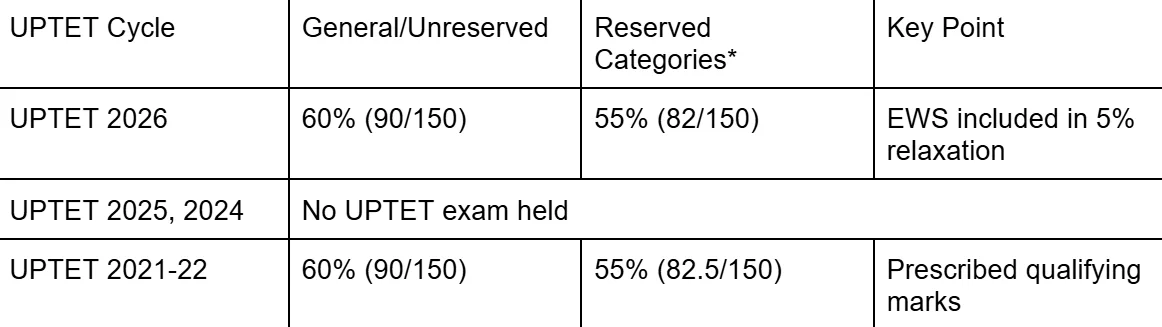
The commonly reported UPTET qualifying criteria are 60 per cent for candidates in the General category and 55 per cent for reserved and certain other eligible categories. On a 150-mark paper, this corresponds to 90 marks for the 60 per cent criterion and 82.5 marks for the 55 per cent criterion. However, candidates should check the marks and qualifying status mentioned in their official UPTET 2026 scorecard rather than relying only on figures circulating on social media or coaching websites.
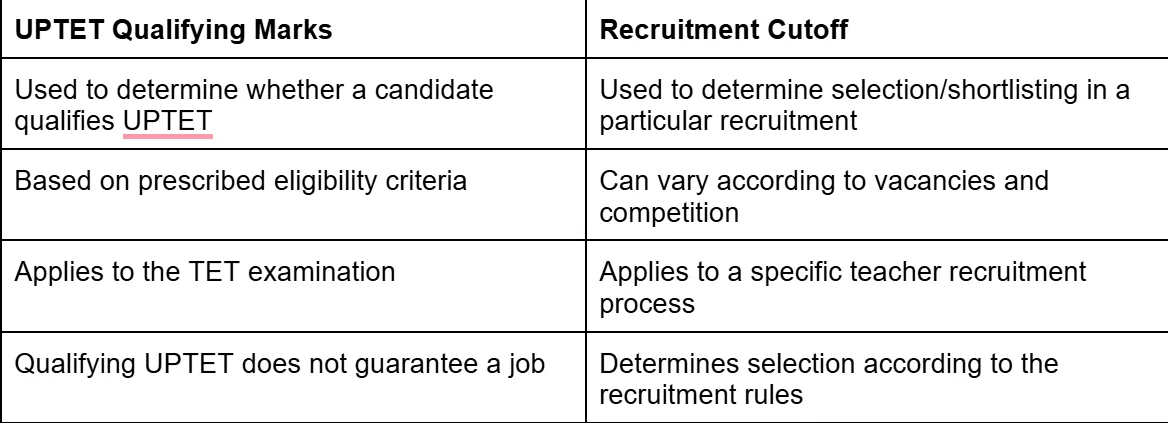
The distinction between qualifying marks and recruitment cutoff is important. In UPTET, qualifying the examination provides eligibility. The eventual cutoff for a teacher recruitment process can be different because it may depend on vacancies, category, candidates’ scores and the selection rules prescribed for that particular recruitment.
What Happens After the UPTET 2026 Result?
Once the UPTET result is declared, candidates should first download their scorecard and check their marks and qualifying status. Those who qualify the exam should keep their UPTET scorecard and eligibility certificate. The UPTET eligibility certificate has a lifetime validity, which means candidates do not have to retake the TET merely because the certificate expires after a fixed period.
The next major step for qualified candidates is to keep an eye on teacher recruitment notifications in Uttar Pradesh. As mentioned above, the UPTET qualification by itself does not guarantee appointment. Candidates will still have to satisfy the educational, training, age and other conditions mentioned in the relevant recruitment notification and participate in the prescribed selection process.
In other words, the UPTET result should be seen as an eligibility milestone rather than the final stage of becoming a government school teacher.
UPTET Previous-Year Cutoff: What Does the Trend Show?
Previous UPTET cycles show that the candidates have generally been assessed against prescribed category-wise qualifying criteria rather than a single recruitment-style cutoff.
What Factors Can Affect the UPTET Cutoff?
Several factors affect how candidates perceive the cutoff and how difficult it is to clear the examination.
1. Difficulty level of the paper – The difficulty of the UPTET question paper can have a major effect on candidates’ overall scores. A comparatively difficult paper may result in fewer candidates scoring very high marks, while an easier paper can help a larger number of candidates with higher scores. However, candidates should not assume that an easier or tougher paper will automatically change the prescribed qualifying percentage. The official qualifying criteria should always be checked separately.
2. Number of candidates appearing – UPTET attracts a large number of candidates. In 2026, around 17.7 lakh candidates appeared for the examination, making it a highly competitive eligibility test. A large candidate pool makes score comparisons more important, particularly when candidates later compete for recruitment vacancies. However, a large number of applicants does not by itself mean that the UPTET qualifying marks will automatically increase.
3. Category-wise qualifying criteria – UPTET qualifying marks are linked to the candidate’s category. Therefore, candidates should compare their scores with the applicable category-wise requirement rather than using one common benchmark for everyone.
4. Final answer key – The UPTET 2026 final answer key is important because the result is prepared based on the answers in the final key. Candidates who calculated their scores using the UPTET 2026 provisional answer key may see a change in their marks after objections are reviewed. Candidates were allowed to raise objections against the provisional answer key through the official process.
5. Recruitment vacancies – Vacancies are particularly important when candidates move from TET qualification to actual teacher recruitment. A candidate may qualify UPTET, but the competition for a particular recruitment drive will depend on the number of posts, category-wise vacancies and the number and performance of applicants.
6. Candidate performance – The overall distribution of marks also matters in recruitment examinations. If a large number of candidates perform strongly, competition for limited teaching posts can become tougher.
UPTET Cutoff 2026: What Candidates Should Do Now
Candidates should take the following steps after release of result:
- Download the UPTET 2026 scorecard and verify the marks and qualifying status.
- Keep a copy of the result and certificate safely for future recruitment applications.
- Check the category mentioned in the scorecard and ensure that it matches the candidate’s application details.
- Do not treat UPTET qualification as a job selection.
- Start tracking UP teacher recruitment notifications for posts for which UPTET qualification is prescribed.
- Check the eligibility conditions separately for every recruitment, including educational qualification, training qualification, age limit and category requirements.
UPTET Cutoff 2026: Qualifying Marks vs Recruitment Cutoff
Previous-year UPTET marks can provide useful context, but they should not be used to predict a recruitment cutoff because TET qualification and teacher recruitment selection are two different stages.
For UPTET 2026 candidates, the result is not the end of the process. Candidates should look beyond the UPTET score and focus on the next stage: upcoming recruitment notifications, vacancies, eligibility requirements and the selection process.