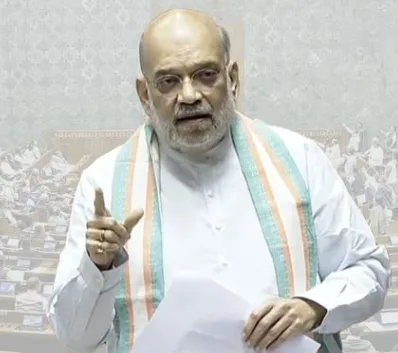
Union Home Minister Amit Shah on August 25, said the government is committed to making India “infiltrator-free”, arguing that illegal infiltration poses challenges to the country’s security, economy and demographic balance.
Addressing the Intelligence Bureau’s National Security Strategies (NSS) Conference, Shah said India was not a “dharamshala” or shelter home and maintained that only citizens have the right to live in the country.
“Modi govt will make the country free of infiltrators in a very short time,” Shah said, according to the account of his address.
The Home Minister said he had travelled to all border states over the past eight months and had shared a document outlining a four-pronged strategy for strengthening border security with the states.
He also called for the implementation of the PRAHAR strategy in daily security operations with the objective of eliminating terrorism and dismantling its “360-degree network”.
Shah links infiltration with security, economy and demographic concerns
In his address, Shah placed infiltration within a wider national-security framework, arguing that the issue has implications beyond border management.
According to Shah, infiltrators pose a threat to the country’s security, economy and demographic changes. He said the government would work towards making India free of infiltration within a short period.
His remarks come against the backdrop of the government’s continuing focus on border surveillance, illegal migration and the use of technology to prevent infiltration and smuggling.
Shah’s address also connected border security with the broader internal-security architecture, stressing the need for coordination between state police forces, central agencies and the Central Armed Police Forces.
Four-pronged border security strategy
Shah said he had visited all border states during the previous eight months and shared a document detailing a four-pronged approach to border security.
The strategy, according to the account of his address, is intended to strengthen the country’s ability to prevent infiltration and address related security challenges.
The Home Minister’s emphasis on coordinated border management comes alongside the government’s plans to increase the use of modern surveillance technologies along sensitive stretches of India’s borders.
He has previously spoken about deploying drones, radars, smart cameras and other technologies along the Pakistan and Bangladesh borders to strengthen surveillance and prevent infiltration and smuggling.
PRAHAR strategy to target terrorism
Shah also called for the PRAHAR strategy to be implemented in daily operations to eliminate terrorism and dismantle its entire support network.
The emphasis, he said, should be on targeting terrorism through a comprehensive approach rather than dealing only with individual incidents.
The Home Minister highlighted the role of coordination between different security agencies and state governments in addressing internal-security threats.
According to Shah, the government has already eliminated major challenges associated with Naxalism, terrorism in Jammu and Kashmir and insurgency in the Northeast.
He credited police forces from different states, central investigative agencies and the Central Armed Police Forces for the progress.
Naxalism, terrorism and Northeast insurgency highlighted
Shah said three major internal-security challenges, Naxalism, terrorism in Jammu and Kashmir and insurgency in the Northeast had been addressed by the government.
He also argued that earlier governments should have recognised the seriousness of issues such as drugs, Naxalism and unrest in the Northeast much earlier.
According to Shah, delays in addressing such challenges resulted in the country having to deal with their consequences for decades.
He cited the government’s action against the Popular Front of India (PFI) as an example of Centre-state coordination. Shah said the entire PFI cadre was eliminated and the organisation was banned in a single night.
The example was presented as evidence of how coordinated action by central and state agencies can be used to address organised security threats.
274 fugitives brought back from abroad
Shah also highlighted the government’s efforts to bring fugitives hiding overseas back within the ambit of Indian law.
According to his address, around 274 fugitives were brought back to India between 2019 and 2026.
He called upon all states to set targets for bringing fugitives hiding abroad back to face Indian law.
The Home Minister also highlighted the upgrading of the Multi-Agency Centre (MAC), describing it as a platform capable of delivering results at multiple levels.
The emphasis on fugitives forms part of a wider effort to strengthen coordination and intelligence-sharing among agencies dealing with organised crime and national security.
New criminal laws to be fully implemented within a year
Shah said the country’s three new criminal laws would be fully implemented over the next year.
He linked their implementation to faster resolution of criminal cases and said the changes could enable cases to be resolved up to the Supreme Court within three years.
He also set a target of increasing the conviction rate by 25 percent.
The Home Minister said the National Security Strategies forum should not restrict itself to existing threats but should anticipate security challenges 15 to 20 years into the future.
According to him, security agencies need to identify emerging risks early and formulate strategies before they become major threats.
AI and data analysis to strengthen policing
Shah called upon young police and security officers to make greater use of data and artificial intelligence.
He said young officers should connect and analyse available data and use AI to identify patterns of crime and develop actionable intelligence.
The objective, according to the Home Minister, is to move towards a more predictive approach to policing and security, allowing agencies to identify potential threats before they develop into major challenges.
The emphasis on technology comes as security agencies increasingly seek to integrate information from multiple sources and use advanced analytical tools to identify patterns.
Three-level strategy for a drug-free India
Narcotics was another major focus of Shah’s address.
He asked police forces across states to implement the Narcotics Control Vision Document 2026-2029 on the ground, stressing the importance of protecting the younger generation from drug abuse.
Shah proposed a three-level strategy, Detect, Disrupt and Destroy, to build a drug-free India.
The approach envisages identifying narcotics networks, disrupting their operations and ultimately dismantling the broader ecosystem supporting the illegal drug trade.
“Only India can fight the most successful battle against narcotics,” Shah said, according to the account of his remarks.
Security policy must anticipate future crises
Shah said national-security policy could not be formulated in isolation from developments taking place globally.
He listed several emerging challenges that security agencies must factor into their planning, including:
Global instability
Energy crises
Supply-chain disruptions
Rising radicalism
Cyber warfare
Infiltration
Narcotics networks
The Home Minister stressed that security agencies must identify potential challenges early and eliminate them before they develop into major crises.
He said the objective should be to create an environment that is secure, infiltrator-free and drug-free.
Shah’s recent focus on border security and infiltration
Shah’s latest remarks are part of a series of statements in recent months focusing on infiltration and border management.
May 22: Smart border security system: On May 22, Shah said the central government would introduce a smart border security system along nearly 6,000 km of the Pakistan and Bangladesh borders within a year.
The proposed system would use drones, radars, smart cameras and other modern technologies to strengthen surveillance and prevent infiltration and smuggling.
The move reflects the government’s emphasis on technology-driven border management.
May 26: Panel to study population changes: On May 26, the government announced the formation of a high-level committee to study unusual population changes across the country.
Retired Justice Prakash Prabhakar Navlekar was appointed chairman of the committee.
According to the material provided, the committee is expected to examine population changes attributed to illegal infiltration and other unusual factors.
The issue of demographic changes has increasingly featured in the government’s discussions around border management and illegal migration.
May 28: Shah asks infiltrators to return: On May 28, Shah had said infiltration occurred regularly during the tenure of the Mamata Banerjee government and claimed that infiltrators had now started returning on their own.
He had urged infiltrators to return voluntarily to their respective countries.
The remarks form part of Shah’s broader political and administrative messaging around illegal immigration and border security.
A wider national-security agenda
Shah’s address at the National Security Strategies Conference brought together several elements of the government’s internal-security agenda.
From infiltration and border surveillance to terrorism, Naxalism, insurgency, narcotics and fugitives, the Home Minister emphasised the need for coordination between central and state agencies.
He also stressed that security policy must increasingly rely on technology, data analysis and artificial intelligence.
At the same time, Shah called for a long-term approach that looks beyond immediate threats and anticipates challenges that could emerge 15 or 20 years into the future.
His central message was that security agencies must identify threats at an early stage and act before they develop into crises.
The government’s stated objective, as outlined in Shah’s address, is to strengthen India’s internal-security architecture while tackling infiltration, terrorism and narcotics through coordinated action, technology and advance intelligence.