
Western political and social thought primarily revolves around two extremes: “Individualism”, where the individual is at the center of society and “Collectivism/Communism”, which places the state above the individual. Both perspectives diminish or subsume the individual’s natural existence.
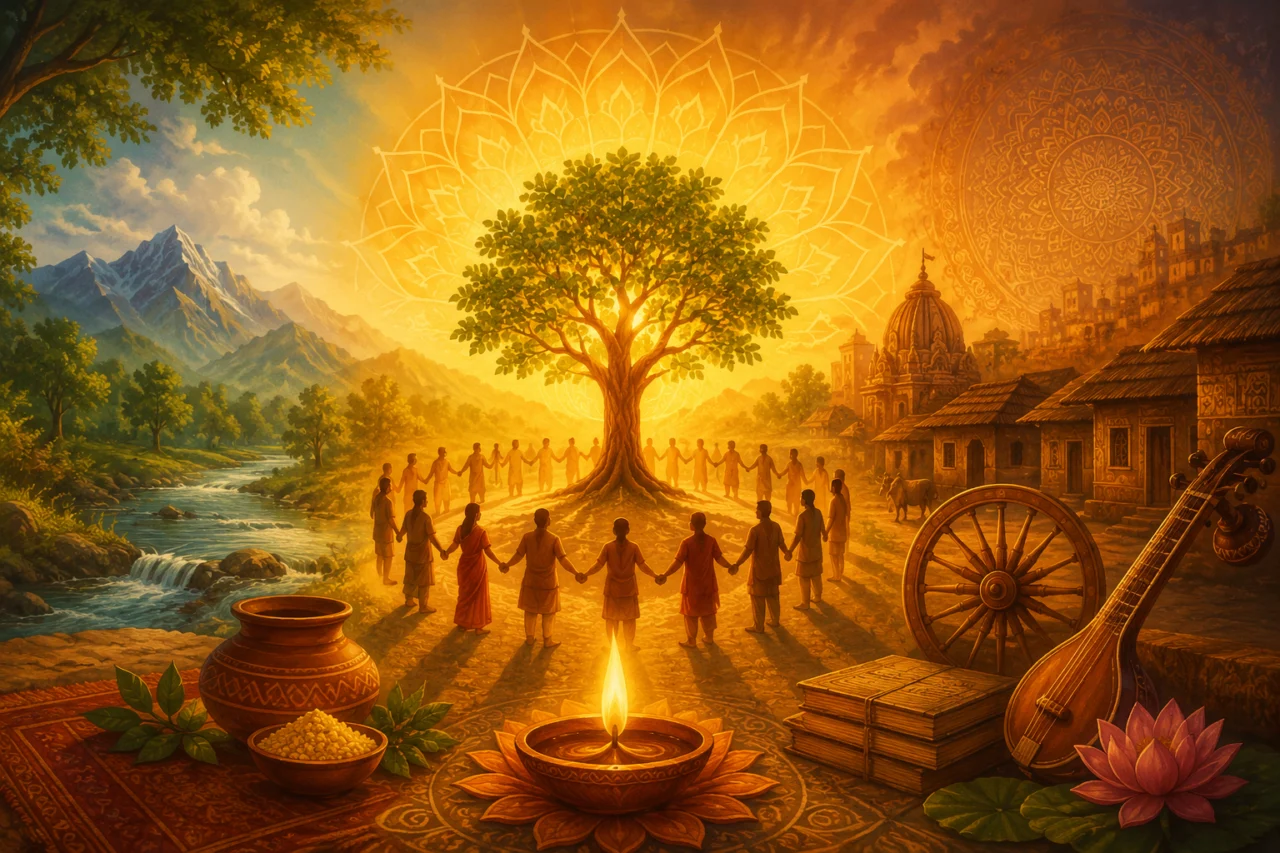
In contrast, Bharatiya culture offers a four-point framework—”Individual (Vyakti), Community (Samashti), Creation (Srushti), and Ishwar (Parmeshti)”—that serves not only as a spiritual concept but also as a model for “Holistic Governance”. This approach represents a journey of growth and expansion rather than a shift from one extreme to another.
Why has Gen-Z drifted from Bharatiya cultural values and how has this impacted them?
One significant issue is the obsession with fair skin, which has fostered discontent among Bharatiyas. Following liberalisation, numerous cosmetic companies capitalized on the desire for fairness, inundating the public with “FAIR IS BEAUTIFUL” advertisements featuring popular stars, thereby deeply influencing the Bharatiya psyche and perpetuating biases based on skin color.
Moreover, Bharatiya scientists and Nobel laureates often lack the recognition afforded to their Western counterparts. Figures like Aryabhatta, Rishi Kanad, Shushruta, Ramanujan, C. V. Raman, and Sir Jagadish Chandra Bose receive insufficient acknowledgment in the Bharatiya education system, while Western figures are celebrated extensively. This may stem from a Euro-centric education that prioritizes Western achievements. Additionally, many Bharatiyas feel embarrassed to speak their native languages, viewing English as a marker of sophistication. In contrast, few can recall prominent global leaders, such as Russian or Chinese presidents, delivering speeches in English?
Discussions about British colonial rule often emphasize how the British unified India which is not true and introduced infrastructure like telegraphs and railways, overshadowing the atrocities committed during that time. Consequently, the average Bharatiya may perceive the British as saviors who brought order to the country.
Social activities, such as going to clubs on Friday nights, are often regarded as superior to attending temple services on any day. Acknowledging and being thankful to God, even occasionally, is viewed negatively. This mindset subtly detaches Bharatiya youth from their cultural ideologies, leading to a greater fascination with Western principles and fostering an inferiority complex at an ideological level.
Time for the Gen -Z’s to clearly distinguish between Bharatiya and Western cultural ideology
The issue at hand is not one of superiority or inferiority, but rather understanding what is beneficial for the individual, society, nation, and the world. It involves determining which mindset or ideology fosters personal growth and enhances the well-being of society, the nation, and the globe. Let’s explore the Bharatiya perspective.
1. The Individual (Vyakti)
In Bharatiya philosophy, the concept of the individual starts with the ‘self’ but transcends the ‘ego’. While individuals are considered independent entities, they are also integral parts of larger families, societies, and the universe. Western perspectives focus on the ‘I’, whereas Bharatiya views emphasize ‘I and my duty’ (Dharma), intertwining individual freedom with social responsibility. The Western notion of privacy, rooted in individualism and strict physical boundaries, is illustrated by anthropologist Edward T. Hall’s concept of “proxemics,” which describes how people maintain personal space, particularly in American and Northern European contexts.
For them, houses and private rooms serve as personal sanctuaries and boundaries, with topics like personal finances or relationship difficulties deemed inappropriate for discussion. Conversely, in Bharat, space is regarded as a social and bonding resource, influenced by historical social structures. Interactions, caring and sharing in public are common, and navigating crowded places involves accepting physical proximity as part of everyday life. Historically, Bharatiya society has not been individualistic; British colonial education promoted individualism, which led to a decline in the Gurukul system that prioritized Dharma and value based learning.
2. The Society (Samashti)
An individual tied to the needs of their family and community forms a ‘society’. In Bharat, the society is viewed as more significant than the state, and it extends beyond human interactions to include all living beings. Here, individual freedom complements societal interests rather than conflicts with them. Traditionally, Bharatiya society embraced a joint family system, characterized by collective community traits, where personal decisions required societal approval. The institution of marriage illustrates this collective behavior, but modern education and job opportunities beyond traditional spheres have fostered a more individualistic outlook.
3. The Nature/Ecology (Shrushti)
In Western ideology, ‘nature’ is often treated as a resource for human exploitation. However, Bharatiya thought sees nature as an essential part of existence. According to the ‘Panchamahabhuta’ concept, the health of the environment directly impacts our well-being. Centering our thoughts around ‘creation’ contributes to ‘Sustainable Development’.
4. The Universal/Cosmic Consciousness (Parmeshti)
The journey culminates in the ‘Universal’, representing the supreme cosmic law or divine consciousness. A person realizes that they exist not solely for themselves but as part of a universal principle (Dharma/Cosmic Order). This awareness diminishes egoism and promotes inclusivity.
The significance of integrated thought in modern times
The four-point framework offers solutions to contemporary issues:
Mental stress: The Western model often portrays the individual as isolated. In contrast, Bharatiya thought emphasizes a connection to creation and the Supreme Being, promoting mental well-being through this interconnectedness.
Environmental crisis: Viewing creation as part of ‘the Supreme Being’ rather than as a separate entity can address pollution and environmental degradation at its core.
Political conflict: Communism restricts individual freedoms while capitalism tends to exploit individuals. Bharat’s ‘samashti’ perspective advocates for a culture-based society, reducing state control and fostering community self-sufficiency.
Western thought often transitions from excess to zero, while Bharatiya thought offers a harmonious journey from the individual to the universe. The concept of Ekatma Manavdarshan embraces individuals within a broader context of wholeness’and creation, offering pathways to peace, balance and sustainable development in a conflict-ridden world.