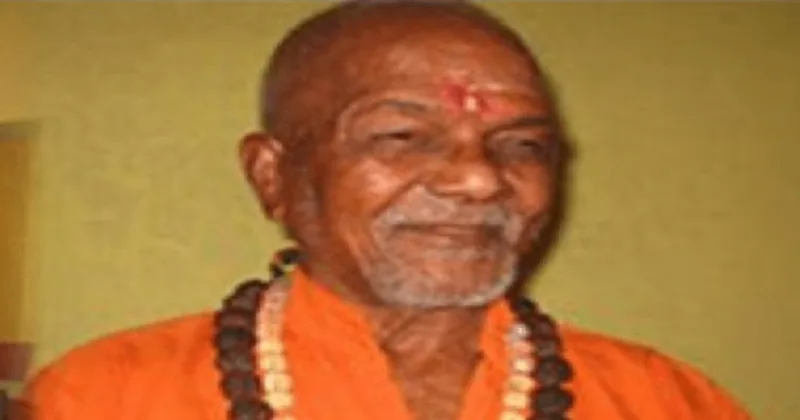
Born in Gurujang village of Angul district in 1924, Swami Laxmanananda devoted nearly four decades to tribal welfare, education, cultural preservation, environmental protection and social empowerment in Odisha. From establishing ashrams, Sanskrit schools and residential institutions for tribal girls to promoting traditional agriculture, cow protection and community self-reliance, he became a prominent figure in Kandhamal’s social and religious landscape.
His killing, following several earlier attacks and threats, remains a deeply contested and sensitive chapter in Odisha’s history. The following account, based on material published by Vishwa Samvad Kendra, Bhubaneswar, presents the life, work, attacks and circumstances surrounding his death. Allegations concerning the role of Christian missionaries, the circumstances of the killing and the subsequent violence are reproduced as claims made in the source material and should be understood in that context.
Swami Laxmanananda Saraswati Balidan Smriti Diwas-August 23, 2008
Vedanta Kesari Swami Laxmanananda Saraswati was brutally killed on the night of August 23, 2008. According to the source material, his work in Kandhamal focused on the welfare of tribal communities and opposition to what he described as fraudulent or coercive religious conversions among vulnerable tribal people.
Swami Laxmanananda Saraswati was born in 1924 in Gurujang village in Phulbani, now Kandhamal district of Odisha. From childhood, he aspired to dedicate his life to the service of society.
After entering family life and becoming the father of two children, he eventually left for the Himalayas to pursue spiritual practices. When he returned from the Himalayas in 1965, he became associated with the cow-protection movement.
Initially, he established the centre of his activities in Chakapad, a predominantly tribal area of Kandhamal district. Within a few years, his service activities became widely known across the forested regions of the district.
For nearly four decades, he worked for the social and religious development and empowerment of tribal communities. In remote Chakapad, he established a school and college based on the Gurukul system to teach Sanskrit.
He also established the Shankaracharya Kanyashram, a residential educational institution and ashram at Jalespeta in Kandhamal, where girls were provided education.
In 1969, he established his first ashram at Chakapad, which became a centre for activities aimed at the welfare of the local tribal population. He also renovated the Birupakshya, Kumareshwar and Jogeshwar temples.
A scholar of Vedanta philosophy and Sanskrit grammar, he came to be known as “Vedanta Kesari.”
He remained based in Phulbani for a long period and worked for the preservation of tribal culture and religious traditions. The Shankaracharya of the Govardhan Peeth in Puri honoured him with the title “Vidharmi Kuchakra Vidaran Maharathi.”
RSS pracharak Shri Raghunath Sethi remained associated with Swami Laxmanananda for a long period from the beginning of his work in Kandhamal. Swamiji initially selected Chakapad because of the presence of the famous Birupakshya temple there. Subsequently, he established the Kanyashram at Jalespeta, Seva School at Tulsipur, and ashrams at Banki in Cuttack district and Pandigola in Angul district.
Chakapad and Its Ancient Heritage
The Birupakshya temple at Chakapad is located in Kandhamal, formerly known as Phulbani district. Situated at an altitude of approximately 800 feet above sea level, the temple is located near the Burutanga River and surrounded by scenic natural landscapes.
Chakapad is also mentioned in the Ramayana. Its ancient name is said to be Ekachakranagari, a name associated with the epic.
A Shiva temple exists here where the Shiva Lingam is inclined towards the south. The trees in the surrounding area are also said to bend towards the south.
Transforming Tribal Life Through Education and Agriculture
Swami Laxmanananda was a visionary, as reflected in the range of his activities. Through his work in different fields, he sought to bring fundamental changes to the lives of people in Kandhamal.
He started night schools for adult education. In 1969, he established a Sanskrit school called Kalyan Ashram at Chakapad, which has since been upgraded into a Sanskrit college.
For girls’ education, he established the fully residential Shankaracharya Kanyashram at Jalespeta in Kandhamal in 1988. Around 250 students are studying there, according to the source material.
He also established a school at Banki in Angul district and an ashram at Pandigola.
Swamiji taught grammar to students in classrooms and modern agricultural techniques in the fields. He taught villagers when and how to cultivate paddy, vegetables and other crops.
His efforts contributed to farmers in the Udayagiri and Raikia block areas producing high-quality and large quantities of beans. He also established a vegetable cooperative society at Katingia. These initiatives helped improve the economic condition of local communities.
Environmental Conservation and Community Forest Management
Today, Kandhamal is known for its extensive greenery and forest cover. The source material attributes a significant part of this conservation culture to Swami Laxmanananda’s efforts.
He established mathas at several hilltops across the district and told villagers that the trees on the hills belonged collectively to the mathas and the village communities.
Under the system he promoted, a tree could be cut and its wood taken only with the permission of the village committee in an emergency. According to the account, this model proved effective.
The source material states that the Joint Forest Management system subsequently introduced by the government had already been practised by Swami Laxmanananda in 1970.
He was also deeply concerned with preserving and developing tribal culture and traditions. He established and renovated several tribal places of worship known as Dharani Penu.
He also organised a Rath Yatra through Gajapati and Kandhamal districts, during which thousands of tribal people were encouraged to reconnect with and practise their traditional faith.
Campaign Against Cow Slaughter
Swami Laxmanananda often said that a region where tears or blood are shed cannot prosper. He strongly opposed indiscriminate cow slaughter and educated people about protecting cattle.
On several occasions, he participated in demonstrations, sit-ins and hunger strikes on the issue and travelled extensively across Odisha.
He remained associated with several social, cultural and religious organisations and was involved in the establishment and renovation of temples in different parts of the state.
Work Against Religious Conversion
According to the source material, one of Swami Laxmanananda’s principal areas of work in Kandhamal was opposition to religious conversion among tribal communities.
He worked to reconnect tribal people with their traditional faith and sought to prevent what he described as fraudulent or coercive conversions.
Thousands of people across Odisha are said to have become his followers and disciples, inspired by his work.
His principal objectives included:
- Empowering tribal youth to become strong, fearless, educated and economically self-reliant.
- Encouraging tribal communities to remain firm in their faith, resist the conversion of their community members and facilitate the return of those who had left their traditional faith.
- Promoting cow protection.
- These activities made him highly popular across the state. At two major events held at Chakapad in 1986 and 2007, large numbers of people gathered at the remote location.
He undertook foot marches through villages across the district, interacted with tribal youth and travelled extensively.
Millions of people in Odisha are said to have held Swami Laxmanananda in high regard. Through foot marches across hundreds of villages, he sought to instil a sense of self-respect among tribal communities and organised Shrimad Bhagavata programmes in numerous villages.
The 1986 Jagannath Rath Yatra
In 1986, Swamiji took the deities of Lord Jagannath from Puri on a large chariot and travelled for nearly three months through Odisha’s tribal districts.
According to the source material, nearly 10 lakh tribal men and women connected with Lord Jagannath through the Rath Yatra and participated in worship.
The initiative was also used to create awareness against social evils and promote cow protection. It was intended to foster cultural awareness, devotion and social consciousness among tribal communities.
Eight Attacks Before His Death
The source material states that Swami Laxmanananda survived eight attacks between 1970 and December 2007. Despite these incidents, his resolve to work among tribal communities remained unchanged.
He reportedly maintained that efforts to obstruct his work would not prevent him from pursuing what he considered a divine mission.
Threats Before the Killing
Between August 10 and August 21, 2008, Swami Laxmanananda reportedly received three letters threatening his kidnapping and death.
Following several complaints to the police, private security was provided to him on August 23, the day he was killed.
The August 23, 2008 Killing
On August 23, 2008, at around 7:30 pm, Swami Laxmanananda was at the Jalespeta Kanyashram in Kandhamal after prayers and was interacting with residents of the ashram.
According to the account, around 15 masked men armed with AK-47 rifles and other weapons entered the ashram.
The attackers allegedly mistook Baba Amritananda for Swami Laxmanananda and shot him.
Another disciple, Mata Bhaktimayi, reportedly escaped through the rear door and entered Swami Laxmanananda’s room. She locked the room from inside and pushed Swamiji into a bathroom in an attempt to protect him.
The attackers reportedly broke through the door and killed Mata Bhaktimayi. They also fired at Kishore Baba, who had arrived to help.
The attackers then entered the room and searched for Swami Laxmanananda. Unable to find him, they opened the bathroom door and shot him.
Swami Laxmanananda died at the scene. He was 84 years old.
The attackers are alleged to have subsequently mutilated the bodies with sharp weapons.
Alleged Motives Behind the Killing
The source material attributes the killing to several issues, including:
- Swami Laxmanananda’s four-decade campaign against what he described as illegal and fraudulent conversion of tribal people by Christian missionaries.
- His campaign against cow slaughter.
- His alleged efforts to expose attempts at illegal land acquisition by Christian missionary organisations.
- His tribal welfare activities, which, according to the source, challenged efforts to convert vulnerable tribal communities.
- These claims concerning the alleged motives and involvement of Christian missionaries are disputed and should be distinguished from established findings of courts or official investigations.
History of Attacks on Swami Laxmanananda
According to the source material, Swami Laxmanananda faced eight attacks before the final attack in 2008:
1969: An alleged attack by a Christian mob led by a local church priest in Rupagaon.
1970: An alleged attack by cattle smugglers.
1978: An incident during a religious gathering at Batingia.
1981: An alleged attack by an armed Christian militant at Khingia.
1983: An alleged attack by Christians at Kambagiri.
1999: An alleged attack at Phiringia.
2002: A life-threatening attack at Kalinga in which he suffered a serious head injury.
2007: An attack while he was travelling to Bramanigaon, in which he was injured.
Questions Over Security Arrangements
The source material raises questions over the security arrangements provided to Swami Laxmanananda despite the earlier attacks.
It alleges that on the day of the killing, the sole security personnel assigned to him was allowed to go on leave without an alternative arrangement.
Developments After the Killing
The killing was followed by tension and protests across Kandhamal and other parts of Odisha.
August 23: Road blockades and protests were reported at several places, while a curfew was imposed in Jalespeta.
August 24: The bodies of the slain saints were taken out in a procession. The Odisha government ordered a judicial inquiry.
August 25: A statewide shutdown was called. Strong reactions were reported from several places, and Swami Laxmanananda’s funeral procession was held at Chakapad.
August 28: Christian educational institutions across the country reportedly remained closed in protest against alleged atrocities against Christians in Kandhamal.
August 25-September 1: The source material alleges that some Christians deliberately set fire to their own homes and moved into churches in an attempt to conceal the alleged role of missionaries in Swami Laxmanananda’s killing.
Subsequently, a large number of Hindus were arrested in Odisha, according to the source.
The source also alleges that a widespread campaign of false and malicious allegations was carried out by Christian groups.
Pope Benedict XVI issued a statement condemning the alleged killings of Christians in Kandhamal.
September 3: Bishop Raphael Cheenath filed a petition before the Supreme Court. The Supreme Court subsequently restricted the state government’s permission for certain processions.
September 5: Police reportedly arrested 453 Hindus whom the source describes as innocent.
September 6: Thousands of saints gathered in Bhubaneswar and were arrested.
The claims concerning arrests, violence, arson and the conduct of different communities are reproduced from the supplied source and would require independent verification before being presented as established facts.
Issues Behind the Conflict in Kandhamal
According to the source material, several issues contributed to tensions in the region:
Reservation
The source alleges that members of the Pano community had been converted to Christianity through force, inducement or fraud and that a campaign was underway to enable converted people to retain or obtain reservation benefits.
Alleged Illegal Land Occupation
The source alleges that churches had acquired or taken control of large areas of land belonging to non-converted Scheduled Tribe communities in the region.
Cultural Concerns
The source claims that Christian missionaries were attempting to alter tribal culture and belief systems as part of religious conversion efforts and that Swami Laxmanananda’s activities posed a challenge to these efforts.
Implementation of Anti-Conversion Law
The source also alleges administrative failure in implementing the Orissa Freedom of Religion Act, 1967.
It similarly alleges inadequate implementation of laws relating to prevention of cow slaughter.
Allegations Concerning the UPA Government
The supplied source makes several political allegations concerning the response of the then UPA government following Swami Laxmanananda’s killing.
It alleges that:
- The UPA government did not issue a statement specifically condemning Swami Laxmanananda’s killing.
- Then Prime Minister Manmohan Singh and the Congress party issued statements in support of Christians affected by the Kandhamal violence.
- Then Union Home Minister Shivraj Patil visited Christian settlements and relief camps but did not visit the ashram.
- Both the Central and state governments allegedly provided financial assistance to affected Christian families while providing no compensation to Hindus.
- The government and administration allegedly made inadequate efforts to arrest those responsible for the killing, investigate illegal weapons and examine the alleged involvement of Christian organisations.
- The alleged role of Christian NGOs in the killing was not investigated.
- The source alleges that hundreds of Hindus were arrested while comparatively few Christians were questioned.
- It also alleges that Christian churches and organisations received substantial relief funds despite, according to the source, not having suffered corresponding damage.
- These are allegations contained in the supplied source and are not presented here as independently established facts.
The Five Victims
According to the supplied account, on the night of August 23, 2008, during the Krishna Janmashtami celebrations, Swami Laxmanananda Saraswati, Mata Bhaktimayi, Baba Amritananda, Kishore Baba and Kanyashram caretaker Purub Ganthi were killed at the Jalespeta Kanyashram.
The source describes the incident as a brutal attack in which armed assailants entered the Kanyashram and killed five people.
Legacy of Swami Laxmanananda Saraswati
Swami Laxmanananda’s legacy extends beyond the circumstances of his death. Over several decades, he established educational institutions, ashrams and community initiatives across Odisha and worked extensively among tribal communities in Kandhamal.
His supporters remember him for promoting education, Sanskrit learning, traditional agriculture, environmental conservation, cow protection, cultural awareness and tribal self-reliance.
His life and work remain a subject of strong admiration among his followers, while his killing and the subsequent Kandhamal violence remain politically and socially contested.
The account is based on material from “Truth Behind the Murder of Swami Laxmanananda Saraswati,” a publication of Vishwa Samvad Kendra, Bhubaneswar, Odisha.