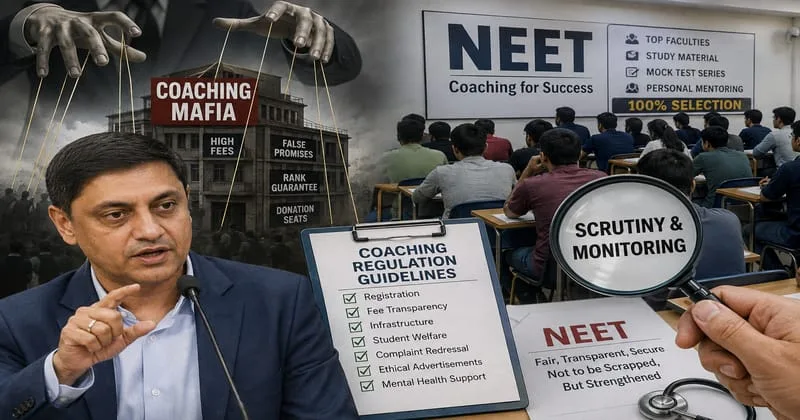
New Delhi: Member of the Economic Advisory Council to the Prime Minister (EAC-PM), Sanjeev Sanyal, has criticised India’s coaching system, calling it a “mafia” and saying that coaching institutes need strict scrutiny and monitoring. He said the growing coaching culture in India has become closely linked to several problems in the education system and pointed to China’s coaching reforms as an example India should examine.
Sanyal said the discussion on education reforms should not be limited to NEET and other competitive exams. The coaching system in India, especially the growing role of private coaching institutes in competitive exams, also needs to be looked at closely. Along with improving exams, the government needs to ensure that the examination system is fair, transparent, safe and accountable for students.
The Union Education Ministry has already issued guidelines for coaching centres. These rules cover areas such as registration, fees, facilities, student safety and welfare, complaint handling. truthful advertisements and mental health. Several states have also brought in their own rules to keep a check on coaching institutes.
Why NEET Should Not Be Scrapped, According to Sanyal
Sanyal’s criticism of the coaching system does not mean he wants NEET to be scrapped. He believes India still needs a common medical entrance exam so that students across the country are assessed through the same process. He also pointed out that before NEET, medical admissions were conducted through several entrance exams and there were concerns such as capitation fees. Therefore, instead of removing NEET, the focus should be on making the NEET examination system more transparent, secure, fair and reliable.
https://twitter.com/indian Ana 319670154797551
NEET Paper Leak Has Renewed Questions Over the System
This statement is highlighted when the CBI is investigating the NEET-UG 2026 paper leak case. The probe has involved coaching institute operators, middlemen and other individuals, with the agency looking into allegations that exam questions were shared before the NEET examination. The case has again raised questions about the link between high-stakes competitive exams and the coaching industry. However, allegations against specific coaching institutes or individuals should not be taken to mean that the entire coaching sector is involved in any wrongdoing.
Government Already Taking Steps to Regulate Coaching Centres
The government has been moving towards tighter regulation of coaching centres. The Ministry of Education issued guidelines in January 2024, covering registration requirements, fee-related issues, infrastructure, codes of conduct and mechanisms for student complaints. The guidelines also ask for greater transparency about faculty, courses, fees and students’ results.
The Central Consumer Protection Authority (CCPA) has also taken action against coaching institutes over misleading advertisements and unfair trade practices. In May 2026, the government said more than 60 notices had been issued to coaching institutes and penalties of over Rs 1.39 crore had been imposed on 31 institutes.
Sanyal’s comments raise a bigger question about India’s education system – should the country reform both the competitive examination system and the coaching ecosystem that has grown around it?
For students, a better examination system would mean secure exams, transparent procedures, accountable testing agencies and strict action against exam malpractice. At the same time, stronger regulation of coaching institutes could help address concerns like misleading advertisements, high fees and unrealistic promises about results. The main challenge is to reduce students’ dependence on expensive coaching classes for competitive exams. Better school education and safer, fairer and more transparent entrance exams can give students a more equal chance to succeed.
Sanyal’s argument, therefore, is not simply about NEET versus no NEET. It is about improving the wider education and examination ecosystem so that both the exam system and coaching industry become more transparent, fair and accountable.