In the Indian civilisational imagination, the granary was never a storehouse of grain it was a sacred trust. From the community kothars of the Vedic age to the state granaries described in Kautilya Arthashastra, ensuring that no citizen went hungry was regarded as the first duty of the state, an obligation later immortalised in the popular invocation to Goddess Annapurna, the eternal giver of nourishment who is said to never let her devotees sleep on an empty stomach.
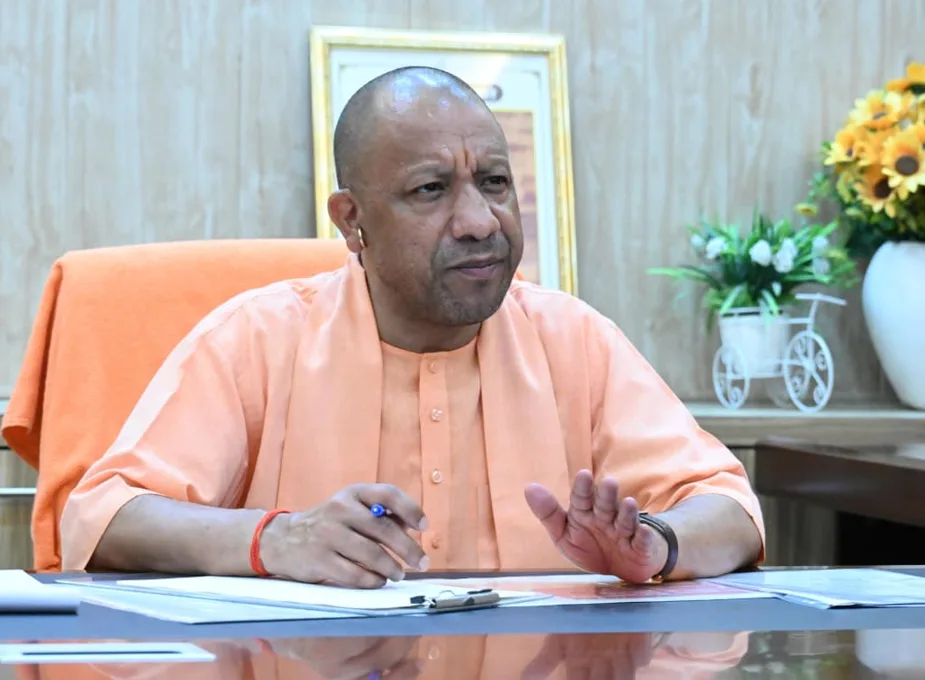
It is this same civilisational commitment, now expressed through the architecture of the modern welfare state, that found renewed expression on August 17, 2026, when Uttar Pradesh Chief Minister Yogi Adityanath addressed a state-wide gathering of fair price shop dealers, popularly called kotedars, at Lok Bhavan in Lucknow. The timing was itself significant, the event fell on the third Monday of the holy month of Shravan, coinciding with Nag Panchami, a day already charged with devotional energy across Uttar Pradesh.
At the Lok Bhavan programme, the Chief Minister pressed a button to formally launch the e-PoS based single stage door step delivery feedback system for fair price shops and simultaneously announced a substantial hike in the commission or laabhansh, paid to the state’s more than 78,000 fair price shop dealers.
The commission, which stood at ₹90 per quintal, has now been raised to ₹125 per quintal a jump of ₹35 that the Chief Minister described as a long overdue leap for the dealer community. The programme was live-streamed to collectorates, tehsil headquarters and legislative assembly constituencies across the state, allowing kotedars in every district, from Aligarh to Ballia, Raebareli to Lakhimpur Kheri, to watch the announcement in real time alongside local officials and elected representatives.
The revised commission structure reflects a cooperative-federalism model of funding, with both the Centre and the state sharing the additional burden.
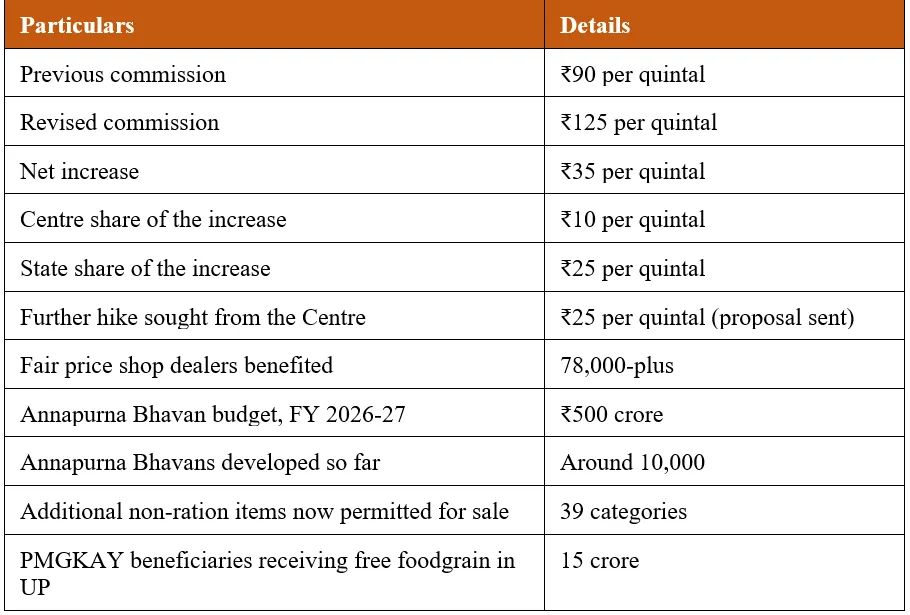
The Chief Minister told the gathering that the state government had already written to the Union government seeking a further increase of ₹25 per quintal, acknowledging that such a request would take time to process but promising that its eventual approval would further strengthen the dealer community earnings.
Transparency Through Technology: The e-PoS Feedback System
The e-PoS feedback mechanism forms the second pillar of the day announcements. Under the new single-stage door-step delivery model, foodgrain moves directly from Food Corporation of India godowns to fair price shops, eliminating intermediate handling points that officials say were historically vulnerable to diversion and short-weighing. This builds on a reform trajectory the state government traces back to 2017, when e-PoS machines were first installed at ration shops to digitise sales and curb leakages in the public distribution chain.
The upgraded system now also captures structured feedback from dealers themselves, giving the food and civil supplies department real-time visibility into distribution bottlenecks rather than relying solely on complaints routed through the administrative hierarchy. The Chief Minister linked this reform to a broader trust-building exercise between the government and dealers, noting that the word “kotedar” had, in years past, become a term associated with public suspicion rather than public service a perception he attributed to systemic failures that predated 2017 rather than to any fault of the dealers themselves. He argued that removing intermediaries between the government and the shop-owner had a direct bearing on the quality and dignity of service dealers could offer their customers.
From ration shops to Annapurna Bhavan
Central to the day proceedings was the ongoing transformation of ordinary ration shops into Annapurna Bhavans, purpose-built premises that combine retail space with proper warehousing facilities. The state government has earmarked ₹500 crore for this initiative in the 2026-27 budget, building on the roughly 10,000 Annapurna Bhavans already constructed across Uttar Pradesh, a figure that includes over a thousand structures inaugurated in earlier phases of the programme.
Dealers operating from these upgraded premises have also been granted permission to stock and sell up to 39 categories of everyday household items beyond subsidised foodgrain provided such items are not intoxicants, inflammable substances, or otherwise objectionable giving kotedars a meaningful new avenue for supplementary income and repositioning fair price shops as genuine neighbourhood provision centres rather than single-commodity outlets.
Contrasting two eras of distribution
The Chief Minister used the occasion to draw a sharp contrast between the current distribution regime and the one that preceded 2017. He recalled instances in which ration cards belonging to poor families were allegedly withheld by local functionaries, contributing to hunger-related distress in communities that should have been protected by the public distribution system. He noted that grievances related to ration distribution had once formed nearly a third of all petitions received during public hearings, a proportion that, according to the state government, has since fallen to negligible levels. He also pointed to the distribution system’s performance during the Covid-19 pandemic, when foodgrain, along with pulses, salt and edible oil, continued reaching households without disruption even as most other economic activity came to a standstill.
The commission hike and the Annapurna Bhavan programme were framed as part of a wider basket of welfare delivery that the Chief Minister said had reshaped rural and semi-urban Uttar Pradesh over the past decade. He cited the Pradhan Mantri Garib Kalyan Anna Yojana, under which around 15 crore people in the state continue to receive free foodgrain, alongside separate arrangements to have rations delivered to the homes of destitute and differently-abled beneficiaries who cannot visit shops in person. He also referenced roughly two crore free LPG connections issued under the Ujjwala Yojana and 1.53 crore free electricity connections extended to households across the state, presenting the fair price shop reforms as one strand within a larger fabric of last-mile welfare architecture.
A call to dealers and a civilisational framing
Addressing dealers directly, the Chief Minister urged them to accelerate construction wherever Annapurna Bhavan works were already sanctioned, assuring them that fund allocation would remain the government’s responsibility and would not become a bottleneck. He appealed to the dealer community to conduct their work in a manner that commanded dignity, cautioning that any activity lacking respect ought never to be pursued, since its consequences tend to be borne across generations. With grievance volumes down and public trust in the distribution chain reportedly restored, he suggested that fair price shop dealers today occupy a position of far greater social standing than a decade ago, no longer routinely regarded with suspicion by the communities they serve.
Coming as it did on a day sanctified by Shravan devotion and the Nag Panchami festival, the Lucknow announcement was pitched less as a routine administrative order and more as a gift extended to the dealer community with a framing consistent with the government’s recurring effort to align welfare delivery with the civilisational and devotional calendar of Uttar Pradesh. For a state carrying a population of over 20 crore, the fair price shop network remains among the most direct points of contact between citizen and state and officials at the event argued that strengthening the dealers who run it is, in effect, an investment in the credibility of the entire distribution system.
Whether read as fiscal policy, as governance reform or as a continuation of Indian ancient covenant to keep the Annapurna’s larder full for every citizen, the twin announcements of a higher commission and a transparent, technology-driven delivery chain mark another incremental step in Uttar Pradesh stated journey toward becoming an active contributor to India’s Atmanirbhar Bharat and Viksit Bharat 2047 aspirations, one ration shop at a time.