New Delhi: India and Japan on August 20, Thursday gave greater momentum to the bilateral defence partnership to seek strategic and industrial edge. Prime Minister Narendra Modi urged Japanese companies and start-ups to explore co-development and co-production opportunities with Indian firms under the Make in India framework.
During high-level talks in New Delhi, Defence Minister Rajnath Singh and his Japanese counterpart Shinjiro Koizumi also signed a landmark agreement on maritime security cooperation, reinforcing coordination between the Indian Navy and Japan Maritime Self-Defence Force amid growing security challenges in the Indo-Pacific.
PM Modi pushes defence co-development under Make-in-India
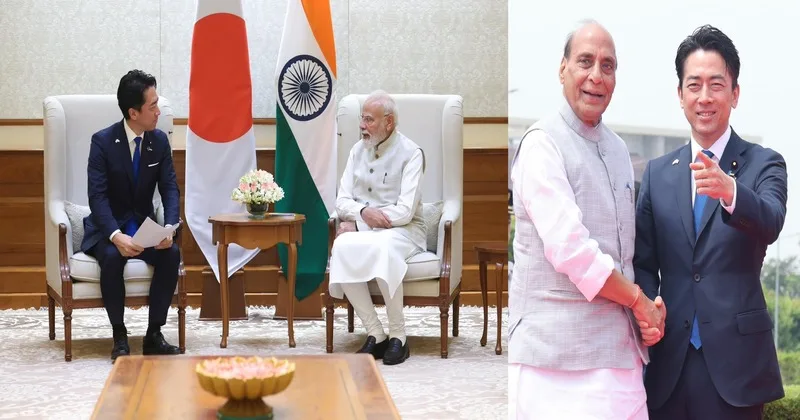
Prime Minister Modi received Japanese Defence Minister Shinjiro Koizumi in New Delhi and held discussions on strengthening the India-Japan Special Strategic and Global Partnership, with defence and security cooperation emerging as key focus.
Recalling his discussions with Japanese Prime Minister Sanae Takaichi during the 16th India-Japan Annual Summit in July, PM Modi noted the steady growth in bilateral defence ties. He stressed that Japanese companies could find significant opportunities to partner with Indian companies and start-ups in defence, particularly in co-development and co-production under the Make-in-India initiative.
Pleased to receive Defence Minister of Japan Shinjiro Koizumi. Had an excellent conversation on deepening defence and security ties between India and Japan. Our Special Strategic and Global Partnership is an important anchor for peace, stability and prosperity in the Indo-Pacific… pic.twitter.com/jHbV6cd6fG
— Narendra Modi (@narendramodi) August 20, 2026
PM Modi also underlined the wider strategic importance of India-Japan cooperation, saying that closer defence and security ties between the two countries can contribute to peace, stability and prosperity across the Indo-Pacific and beyond, which is emerging as a contentious geopolitical theatre.
Following the meeting, PM Modi described his conversation with Koizumi as productive and said that the two sides discussed ways to deepen defence and security ties. He described the Special Strategic and Global Partnership between India and Japan as an important anchor for regional stability.
Koizumi, meanwhile, briefed PM Modi on the progress of bilateral defence cooperation and reaffirmed Tokyo’s commitment to further strengthening defence ties with New Delhi.
Rajnath Singh, Koizumi sign maritime security agreement
Earlier in the day, Defence Minister Rajnath Singh held extensive bilateral talks with Koizumi, during which both sides agreed to expand cooperation across maritime security, defence technology, military exercises and the wider Indo-Pacific.
インド太平洋地域の安定に向けた重要な一歩!… https://t.co/pcvpjSGzDf
— Rajnath Singh (@rajnathsingh) August 20, 2026
A major outcome of the meeting was the signing of the Memorandum of Arrangement on Maritime Security Cooperation between the Indian and Japanese defence ministries. The agreement establishes a framework for closer cooperation between the Indian Navy and the Japan Maritime Self-Defence Force. It envisages enhanced information sharing in Maritime Domain Awareness (MDA), as well as greater cooperation in search & rescue and humanitarian assistance and disaster relief operations.
The two countries also agreed to strengthen coordination for the protection of Sea Lines of Communication (SLOCs) through naval ship visits, joint exercises, personnel and subject-matter expert exchanges and logistical cooperation, including the use of ports and maintenance and repair facilities.
The agreement assumes greater significance as India and Japan seek to safeguard maritime routes and uphold freedom of navigation and lawful commerce across the Indo-Pacific.
MAHASAGAR and FOIP: India-Japan strategic convergence for Indo-Pacific security
During the bilateral meeting, Defence Minister Rajnath Singh stressed that the strategic interests of India and Japan are increasingly converging across the Indian and Pacific Oceans. Highlighting growing vulnerabilities to maritime lifelines, the Minister said that the freedom of navigation, unimpeded & lawful commerce were not merely economic necessities but strategic imperatives.
A milestone for Indo-Pacific stability! Had a very productive meeting with Japan’s Minister of Defence, @shinjirokoiz San in New Delhi. Our discussions focused on deepening maritime security, 'Make in India' defence technology, and expanding strategic trust. 🇮🇳🇯🇵 pic.twitter.com/6WaORCspLd
— Rajnath Singh (@rajnathsingh) August 20, 2026
He emphasised the close alignment between India’s MAHASAGAR vision — Mutual and Holistic Advancement for Security and Growth Across Regions — and Japan’s Free and Open Indo-Pacific (FOIP) initiative, describing their convergence as more important than ever. Both ministers reaffirmed their commitment to a free and open Indo-Pacific and exchanged assessments of the regional and international security environment.
They also opposed unilateral actions that threaten the freedom & safety of navigation and, as well as attempts to change the status quo through force or coercion.
Defence manufacturing, shipbuilding on the agenda
Beyond traditional military cooperation, the talks between India and Japanese Defence Ministers also placed emphasis on defence manufacturing and gaining leverage in emerging military technologies. India and Japan agreed to explore opportunities for joint development in naval shipbuilding and design, combining Japan’s technological expertise with India’s expanding production capabilities. Both sides also discussed strengthening defence shipbuilding and integrating India’s manufacturing ecosystem under the Make in India initiative.
The discussions come at a time when Japan has revised its framework governing the transfer of defence equipment and technology to partner countries. This has potentially created a greater space for advanced technology cooperation, joint production and industrial partnerships with India.
Minister Rajnath Singh also stressed that the two countries must broaden cooperation into emerging domains and industrial manufacturing to stay ahead of evolving global security uncertainties.
Military exercises, special forces cooperation to expand
India and Japan also agreed to expand military-to-military engagement across the three services. The two sides welcomed the continued strengthening of the Dharma Guardian army exercise and JAIMEX maritime exercise, while noting progress towards Veer Guardian 26, the bilateral air exercise.
The upcoming air exercise is expected to be particularly significant as Japanese Air Self-Defence Force fighter aircraft are scheduled to participate in India for the first time. The two countries further agreed to promote exchanges between their respective Special Operations Forces and explore cooperation with India’s integrated theatre commands after their establishment.
UNICORN project, defence R&D cooperation gain momentum
The India-Japan bilateral defence talks also reviewed progress on the shipborne UNICORN integrated communications antenna system, described as the first major defence equipment transfer project between India and Japan. Both sides reaffirmed their commitment to ensuring its early realisation and agreed to continue discussions on additional defence equipment and technology projects based on operational requirements.
At the research and development level, India’s Defence Research and Development Organisation (DRDO) and Japan’s Acquisition, Technology & Logistics Agency (ATLA) will deepen cooperation in advanced defence technologies. The two countries also agreed to convene a Defence Industry Forum aimed at strengthening industrial collaboration and creating greater opportunities for defence companies from both countries.
Koizumi calls for rapid elevation of defence ties
Koizumi, who is on his maiden official visit to India as Japan’s Defence Minister, acknowledged the growing strategic importance of bilateral ties but said defence relations had yet to reach their full potential. Recalling his 2018 visit to India, Koizumi expressed appreciation for India’s tradition of holding a memorial ceremony for the victims of the atomic bombings of Hiroshima and Nagasaki. He said that the tradition had left a deep impression on him and reflected the shared commitment of India and Japan to peace.
インドのシン国防大臣とは初めての会談にも関わらず、共同声明では多岐にわたる項目について合意することができました。これも、今日まで調整作業を重ねてくれた防衛省職員のおかげです。今日の会談の成果を年内に予定される2プラス2に繋げようとシン大臣と意気投合しました。別れ際まで何度も「今日は… pic.twitter.com/UGOCv5TT7v
— 小泉進次郎 (@shinjirokoiz) August 20, 2026
Referring to PM Takaichi’s recent visit to India, Koizumi said both countries had agreed to strengthen ties as trusted partners sharing a strategic direction. He stressed that defence cooperation was indispensable to that partnership and called for a rapid elevation of Japan-India defence relations in view of the increasingly complex and uncertain Indo-Pacific security environment.