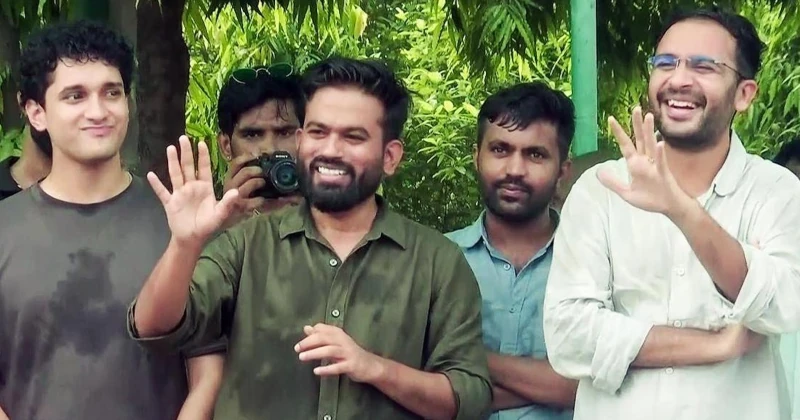
Abhijeet Dipke has taken his political campaign into a place where politics should have the least room to intrude the classroom. The founder of the Cockroach Janta Party (CJP) has launched his “School Thik Karo” (Fix the School) campaign from Hingoli in Maharashtra, presenting it as a nationwide effort to expose the poor condition of government schools and document the lack of basic facilities.
There is, undeniably, a legitimate public issue here. Government schools must have functioning classrooms, toilets, drinking water, electricity, fans, teachers and basic learning facilities. Dipke is perfectly entitled to question governments over failures in public education. He is entitled to protest peacefully, collect publicly available information, file complaints and demand corrective action.
Abhijeet Dipke, who authorised you to enter government schools and conduct “audits”? What legal authority do you have? Question the government. Protest peacefully. But don’t barge into public institutions, film officials and behave as though you possess powers the law never gave… pic.twitter.com/7krdGHaUzF
— Bhaavna Arora (@BhaavnaArora) August 19, 2026
Who authorised Abhijeet Dipke to enter government schools and conduct an “inspection”?
Dipke is a political activist, not a government school inspector. He does not hold himself out as an officer of the education department. He is not the head of a statutory school-inspection authority.
Yet, according to accounts surrounding his visits in Hingoli, Dipke has been entering government school premises, interacting with teachers and students, examining classrooms and facilities and documenting the proceedings with cameras and supporters.
Reports have described him questioning teachers over school conditions and raising issues such as broken doors, missing taps and inadequate infrastructure. His campaign has subsequently expanded to other schools and, according to recent reports, he has announced plans for social audits of government and municipal schools in Latur as well.
That immediately raises a fundamental issue, A campaigner can demand an inspection. But can a campaigner become the inspector?
Abhijit Dipke is out on another “school inspection.”
> He did not go as a parent.
> He did not go as an official.
> He arrived with nearly 50 people and police security, walked in, & got the class shut down.For three days this circus has continued in Hingoli.
In what legal… pic.twitter.com/0DohdoMZ6c
— The Analyzer (News Updates🗞️) (@Indian_Analyzer) August 19, 2026
A government school is public but that does not mean it is politically ownerless
There appears to be a growing misconception in activist politics that because a government school is funded by taxpayers, anyone claiming to act in the public interest automatically has an unrestricted right to enter it.
That is not how public institutions function.
A government hospital is publicly funded. That does not give a political activist the right to walk into an operating theatre and conduct an inspection. A government office belongs to the public. That does not allow a private campaigner to enter an official’s room with a crowd and begin filming and interrogating staff. A court is a public institution. That does not mean a political group can enter and conduct its own proceedings.
A government school is no different. Public accountability does not eliminate institutional authority.
If Dipke had permission from the competent education authorities, that permission should be made clear. If school authorities invited him, they should explain the basis and scope of that invitation. If he was operating under a formal social-audit arrangement, the relevant government order or authorisation should be disclosed.
And if none of those exist, then the government has an even bigger question to answer, Why were private political activists allowed into classrooms in the first place?
Who gave the green light?
The most striking aspect of the controversy is not that Dipke is criticising government schools. It is that he appears to be doing so from inside them. The reports and videos surrounding the campaign have shown Dipke visiting government schools and directly examining their conditions.
The campaign began on August 15 from his native Santuk Pimpri in Hingoli, with Dipke calling for a wider social audit of government schools. His stated objective is to document deficiencies and compile the information. That sounds straightforward.
But there is an established difference between documenting a public problem from outside an institution and entering the institution and assuming the role of an inspector.
When activism walks into the classroom
The issue becomes substantially more serious when students are involved. A school is not merely another public building. It is a protected educational environment where children are placed under the responsibility of teachers and administrators.
Students are there to learn. They are not there to become an audience for political campaigns. They are not props for political videos. They should not be compelled, persuaded or subtly encouraged to participate in partisan activism.
And they certainly should not be placed in the middle of a confrontation between political campaigners and government employees. This is particularly important because Dipke’s campaign is being conducted under the banner of a political organisation rather than an independent statutory education body.
If CJP is entering schools, distributing forms, collecting information from students or speaking to them about government and politics, the government must establish precisely what rules govern such activity.
Young people should learn about democracy, constitutional rights, public accountability and civic responsibility. But civic education and political indoctrination are not the same thing. One teaches children how democracy works.
The other attempts to persuade them whom to blame, whom to support and what political narrative to adopt.
The “brainwashing” question cannot simply be dismissed
The CJP is using student issues as a vehicle for political mobilisation and ideological messaging. Those allegations should not automatically be treated as established fact. However, they warrant scrutiny precisely because the campaign is taking place inside educational institutions.
The question is simple, What is being communicated to students when political activists enter classrooms?
If the interaction is limited strictly to documenting infrastructure how many toilets, whether fans work, whether classrooms have desks, whether drinking water is available then that should be demonstrable through a transparent methodology.
But if the interaction expands into political speeches, anti-government messaging, organisational recruitment, distribution of political material or attempts to persuade students that a particular political movement represents their interests, the nature of the exercise changes fundamentally.
At that point, it is no longer merely a school audit. It becomes political mobilisation inside an educational institution. And that is precisely the kind of activity that should concern every parent, regardless of political affiliation.
From missing fans to political messaging
Dipke has used an emotionally powerful contrast in his campaign poor children allegedly study in schools without basic amenities while the children of politicians enjoy access to expensive education, including institutions abroad. The underlying issue of inequality is legitimate.
But the political framing deserves scrutiny.
During a reported interaction with a journalist, Dipke was challenged over his own education abroad and was asked why the same standard should not apply to politicians across party lines. Examples involving the children of opposition leaders were reportedly raised.
The point is not whether any particular politician’s child should or should not study abroad. The point is that education policy should not be reduced to a partisan morality play.
- If the issue is poor government schools, fix government schools.
- If the issue is misuse of public money, produce evidence and seek an investigation.
- If the issue is inequality, debate inequality.
But turning every educational grievance into an attack on one political party does little to improve the classroom. And if CJP genuinely wants to conduct a national audit, it should apply the same methodology to states governed by parties across the political spectrum. A credible audit cannot be politically selective.
Is the classroom becoming the new political stage?
The larger concern is the precedent being created. If one political organisation is allowed to enter government schools to conduct its own inspection, what happens when another party demands the same privilege?
The presence of a crowd changes the character of the visit from an ordinary citizen interaction into a public political event.
Reports and social-media accounts surrounding the campaign have also raised allegations of classrooms being disrupted during some visits. The classes were in fact stopped because of the campaign, that would raise a straightforward question:
What gives a political activist the right to interrupt teaching?
The government should not have to choose between defending school administration and defending educational infrastructure. It should be capable of doing both. The irony accountability is being demanded from the government but who will hold the activist accountable?
Dipke’s campaign repeatedly invokes accountability. If public institutions are expected to follow rules, political organisations must follow rules too. Being a taxpayer does not confer governmental authority.
Millions of Indians pay taxes. They do not thereby acquire the power to inspect police stations, enter hospitals, interrogate civil servants or walk into classrooms. The same principle must apply to activists.
CJP’s political background makes the school question more important
The controversy cannot be separated entirely from CJP’s political identity. Dipke has been associated with political activism and has previously been linked with the Aam Aadmi Party’s social-media ecosystem. His organisation has subsequently developed its own political platform and a strong street-and-online presence.
That history does not establish that every CJP initiative is controlled by another political party, nor does it invalidate legitimate concerns about education. But it does make the question of political messaging in schools more important.
The wider political ecosystem
CJP’s previous protest politics and its association with opposition voices have also been pointed out. There have been contentious episodes surrounding student activism and demonstrations associated with the wider movement, including allegations by critics of anti-government and anti-Hindu slogans and support for controversial political figures.
Such allegations should be independently verified before being presented as established fact. But they are relevant to the larger debate over whether political organisations with contentious ideological positions should be given unrestricted access to schoolchildren.
The principle should be applied universally. A school cannot become a political laboratory simply because the organisation entering it claims to be fighting for a good cause. Children should not be political battlegrounds.
Recent reports, say Dipke questioned school staff over allegations that children were being made to clean classrooms, while other reports have detailed his complaints about missing taps, broken doors and other infrastructure deficiencies.
These are matters the administration should address on their merits. But fixing schools does not require surrendering their institutional boundaries. The government must be capable of saying both, “We will fix what is wrong.” and “No private political organisation gets to take over the inspection function of the state.”
There is an easy way to determine whether “School Thik Karo” is genuinely about schools or primarily about politics. Ask Dipke to publish the complete audit.
The Rahul Gandhi comparison exposes the broader political strategy
CJP’s “School Thik Karo” campaign also fits into a wider opposition effort to occupy the political space around student grievances. Rahul Gandhi’s “Chhatron Ki Goonj” campaign has similarly sought to present student concerns as a political mobilisation issue.
The methods and organisations are different, but the political incentive is obvious: student grievances provide a powerful emotional platform.
The controversy also cannot be completely separated from CJP’s political identity. Dipke has been associated with the Aam Aadmi Party’s social-media ecosystem before launching his own political platform.
CJP has subsequently developed a distinct political identity and has increasingly used protests, street mobilisation and social media to generate political attention.