A representative image
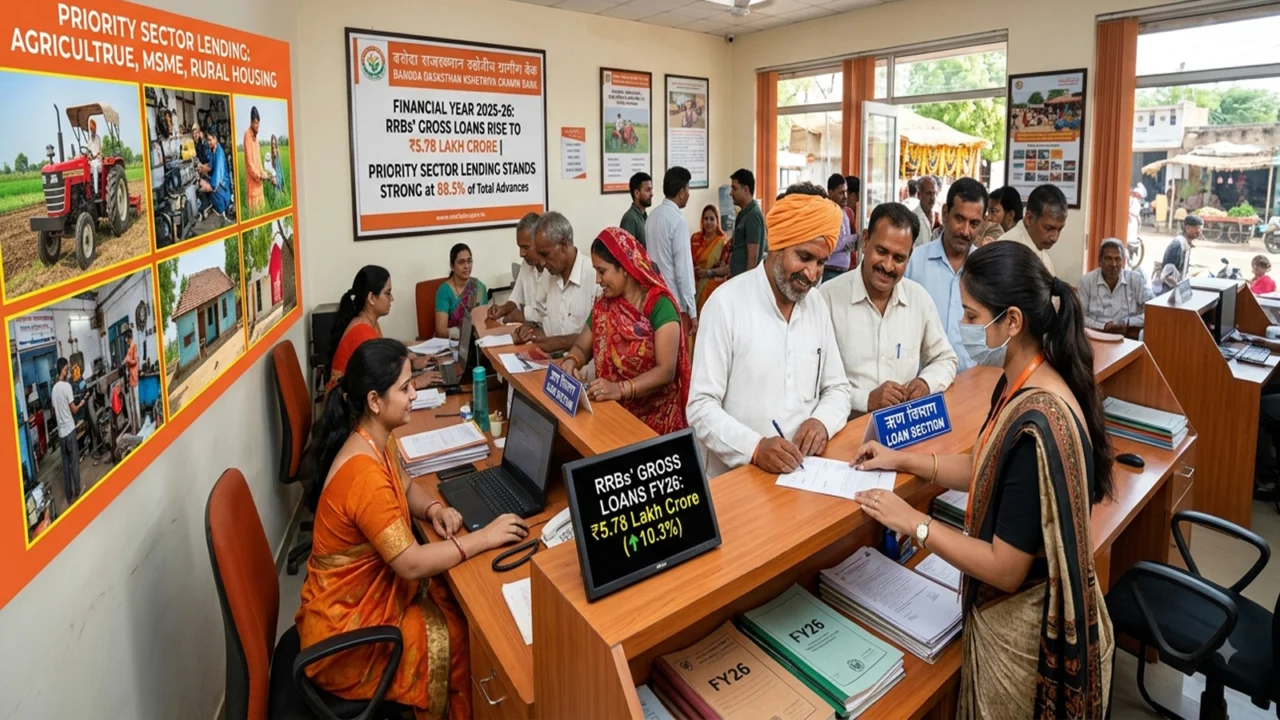
Regional Rural Banks (RRBs) recorded strong growth in credit delivery during 2025-26, with their gross loans outstanding rising 10.3 per cent to Rs 5.78 lakh crore from Rs 5.24 lakh crore in the previous financial year, according to data released by the Ministry of Finance on August 18.
The increase highlights the continued role of RRBs in expanding formal institutional credit across rural India, particularly for agriculture, micro and small enterprises, and economically weaker sections. RRBs have traditionally served as an important link between the formal banking system and rural borrowers who may have limited access to other sources of institutional finance.
The strong credit growth was accompanied by robust performance under the Reserve Bank of India’s Priority Sector Lending (PSL) framework. During FY2025-26, RRBs recorded an average achievement of 91.7 per cent against the overall PSL target of 75 per cent of Adjusted Net Bank Credit (ANBC).
The Ministry said almost all RRBs achieved the prescribed overall PSL target, indicating broad-based compliance with the regulatory requirement and continued focus on lending to sectors identified as critical for inclusive economic development.
Agriculture remains the biggest beneficiary
Agriculture and allied activities continued to account for the largest share of RRBs’ priority-sector lending during the financial year.
Outstanding credit to agriculture and allied activities stood at Rs 3.78 lakh crore, accounting for 77 per cent of total priority-sector lending. The figures underline the central role played by RRBs in financing the rural economy, particularly farmers and agriculture-dependent households.
Farm credit accounted for nearly 98 per cent of agricultural lending by RRBs. The lending supported crop cultivation, allied agricultural activities and investment across the rural economy.
The substantial share of agriculture in RRB lending reflects the banks’ mandate and their established presence in rural areas. By providing institutional finance to farmers, RRBs help reduce dependence on informal sources of credit while supporting agricultural production and rural economic activity.
MSME credit reaches Rs 66,978 crore
RRBs also maintained a significant focus on micro, small and medium enterprises, with outstanding credit to the MSME sector reaching Rs 66,978 crore during FY2025-26.
MSME lending accounted for 13.6 per cent of total priority-sector lending. More than 95 per cent of the credit extended to the sector was directed towards micro enterprises, highlighting the focus on the smallest business units and entrepreneurs.
The lending covered first-generation entrepreneurs, self-employed individuals, artisans and small business units operating largely in rural and semi-urban areas. Such credit can provide working capital as well as financing for business expansion and investment.
Within the MSME portfolio, the services sector accounted for the largest share of lending, followed by manufacturing enterprises and Khadi and Village Industries.
The emphasis on micro enterprises is particularly significant for rural economies, where small businesses and self-employed workers form an important part of local employment and income generation. Greater access to formal credit can help such enterprises expand their operations while reducing their dependence on informal borrowing.
Rs 3.49 lakh crore credit extended to weaker sections
RRBs extended Rs 3.49 lakh crore in credit to weaker sections during FY2025-26, reaffirming their role in promoting financial inclusion and improving access to institutional finance.
The lending demonstrates the continued focus of RRBs on borrowers and communities that may face greater barriers in accessing conventional banking services.
In addition to agriculture and MSMEs, RRB lending covered sectors including housing, education, renewable energy and social infrastructure. Credit to these areas supports household asset creation, education and human capital development, adoption of clean energy and development of essential infrastructure.
The diversified lending portfolio also indicates that RRBs are contributing to rural development beyond conventional farm credit.
RRBs strengthen their role in rural economy
The overall performance of RRBs in FY2025-26 points to sustained expansion in rural credit and continued alignment with broader financial inclusion and development priorities.
The 10.3 per cent growth in gross loans, combined with the strong performance under the PSL framework, shows that RRBs continue to play an important role in directing formal credit towards priority sectors.
Agriculture remained the dominant component of priority-sector lending, while significant credit also flowed to micro enterprises and weaker sections. This combination allows RRBs to support both farm-based livelihoods and non-farm economic activity in rural and semi-urban areas.
With their extensive rural presence and focus on underserved borrowers, RRBs remain an important channel for delivering institutional finance to sections of the economy that are central to inclusive growth.
The latest figures therefore underline the continuing importance of RRBs in strengthening rural livelihoods, supporting entrepreneurship, expanding financial inclusion and promoting more balanced economic growth.
