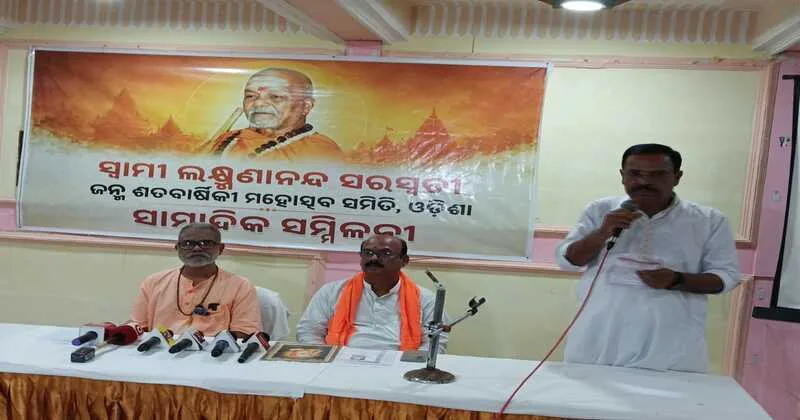
Bhubaneswar: The birth centenary celebrations of Swami Laxmanananda Saraswati, a revered spiritual leader known for his work among tribal communities and his initiatives in education, healthcare, agriculture, and social service, are set to commence on August 21, 2026, at Gurujanga in Talcher. This announcement was made on Wednesday by the Swami Laxmanananda Saraswati Birth Centenary Celebration Committee, Odisha.
The celebrations will extend through November 2027, featuring programs across Odisha and various other parts of India. Organizers anticipate holding centenary-related events at approximately 25,000 locations across Odisha, alongside major gatherings in cities such as Haridwar, Delhi, Mumbai, Bengaluru, Hyderabad, and Kolkata.
During a press conference, committee president Swami Jivanmuktanandapuri and convenor Binay Kumar Bhuyan unveiled the detailed program and outlined the year-long activities. They emphasised that the centenary would serve as an opportunity to honor Swami Laxmanananda Saraswati’s life and work, inspiring individuals to uphold his commitment to education, social service, cultural awareness, and community development.
Inaugural Program at Gurujanga on August 21
The inaugural ceremony will take place on August 21, which corresponds to Shravan Shukla Navami, at Gurujanga in Talcher.
The day-long program will begin with a Kalash procession at 7 am, followed by Go Puja at 8:30 am, and the commencement of a yajna at 9 am. A town procession is scheduled for 10 am, leading into a religious assembly at 11 am.
The yajna will conclude with Purnahuti around 1 pm, followed by Prasad distribution. A meeting of centenary celebration functionaries will be held at 3 pm.
The evening program, starting at 6 pm, will feature cultural performances, devotional music, dance, Pala, and discourses by saints at various locations within the village. An exhibition showcasing Swami Laxmanananda Saraswati’s life, work, and ideals will also be organized.
Several sadhus and prominent personalities are expected to attend the inaugural event. Scheduled participants include Brahmananda Saraswati, Sachchidananda Maharaj, Shivdas Baba, Smriti Sagar Maharaj, Jivan Chaitanya Maharaj, Sachchidananda Das Maharaj, Babaji Biswanath Das, Shraddhananda Saraswati, and Avinash Baba. RSS Kshetra Karyavah Durga Prasad Sahu and other notable figures from Odisha will also be in attendance.
Extensive Programme Across Odisha and India
The committee has prepared a comprehensive calendar of programmes extending from August 2026 to November 2027.
From August 23 to September 4, tribute and condolence meetings will be organized in villages and urban settlements to honor Swami Laxmanananda Saraswati.
In October 2026, a Sanskrit conference will be held at Chakapad, while a women’s conference is scheduled at Jalespeta.
Three major conferences are proposed in Odisha in November 2026, with programmes planned in Sambalpur, Berhampur, and Bhubaneswar. Significant gatherings will also be organized in prominent cities across India, including Haridwar, Delhi, Mumbai, Bengaluru, Hyderabad, and Kolkata.
From January to April 2027, saints will undertake awareness and outreach journeys covering villages and urban settlements. Large conferences at the block and city levels are proposed during April and May 2027.
The celebrations will continue through 2027, with additional programmes planned around the anniversary of Swami Laxmanananda Saraswati’s death and Janmashtami.
Focus on Education and Tribal Welfare
Speaking at the press conference, Swami Jivanmuktanandapuri highlighted Swami Laxmanananda Saraswati’s contributions beyond spiritual activities. According to him, the Swami dedicated a significant part of his life to education, healthcare, livelihood promotion, and community development, particularly in the tribal-dominated areas of Kandhamal.
The committee noted that the Swami worked to establish educational institutions and promote learning among communities with limited access to formal education. He was associated with the establishment of two Sanskrit schools and two colleges in Kandhamal, in addition to a high school at Tulsipur.
The organizers also emphasized his efforts to promote women’s education. According to them, he supported the establishment of night schools in Kandhamal and encouraged yoga and physical exercise as part of community life.
His activities also extended to healthcare. The committee stated that he was associated with an Ayurvedic health center at Katingia in Kandhamal and a primary health center in Rayagada.
Agriculture, Irrigation, and Environmental Initiatives
The centenary committee reported that Swami Laxmanananda Saraswati also encouraged communities to become self-reliant through agriculture and cattle rearing.
According to the organizers, he promoted organic farming and cattle rearing, while helping local communities acquire skills in these areas. Small check dams were constructed in some areas to support irrigation, and an agricultural cooperative society was established at Katingia.
He also encouraged forest conservation through village-level committees and promoted awareness about environmental protection. The committee said he advocated reducing plastic use and encouraged households to plant and nurture Tulsi.
The organizers also credited him with encouraging the formation of Kirtan groups, Bhagabat Tungis, and other cultural and religious forums in villages. He was associated with temple-related activities in Kandhamal and Gajapati and encouraged the formation of women’s Kirtan groups in Kandhamal.
Role in Cow Protection and Religious Awareness
The committee also recalled Swami Laxmanananda Saraswati’s involvement in the cow protection movement. According to its members, he participated in the movement led by Karpatri Ji Maharaj in Delhi in 1966 and was subsequently imprisoned.
The following year, he led a cow protection movement in Odisha and served a prison term in connection with it, the committee claimed.
The organizers further stated that Swami Laxmanananda worked to raise awareness among communities regarding religious conversion and supported efforts aimed at people returning to their ancestral faith.
A Life Marked by Service and Controversy
Swami Laxmanananda Saraswati was born on July 19, 1926, on Shravan Shukla Navami. According to the centenary committee, he became particularly associated with Kandhamal, where he established centers of activity at Chakapad and Jalespeta and worked among tribal and other rural communities.
His work in Kandhamal made him a prominent figure in the region’s social and religious landscape.
Swami Laxmanananda Saraswati and four of his associates were killed at the Jalespeta Ashram in Kandhamal on August 23, 2008, on the occasion of Janmashtami. His death was followed by widespread violence in Kandhamal.
The centenary committee said the celebrations will focus on remembering his contributions and encouraging social initiatives inspired by his life and work.
Five-Point Resolve
As part of the centenary observance, the committee has called for a five-point resolve based on what it describes as Swami Laxmanananda Saraswati’s ideals.
These include creating awareness against religious conversion, Go Rakshya, promoting cow rearing at the household level, encouraging tree plantation and environmental protection, strengthening community organization through regular satsangs, and protecting “Maa, Mati and Matrubhasha” — mother, motherland, and mother tongue.
The committee has also emphasized the preservation of Indian cultural traditions and Sanskrit.
Convenor Binay Kumar Bhuyan appealed to people to adopt these resolutions in their personal and social lives and use the centenary year as an opportunity for community service and cultural awareness.
A Year of Remembrance and Outreach
The organizers said the year-long celebrations are intended not merely as commemorative events but also as a platform for expanding social and educational activities inspired by Swami Laxmanananda Saraswati’s life.
With programs planned across thousands of locations in Odisha and major cities across India, the centenary committee expects the celebrations to bring together saints, social workers, community representatives, and members of the public.
The committee has appealed to people to participate in the programs and the various outreach initiatives planned during the centenary period.