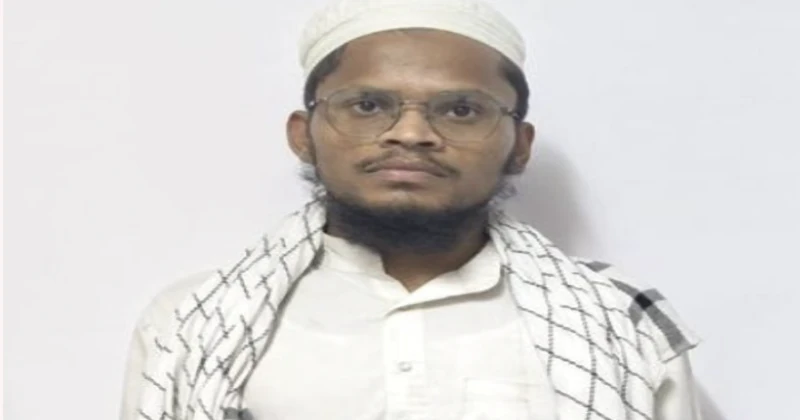
Mohammad Zafar
Meerut: A fresh counter-terror operation in Uttar Pradesh has exposed yet another alleged Pakistan-linked attempt to recruit, radicalise and financially mobilise Indians for jihadist activities. The Uttar Pradesh Anti-Terrorist Squad (ATS) has arrested 24-year-old Mohammad Zafar, a native of Bihar’s Purnia district, over his alleged links with Pakistan-based terrorist organisation Jaish-e-Mohammed (JeM).
According to the UP ATS, Zafar was allegedly collecting donations in the name of madrasa-related activities and attempting to divert funds towards a Pakistan-based terrorist organisation. Investigators also reportedly recovered evidence from his mobile phone pointing to his involvement with Pakistan-based jihadist groups and his communication with suspected handlers.
The arrest, made on August 16, comes against the backdrop of a series of investigations across India into Pakistan-linked networks accused of using online radicalisation, encrypted communication, recruitment, financial transfers and local sleeper cells to expand their operational footprint.
According to a press note issued by the UP ATS on August 17, investigators began examining Zafar’s social media activity after receiving intelligence about an individual allegedly collecting money in the name of a madrasa and attempting to send it to a Pakistan-based terrorist organisation.
The ATS alleged that Zafar had been sharing inflammatory and jihadist speeches attributed to JeM chief Masood Azhar and attempting to influence others towards violent jihad.
Zafar, who hails from Mirganj village under Rauta police station in Purnia district, had previously spent around five years studying at a madrasa in Meerut. During questioning, he allegedly told investigators that he first became acquainted with JeM during his time there.
The agency claimed that material relating to jihad and the alleged “martyrdom” of militants influenced him and that he subsequently developed an ambition to become a “mujahid” under the influence of Masood Azhar.
The allegations point to a troubling trajectory being examined by investigators, exposure to extremist propaganda, online ideological reinforcement, contact with foreign-based operatives and eventually attempts to provide financial or logistical assistance.
The alleged network was not confined to physical meetings. According to the ATS, several Pakistan-based jihadist WhatsApp groups were found on Zafar’s mobile phone. Investigators said discussions in these groups revolved around jihad and fundraising.
The agency also alleged that Zafar used Facebook to post statements relating to jihad and “khilafat” while concealing his face.
The ATS further claimed that he subsequently became associated with a JeM jihadist group and established contact with a Pakistan-based handler. According to investigators, Zafar offered to assist the handler in jihad-related activities.
The case therefore highlights how terror networks can attempt to build influence without immediately relying on traditional physical infrastructure. Social media platforms, messaging groups and direct contact with overseas handlers can create an ecosystem in which ideological propaganda, recruitment and fundraising operate simultaneously.
The alleged financial trail has added another dimension to the investigation. According to the UP ATS, the Pakistan-based handler provided Zafar with details of a Pakistani bank account to which he attempted to transfer money. The transaction was unsuccessful.
Zafar allegedly then asked the handler for a Binance account. Following contact with other suspected Pakistani operatives, he allegedly transferred money multiple times in USDT, a cryptocurrency.
The ATS said Zafar admitted to the offences during interrogation.
The alleged use of cryptocurrency is significant because digital assets can provide another avenue for moving money across borders, potentially complicating conventional financial investigations. In this case, investigators are now examining the transactions, the identities of the recipients and whether other individuals participated in the alleged funding chain.
The agency is also probing Zafar’s wider network, including his contacts, financial dealings and possible links with additional members of the suspected terror ecosystem.
Zafar’s arrest is not an isolated development. In recent months, counter-terror agencies have uncovered multiple alleged networks involving Pakistan-based handlers and Indian recruits.
While the organisations and modus operandi have varied, investigators have repeatedly focused on a combination of online radicalisation, recruitment, encrypted communications, financial transfers and local support structures.
Assam: Pakistan-linked network allegedly targeted recruitment and sleeper cells
In July, the Assam Police Special Task Force arrested three alleged terrorists linked to the Pakistan-based Shahzad Bhatti Network. The arrests of Akramul Islam, Aminur Rahman and Abdul Hussain were carried out on July 24 in coordinated operations across Dhubri, Chirang and Barpeta districts.
According to Assam STF investigators, the network was allegedly involved in recruitment, online radicalisation, reconnaissance, logistics, espionage, illegal procurement of weapons and attempts to establish sleeper cells.
Investigators also alleged that Pakistan-based handlers relied on encrypted communication channels to coordinate activities.
The operation resulted in the recovery of mobile phones, SIM cards, Aadhaar cards, bank passbooks, debit cards and other documents, according to the authorities.
The investigation began expanding after an alleged operative of the network was arrested in Nalbari in May. Authorities subsequently focused on identifying additional members and establishing the extent of the network’s activities in Assam and the wider Northeast.
Earlier in July, the Gujarat ATS arrested eight people from Gujarat and Madhya Pradesh over alleged links with JeM. Seven suspects were arrested in Gujarat and another in Dewas, Madhya Pradesh, during coordinated operations on July 2.
According to the Gujarat ATS, the suspects had allegedly been working for approximately six months to establish an active JeM network in Gujarat. Investigators alleged that the group was using multiple platforms to contact people, spread JeM’s ideology and identify potential recruits for radicalisation.
The probe also uncovered alleged communication with Pakistani handlers. The suspects were reportedly working on translating JeM literature into Gujarati and disseminating it.
Security agencies recovered 254 pieces of literature, including material carrying the JeM flag, during the operation. The accused were booked under provisions of the UAPA and BNS relating to unlawful activities, terror financing, conspiracy, membership of a terrorist organisation and providing support to such an organisation.
Another major investigation unfolded in Delhi in May, when the Delhi Police Special Cell arrested nine suspected terrorists over alleged links with Pakistan’s Inter-Services Intelligence (ISI) and a network associated with fugitive underworld figure Dawood Ibrahim.
Investigators alleged that the suspects were planning attacks against critical installations and security personnel in Delhi, Mumbai and elsewhere in the country. The accused reportedly came from different parts of India, including Delhi, Maharashtra and Punjab, while some were foreign nationals.
Weapons and ammunition were recovered during the operation, while investigators examined whether the network had received financial, logistical or operational assistance from handlers outside India.
The investigation also focused on identifying additional members and determining the extent of the alleged international network. Taken together, these cases reveal the broad range of methods allegedly being examined by Indian security agencies in Pakistan-linked terror investigations.
