New Delhi: The Indian higher education system carries a student population of roughly 4.3 crore, spread across some 1,100-plus universities and more than 45,000 colleges. Gross Enrolment Ratio stands near 28 per cent; the Policy commits the country to 50 per cent by 2035. Female enrolment has crossed two crore and now approaches parity, a structural change in Indian society that few countries have achieved at this speed.
Into that vast, uneven, multilingual system, NEP 2020 introduced not one change but a dozen simultaneous ones. Multiple entry and multiple exits, so that leaving is no longer failing. The four-year undergraduate programme with research. The Academic Bank of Credits, which turns learning into a portable asset rather than an institutional possession. The National Credit Framework, which finally places vocational and academic learning on one ladder. Credit recognition for SWAYAM online courses. Indian Knowledge Systems restored to the curriculum. The dissolution of the rigid science-commerce-arts partition that had quietly narrowed Indian minds for seventy years.
Every one of these is a genuine expansion of student freedom. Every one of them is also, on first encounter, confusing. A student who does not know that an exit is not an ending drops out permanently instead of temporarily. A student who never registers on the Academic Bank of Credits cannot transfer what she has earned. Unexplained rights are unused rights.
An idea that respects how students actually learn things
The conventional response would have been another circular, another portal, another advisory to Vice-Chancellors. The University Grants Commission chose differently, and the choice reflects real institutional maturity.
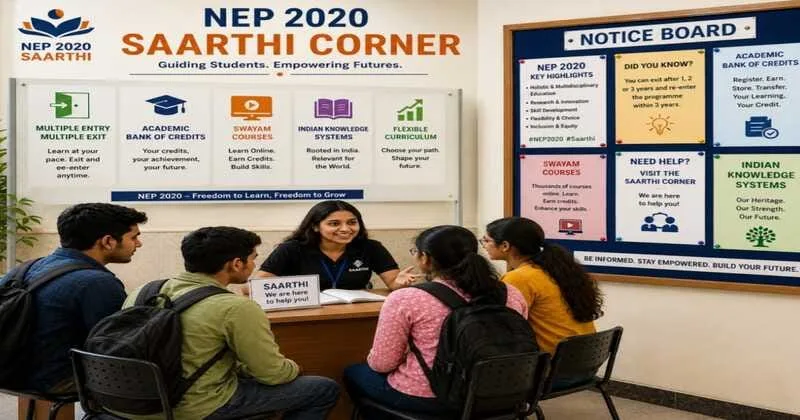
Students do not learn about policy from policy documents. They learn from the senior in the next room, from a hostel conversation at eleven at night, from the classmate who has already filled the form. The NEP Saarthi initiative accepts that reality and works with it, recruiting students themselves as ambassadors of the reform and giving them a designated space on campus, the Saarthi Corner, from which to work.
The word was well chosen. A saarthi is a charioteer. He does not fight the battle and does not choose its object. He holds the reins steady and tells the warrior clearly what lies in front of him. That is precisely the function not instruction, but orientation.
What the Corner delivers
It closes the last mile at almost no cost. A reform is only as strong as its weakest point of transmission, and in India that point has always been the ordinary undergraduate college far from the metropolitan university. A corner requires a wall, a table and willing students. Set against a Ministry of Education outlay of well over a lakh crore rupees and against schemes such as PM-USHA with its multi-thousand-crore commitment to strengthening state institutions, the Saarthi Corner is a rounding error that carries the message the rest of the money is paying for.
It borrows credibility that no administration can manufacture. A principal explaining multiple entry and exit is an authority defending a decision. A third-year student explaining the same thing is a peer sharing information. The second is believed. This is not a small advantage it is the whole ball game.
It operates in the language of the district. A Saarthi in Bhagalpur explains in Bhojpuri, in Coimbatore in Tamil, in Guwahati in Assamese, in Nashik in Marathi. No central communication apparatus can localise at this granularity. Peer networks do it without being asked and do it in the idiom that carries conviction.
It converts abstract entitlements into completed transactions. The measure of the Academic Bank of Credits is not how many students have heard of it but how many hold an ID. The measure of SWAYAM, with its thousands of courses and enrolments running into crores, is not availability but uptake. Corners have become the place where a student is walked through registration on a phone, there and then. Awareness becomes action at the table.
It builds the ambassadors themselves. The Saarthi learns to read an official document, address a room, field a difficult question and say honestly that she will find out. For many, this is the first responsibility they have carried that was not an examination. The Policy asks Indian education to produce graduates with communication, initiative and civic sense; the initiative quietly manufactures exactly that in the students who run it.
It creates a channel that points upward. This is the most underappreciated function of all. A corner that records what students actually ask becomes a live diagnostic of the reform. When the same query about credit transfer arrives two hundred times in a semester, the system has learned something no survey would have told it as quickly. Good governance is not the absence of friction; it is the ability to detect friction early. The Saarthi network gives the reform a nervous system.
Reaching the student who needs it most
There is one constituency for whom all of this matters more than for anyone else, and it is worth naming. A large share of India’s undergraduates are the first in their families to reach a college gate. Their parents cannot advise them on credit portability, because the concept did not exist when they were young and in most cases neither did the opportunity. They have no cousin working in a university office, no family friend who can decode a circular over dinner. What they have is a phone, a WhatsApp group and whatever the senior in the next room happens to believe.
For that student, information asymmetry is not an inconvenience. It is the mechanism by which advantage reproduces itself. The child of educated parents will find out about the fourth year with research, the minor in a second discipline, the internship that carries credit. The first-generation learner, sitting in the same classroom, often will not and will conclude that these things were meant for somebody else.
A Saarthi Corner is a direct assault on that asymmetry, and it is cheap enough to place in precisely the districts where the asymmetry is worst. When a young woman in a small-town college learns that stepping out for a year to manage a family situation need not end her degree, that a diploma is a real credential rather than a mark of failure and that her credits will wait for her in a national bank until she returns, an abstraction in a policy document becomes a door she can actually see. That is not communication work. That is equity work, conducted with a table and a poster.
Building on what works
A good initiative earns the right to be strengthened, and the road ahead is clear enough. Training should be refreshed as rules evolve, so that the Saarthi is never the last to know. Every corner benefits from a faculty mentor with the standing to obtain answers quickly, so that a hard question travels upward rather than stalling at the desk. A digital twin on the institution’s website extends the corner to the student who will not walk up to a table but will read a page at midnight.
The questions received deserve to be logged and summarised annually and published; they would sharpen implementation across the country faster than any inspection. The role itself deserves formal recognition as community engagement or skill credit under the National Credit Framework, an elegant proof that the system means what it says about valuing work outside the lecture hall. And rotation each year ensures that what one cohort learns is handed on rather than lost at graduation. None of this is expensive. All of it is the difference between a good idea and a permanent institution.
India is attempting something few large democracies have tried: the simultaneous restructuring of curriculum, credit, assessment and institutional design across tens of thousands of campuses, on a timetable measured in years rather than generations. It is an ambitious undertaking and ambition of that order is usually undone not by opposition but by opacity, by the ordinary student who never quite understood what was on offer and therefore never claimed it.
The NEP Saarthi Corner exists to make sure that does not happen. It costs almost nothing. It uses the one channel students genuinely trust. It turns beneficiaries into participants. And it treats the young not as recipients of reform but as its carriers, which is in the end both the most practical and the most respectful assumption a state can make about its own citizens.
The charioteer never won the war himself. He kept the field in view and gave clear counsel at the moment it was needed, and the outcome followed from that. Every corridor in the country that now has a corner, a table and a student willing to sit at it has quietly acquired the same advantage. It is a small thing to have built. It may prove to be one of the load-bearing ones.