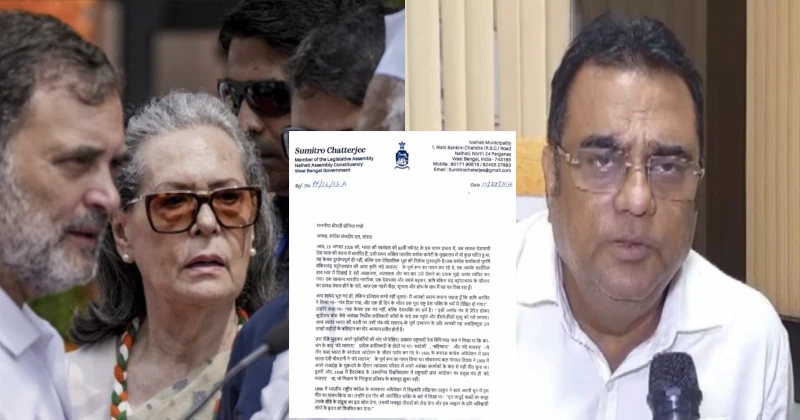
BJP MLA Sumitro Chatterjee, a direct descendant of Vande Mataram composer Bankim Chandra Chattopadhyay, has written to Congress Parliamentary Party chairperson Sonia Gandhi demanding an unconditional apology over the controversy surrounding the rendition of the national song at the Congress headquarters during Independence Day celebrations.
The controversy over the alleged interruption of Vande Mataram at the Congress headquarters has now acquired a deeply personal and historical dimension, with BJP MLA from Naihati, West Bengal, Sumitro Chatterjee, stepping into the row as a direct descendant of Bankim Chandra Chattopadhyay, the literary icon who composed the song.
In a strongly worded letter to Sonia Gandhi, Chatterjee expressed anguish over what he described as the alleged discomfort and repeated attempts to stop the full rendition of Vande Mataram during the Congress’s Independence Day programme. He demanded that Gandhi issue an unconditional apology to the citizens of India, particularly the people of West Bengal.
Sumitro Chatterjee, BJP MLA, Naihati, and direct descendant of Bankim Chandra Chattopadhyay, has written to Sonia Gandhi expressing anguish over the Vande Mataram recitation at Congress HQ row. He has demanded an unconditional apology from her to the citizens of India,… pic.twitter.com/Ei3d6OGAKy
— ANI (@ANI) August 16, 2026
For Chatterjee, the controversy is not merely about a political party’s programme or the manner in which a song was performed. As a descendant of Bankim Chandra, he portrayed the episode as an affront to a national symbol that, he argued, belongs to every Indian and carries the memory of the country’s freedom struggle.
In his letter, Chatterjee described the alleged episode as “not merely unfortunate but a shameless repetition of a historical mistake.”
Writing in his capacity as a patriot and as a direct descendant of the composer of Vande Mataram, he said the incident had left him with a sense of “deep pain, emptiness and anger”.
Chatterjee alleged that there was visible discomfort during the rendition of the full song and that attempts were made to stop it midway. He argued that any such attempt to curtail the rendition of Vande Mataram was particularly painful for the people of Bengal, given the song’s deep historical association with the Bengali renaissance and India’s nationalist movement.
He therefore called upon Sonia Gandhi to introspect and publicly acknowledge the hurt caused by the alleged incident. His demand was unequivocal: an unconditional apology to the people of India, with particular emphasis on the people of West Bengal.
Speaking to reporters, Chatterjee sharpened his criticism, alleging that the episode had insulted both the nation and the Bengali community. “Her actions were truly shameful. It is an insult to the country, an insult to all of India and to the Bengali community. My entire family was hurt,” he said.
Chatterjee also clarified that he had directly emailed Sonia Gandhi and marked a copy to Congress president Mallikarjun Kharge.
“I emailed the person responsible and sent a copy to the head of her party,” he said, explaining that he had deliberately chosen not to approach the President or any other constitutional authority.
The move places the controversy directly before the Congress’s top leadership and makes the issue one that Chatterjee believes demands an answer from the party leadership rather than a routine political rebuttal.
Chatterjee’s letter also sought to place the controversy in its larger historical context.
Vande Mataram, composed by Bankim Chandra Chattopadhyay and incorporated into his novel Anandamath, became one of the most powerful rallying cries of India’s freedom movement. Its historical association with the Indian National Congress also predates Independence by several decades.
Chatterjee recalled that Rabindranath Tagore rendered Vande Mataram at the 1896 Congress session, while Sarala Devi Chaudhurani sang it at the 1905 Benares session. The song subsequently became closely associated with nationalist mobilisation and the anti-colonial struggle.
For Chatterjee, therefore, the alleged interruption at the Congress headquarters cannot be viewed in isolation from this history. He argued that Vande Mataram represents the sacrifices of countless freedom fighters and remains an integral part of India’s national heritage.
The BJP MLA also drew a parallel with the historical controversy surrounding Vande Mataram within the Congress itself.
Chatterjee alleged that Congress had truncated the song in 1937 following objections raised by Muhammad Ali Jinnah and argued that the latest controversy risked reviving what he characterised as an old political compromise over the national song.
By invoking the history of the song, Chatterjee sought to shift the debate beyond party politics and towards the question of how India’s national symbols and the memory of the freedom struggle are treated.
Union Home Minister Amit Shah while addressing a public gathering in Rajasthan’s Chittorgarh, Shah accused the Congress of “shamelessness” over the alleged episode. Shah alleged that Sonia Gandhi instructed Congress president Mallikarjun Kharge to stop the rendition of Vande Mataram midway during the party’s Independence Day programme.
“Look at their shamelessness,” Shah said, arguing that the alleged incident had been witnessed by the country and warning that the Congress leadership would face public criticism over it.
At the heart of Chatterjee’s letter is a broader assertion: that Vande Mataram cannot be treated as the property of any political party. Calling it a sacred national symbol, he maintained that the song belongs to every Indian, irrespective of political affiliation.
He contended that respecting Vande Mataram is inseparable from respecting the freedom struggle and the sacrifices of those who fought for India’s independence.