On August 15, 1947, India inherited freedom without the industrial base to manufacture so much as a bicycle. Sixteen years later, in 1963 a rocket component was carried to a launch pad on a bicycle in the fishing village of Thumba as the starting point of a space programme built by a nation with almost nothing to build it with. Vikram Sarabhai’s conviction was that a country did not need to be rich to reach for the stars, it needed only the discipline to try. Eighty years after independence, on this Independence Day, that conviction has matured into something the freedom generation could scarcely have imagined a space economy worth billions of dollars, a private industry building rockets once made only inside government laboratories and satellites of Indian make now serving the world rather than the other way around.
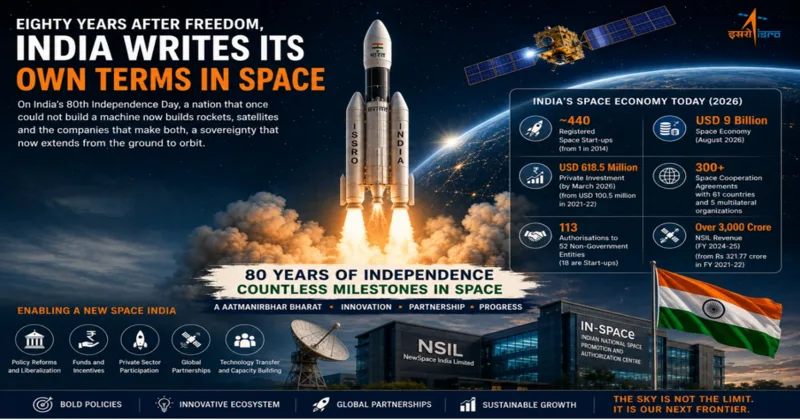
This 80th Independence Day lays out the scale of that transformation in numbers rather than sentiment. Indian space economy stood at nine billion dollars as of August 2026, the backgrounder notes and is projected to reach forty to forty-five billion dollars within the next decade. That growth is not confined to ISRO’s own balance sheet. Registered space start-ups rose from a single company in 2014 to around 440 by August 2026 and private investment into the sector climbed nearly six-fold, from just over 100 million dollars in 2021-22 to more than 618 million dollars by March 2026 with 187 million dollars of that arriving in 2026 alone. By the middle of this year, 113 authorisations had been granted to 52 non-government entities, eighteen of them start-ups working across satellite operations, payloads and launch services.
Numbers of this kind mean little without the policy architecture that produced them and that architecture is itself a story of a state consciously stepping back to let industry step forward. India’s space sector was opened to private participation only in 2020 a genuinely recent shift after six decades in which spaceflight was the exclusive preserve of government laboratories. The Indian Space Policy of 2023 extended that opening across the entire value chain and formally defined the roles of NewSpace India Limited, ISRO’s commercial arm and the Indian National Space Promotion and Authorisation Centre, which now runs a single-window system for private space activity. Foreign direct investment rules liberalised in February 2024 permit up to 74 per cent automatic investment in satellite manufacturing and operations, 49 per cent in launch vehicles and spaceports, and full foreign ownership of satellite and ground-segment components. Dedicated capital followed the policy where a seed fund for early-stage start-ups, a thousand-crore venture capital fund, a five-hundred-crore technology adoption fund and a scheme to help companies build satellite-bus capability from scratch.
One of the more recent products of this framework is the Earth Observation Public-Private Partnership, an IN-SPACe initiative bringing government oversight and private capital together to build India’s first privately owned earth observation satellite constellation, backed by around 1,200 crore rupees in private investment commitments. It is a fitting example of where the policy architecture is heading not government funding private ambition from a distance, but government and industry co-owning the same orbital infrastructure. This domestic opening has been matched by an outward-facing one India now holds more than 300 space cooperation agreements across 61 countries and five multilateral organisations, spanning joint missions, technology sharing and capacity building, so that a sector once defined by self-sufficiency out of necessity is increasingly defined by partnership by choice.
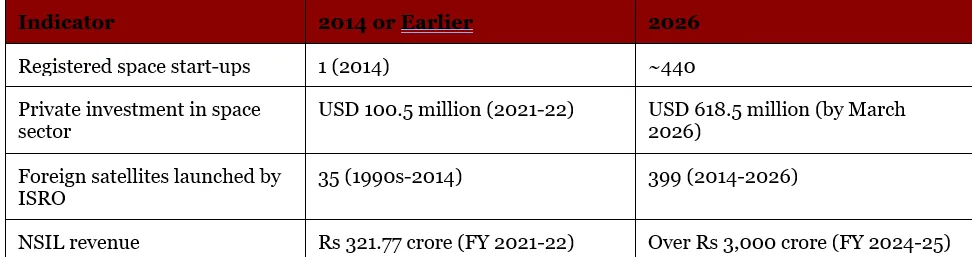
The commercial arm of this transformation, NewSpace India Limited, has seen its revenue rise from roughly 322 crore rupees in 2021-22 to over 3,000 crore rupees by 2024-25, a direct measure of how much of ISRO’s technology is now flowing outward into industrial hands. As of this year, NSIL has signed 118 technology transfer agreements covering 83 technologies developed within ISRO and the Department of Space, while IN-SPACe has separately facilitated 71 such transfers to industry and start-ups. Among the most significant of these is the transfer of Small Satellite Launch Vehicle technology to Hindustan Aeronautics Limited, agreed in 2025 the same programme whose upgraded booster ISRO qualified through a ground static test at Sriharikota earlier this month, a small but telling sign of how quickly a technology transfer on paper becomes hardware qualified for flight.
Launch infrastructure has expanded to match this ambition. India now operates four indigenous launch vehicles the Polar Satellite Launch Vehicle, the Geosynchronous Satellite Launch Vehicle in its standard and Mark III variants, and the Small Satellite Launch Vehicle supporting everything from earth observation and navigation to commercial launches for international customers. Over the three years to June 2026, these vehicles completed twelve missions carrying eleven national satellites and nine satellites for foreign customers, continuing a longer trend that has seen the number of foreign satellites launched by ISRO rise from 35 in the decades before 2014 to 399 since. Sriharikota’s two operational launch pads are being joined by a third built for next-generation vehicles, while Kulasekarapattinam in Tamil Nadu is emerging as India’s second spaceport, dedicated to small satellite and private-sector launches infrastructure built not for one flagship mission but for sustained, high-frequency operations.
Exploration achievements have kept pace with this industrial expansion, and each has quietly rewritten what was thought possible for a developing space programme. Chandrayaan-1 in 2008 detected water molecules on the lunar surface, the first hint that India’s space programme could produce science the world would cite, not merely replicate. Chandrayaan-2 returned lunar images at resolutions of up to 30 centimetres from a 100-kilometre orbit, among the sharpest ever captured from a lunar platform. Chandrayaan-3, in 2023, made India the first nation to soft-land near the Moon’s south pole and only the fourth to soft-land on the Moon at all. Chandrayaan-4, targeted for 2027, will attempt to collect a lunar sample and return it to Earth, while Chandrayaan-5, a joint mission with Japan’s space agency, will study lunar water near the same south polar region. Beyond the Moon, the Mars Orbiter Mission of 2014 operated for more than eight years against a planned lifespan of six months, Aditya-L1 has released over 27 terabytes of solar data since 2023, and the Space Docking Experiment of January 2025 made India only the fourth nation to demonstrate autonomous docking and undocking in orbit a capability with no purpose except as a building block for larger, more ambitious missions still to come.
Those missions are now visibly under way. The Gaganyaan human spaceflight programme, approved in 2019 and expanded in 2024 to a total outlay of over 20,000 crore rupees across eight missions, is working toward an uncrewed test flight carrying the half-humanoid Vyommitra later this year, ahead of a crewed mission targeted for 2027. India’s first astronaut to reach the International Space Station, Group Captain Shubhanshu Shukla, completed the Axiom-4 mission in the summer of 2025, gathering operational experience that feeds directly into Gaganyaan and into the Bharatiya Antariksh Station, a five-module space station targeted for full operation by 2035 with its first module due for launch in 2028. None of this sits apart from the commercial and industrial story above; it depends on it. A human spaceflight programme cannot be sustained by government laboratories alone, and every docking experiment, every semi-cryogenic engine under development, every reusable booster technology ISRO is testing feeds back into the same industrial base now being built with private hands.
That dependence runs in the other direction too, in ways that touch ordinary life rather than orbital mechanics. NavIC, India’s indigenous navigation constellation, now provides positioning and timing across the country and up to 1,500 kilometres beyond its borders, with a second generation of satellites steadily replacing the first. It has moved well beyond a defence or scientific instrument, NavIC now synchronises power grids, tracks trains in real time, geo-tags Aadhaar records, and sits inside mobile chipsets used every day by citizens who have likely never heard the acronym. This is, in the end, the quieter meaning of space sovereignty not only the capacity to reach the Moon or dock spacecraft in orbit, but the capacity to run a nation’s infrastructure on technology built and owned at home.
Eighty years ago, independence meant the right to govern without permission from elsewhere. Today, as India works on a partially reusable next-generation launch vehicle, a 200-tonne semi-cryogenic engine and a winged vehicle to demonstrate runway landings from orbit, that same idea has simply been extended skyward. A nation that once needed a bicycle to carry a rocket to its launch pad now builds the rockets, the satellites and increasingly the companies that make both not to compete for prestige with older space powers, but to ensure that when India reaches into space, it does so on terms it has written for itself.